
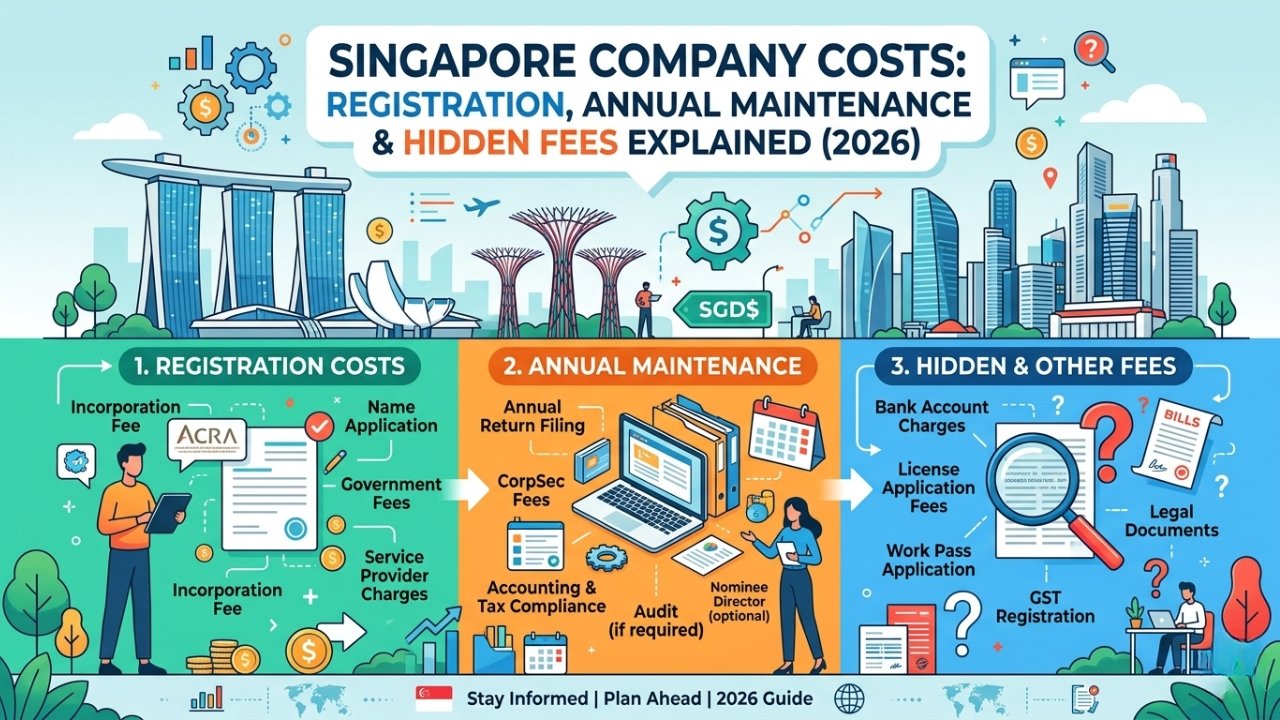
Singapore company registration cost starts at SGD 315 in ACRA fees (SGD 15 for the name, SGD 300 to register). Add a registered address, company secretary and bank setup and the first year comes to about SGD 815–2,115, or SGD 2,315–5,115 with a nominee director. Annual upkeep runs about SGD 3,160–8,260 before any audit. Our Singapore company formation package starts from ₹45,000* plus ACRA fees.
Key facts
- ACRA charges SGD 15 for the name application and SGD 300 to register a Pte Ltd: SGD 315 in government fees.
- First-year cost with a registered address, company secretary and bank setup: about SGD 815–2,115. With a nominee director: SGD 2,315–5,115, or about ₹1,45,000–₹3,20,200 at SGD 1 = INR 62.6.
- Annual upkeep before any audit: about SGD 3,160–8,260, including the SGD 60 annual return fee. An audit (SGD 2,500–8,000) applies only if the company is not small.
- You must appoint a company secretary within six months of incorporation and keep at least one director ordinarily resident in Singapore.
- GST registration becomes compulsory once taxable supplies exceed SGD 1 million in 12 months, which adds quarterly GST returns to your accounting bill.
This guide breaks down every cost registration, annual maintenance, and the fees most service providers bury in the fine print so you can plan with complete clarity.
Registration Costs Breakdown
When you register a private limited company (Pte. Ltd.) in Singapore, you’re paying for government fees plus the cost of whoever helps you set it up.
Here’s what each item actually costs in 2026:
Registration Item | SGD | INR (approx.) |
ACRA name reservation fee | SGD 15 | ₹940 |
ACRA incorporation filing fee | SGD 300 | ₹18,800 |
Registered address (1 year) | SGD 200–500 | ₹12,500–₹31,300 |
Company secretary (first year) | SGD 300–800 | ₹18,800–₹50,100 |
Nominee director (if required) | SGD 1,500–3,000 | ₹94,000–₹1,87,900 |
Corporate bank account setup | SGD 0–500 | ₹0–₹31,300 |
Total (without nominee director) | SGD 815–2,115 | ₹51,000–₹1,32,400 |
Total (with nominee director) | SGD 2,315–5,115 | ₹1,45,000–₹3,20,200 |
Exchange rate used: 1 SGD ≈ INR 62.6 (May 2026)
Who needs a nominee director? Every Singapore company needs at least one director who is ordinarily resident in Singapore, such as a citizen, permanent resident or qualifying pass holder. If none of your directors lives there, you appoint a nominee director, which ACRA accepts. This is the single largest variable in your registration cost, so factor it in from day one.
Annual Maintenance Costs
Once your company is registered, the costs don’t stop. Singapore requires ongoing compliance from every active company, regardless of revenue.
Annual Maintenance Item | SGD | INR (approx.) |
Registered address renewal | SGD 200–500 | ₹12,500–₹31,300 |
Company secretary (annual retainer) | SGD 300–800 | ₹18,800–₹50,100 |
Nominee director (annual fee) | SGD 1,500–3,000 | ₹94,000–₹1,87,900 |
Annual Return filing (ACRA) | SGD 60 | ₹3,756 |
Corporate tax filing (Form C-S) | SGD 500–1,500 | ₹31,300–₹93,900 |
Accounting & bookkeeping | SGD 600–2,400 | ₹37,600–₹1,50,200 |
Audit (if required) | SGD 2,500–8,000 | ₹1,56,500–₹5,00,800 |
Total (without audit) | SGD 3,160–8,260 | ₹1,97,800–₹5,17,100 |
Note on audits: Most small companies qualify for audit exemption if they meet at least 2 of 3 criteria: revenue of not more than SGD 10M, total assets of not more than SGD 10M, and not more than 50 employees.
The real number to budget: For a lean foreign-owned startup with nominee director, bookkeeping, and tax filing, expect SGD 4,000–6,000 per year as a realistic baseline
Hidden Costs Nobody Tells You About
This is where many founders get caught off guard. Service providers advertise low headline prices but recover margin through add-ons, per-action fees, and renewal hikes.
Nominee director” isn’t just an annual fee
Many providers charge additional fees every time the nominee director signs a document, opens a bank account, or attends to KYC requests. These per-signature or per-action charges of SGD 100–300 add up fast.
Bank account facilitation fees
Getting a corporate bank account in Singapore as a foreign-owned entity is genuinely difficult. Some service providers charge SGD 500–2,000 to “assist” with introductions to banks a service that may not even result in a successful account opening.
Registered address surcharges
Basic packages often include a registered address but charge extra for mail handling, scanning, or forwarding. If you’re running operations remotely, this can add SGD 200–500 annually that was never mentioned upfront.
Government liaison fees
Any interaction with ACRA, IRAS, or MOM (Ministry of Manpower) filing changes, updating directors, processing employment pass applications often carries a per-filing charge from your service provider on top of the government fee itself.
Dormant company maintenance
Even if your company generates zero revenue, you still need a company secretary, registered address, and must file an Annual Return. “Pausing” your company is not a real option it remains a compliance obligation.
GST registration costs
Once your revenue crosses SGD 1 million, GST registration becomes mandatory. Preparing and filing quarterly GST returns adds SGD 400–1,200 per year in accounting costs that most initial cost estimates don’t mention.
Price escalation in year 2
Introductory pricing is common in this industry. Many providers offer discounted first-year packages, then raise fees significantly at renewal. Always ask for multi-year pricing before you commit.
Comply Globally’s All-Inclusive Pricing
At Comply Globally, we price transparently one annual fee that covers everything your company needs to stay legally compliant in Singapore.
What’s included.
- Company registration with ACRA (first year)
- Registered office address with mail handling
- Named company secretary (not a shared pool)
- Nominee director service (for foreign-owned companies)
- Annual Return filing
- Corporate tax filing (Form C-S/C-S Lite)
- Bookkeeping up to 100 transactions/month
- Unlimited document signing by nominee director
- Dedicated account manager
No per-action charges. No surprise renewal hikes. No separate “government liaison fees.”
We believe the cost of staying compliant should be predictable because unpredictable compliance costs are a business risk, not just an inconvenience.
Our Pte Ltd package starts from ₹45,000* plus ACRA fees, and annual compliance from ₹75,000* a year. We quote in writing before you pay, based on your company’s structure and transaction volume. *Our professional fee; government fees are charged at cost.
Cost Comparison: DIY vs. Consultant vs. Big 4
Not all incorporation paths are equal. Here’s how the three main approaches compare across cost, risk, and suitability.
Factor | DIY (Self-File via ACRA) | Boutique Consultant | Big 4 / Large Law Firm |
Year 1 Cost | SGD 500–900 | SGD 1,500–4,000 | SGD 8,000–20,000+ |
Annual Cost | SGD 1,500–3,000 | SGD 2,500–6,000 | SGD 10,000–30,000+ |
Who it suits | Singapore-resident founders only | SMEs, foreign startups, e-commerce | MNCs, regulated industries, IPO-track |
Nominee director included? | No | Usually yes | Yes |
Compliance risk | High (easy to miss deadlines) | Low | Very low |
Personalised advice | None | Yes | Yes (senior-level) |
Speed | 1–3 days | 1–5 days | 1–4 weeks |
Hidden fees risk | Low | Medium | Low |
The verdict: For most international founders and SMEs, a reputable boutique corporate services provider usually gives a better balance of cost, compliance coverage and personal attention than DIY or a Big 4 firm. Big 4 fees are justified only when you have complex structures, significant funding, or regulatory requirements.
Is Singapore Worth the Investment? (ROI Analysis)
Let’s be direct: Singapore incorporation is not the cheapest option on the planet. If you’re looking purely at cost, an offshore jurisdiction like the BVI or Cayman Islands may appear cheaper at registration. But for businesses that want to actually operate, invoice, and bank Singapore usually works out better value than a cheaper offshore registration.
Why the investment pays off.
Access to banking infrastructure
Singapore-registered companies open doors to DBS, OCBC, HSBC, and international neobanks like Wise Business and Airwallex. Many global payment processors and B2B clients want an entity in a jurisdiction they recognise Singapore is one most of them accept.
Tax efficiency
Singapore’s corporate tax rate is a flat 17%, but startups benefit from the Start-Up Tax Exemption (SUTE) scheme: 75% exemption on the first SGD 100,000 of chargeable income and 50% on the next SGD 100,000, for the first three years. That works out to an effective 4.25% on the first SGD 100,000 and 6.375% across the first SGD 200,000 of chargeable income.
Zero withholding tax on dividends
Singapore does not levy withholding tax on dividends paid to foreign shareholders. If you’re building a holding structure, this is a significant advantage over many competing jurisdictions.
Credibility with investors and clients
Singapore’s legal system, IP protection framework, and bilateral tax treaties (with 90+ countries, including India, the US, UK, and UAE) make it the preferred jurisdiction for venture-backed startups and professional services firms operating across Asia.
Ease of doing business
ACRA’s digital-first approach means filings happen online, quickly, and with minimal friction. The regulatory environment is demanding but predictable which is exactly what growing businesses need.
The bottom line: If your business generates SGD 50,000+ in annual revenue, or you’re building towards fundraising or enterprise contracts, Singapore’s compliance bill is usually small next to the banking, client and investor access it brings.
Frequently Asked Questions
How much does it cost to register a company in Singapore?
ACRA’s fees are SGD 315: SGD 15 for the name application and SGD 300 for registration. With a registered address, company secretary and bank setup, the first year costs about SGD 815–2,115, or SGD 2,315–5,115 if you need a nominee director. At SGD 1 = INR 62.6 that is about ₹51,000–₹1,32,400 without a nominee. Our Pte Ltd package starts from ₹45,000* plus ACRA fees.
What are the annual running costs of a Singapore company?
Plan for about SGD 3,160–8,260 a year before any audit. That covers the registered address (SGD 200–500), company secretary (SGD 300–800), nominee director (SGD 1,500–3,000), the SGD 60 annual return fee, the corporate tax filing (SGD 500–1,500) and bookkeeping (SGD 600–2,400). A dormant company still pays most of these.
How much are company secretary fees in Singapore?
Most providers charge about SGD 300–800 a year for a company secretary. The role is compulsory: you must appoint one within six months of incorporation, the secretary must live in Singapore and cannot be your sole director. Check whether the fee covers annual return filing and routine changes, or whether each filing is billed separately.
Do I need a nominee director, and how much does it cost?
You need one if none of your directors is ordinarily resident in Singapore. Nominee director fees typically run SGD 1,500–3,000 a year, depending on the provider and how much signing is involved. Ask whether signatures, bank visits and KYC requests are included, because some providers charge SGD 100–300 for each action on top of the annual fee.
How much are accounting fees in Singapore?
Bookkeeping usually costs SGD 600–2,400 a year and the corporate tax filing on Form C-S SGD 500–1,500, depending on transaction volume. Once you register for GST, quarterly GST returns add about SGD 400–1,200 a year. Every company must keep proper accounting records under the Companies Act, even with no revenue.
Are there hidden costs I should plan for?
Yes, mostly add-ons. Watch for per-signature charges from nominee directors (SGD 100–300 each), bank introduction fees (SGD 500–2,000), mail handling or scanning (SGD 200–500 a year), per-filing charges for routine ACRA, IRAS or MOM changes, and sharp price rises at the first renewal. Ask for multi-year pricing in writing before you sign.
When does a Singapore company need an audit?
Only when it does not qualify as a small company. A private company is exempt if it meets at least two of three tests: revenue of not more than SGD 10 million, total assets of not more than SGD 10 million and not more than 50 employees. Companies that need an audit typically pay SGD 2,500–8,000 a year.
What happens if I file my annual return late?
ACRA charges a late lodgement penalty of SGD 300 if you file within three months after the due date and SGD 600 after that, applied automatically when you file. If you know you will be late, you can apply for a 60-day extension for SGD 200. Directors who are prosecuted face fines of up to SGD 10,000 per charge.
More Singapore guides
Setting up in Singapore? Our Singapore company formation page explains the process and the services we offer. Other guides in this series:
- Advanced Singapore Structures Holding Companies, IP, ESOP & Fundraising for Indian Founders
- Singapore vs Dubai vs USA Which Country is Best for Indian Startups? (2026 Comparison)
- FEMA & RBI Rules for Indians Owning a Singapore Company ODI, Reporting & Profit Repatriation
- How to Open a Business Bank Account in Singapore Banks, Documents & Remote Options (2026)
- Singapore Company Compliance Checklist ACRA, XBRL, Annual Returns & Penalties (2026)
- Singapore Corporate Tax Guide for Indian Entrepreneurs CIT, GST, DTAA & Incentives (2026)
- How to Register a Company in Singapore from India Complete Step-by-Step Guide (2026)
All Singapore articles: Singapore guides.