
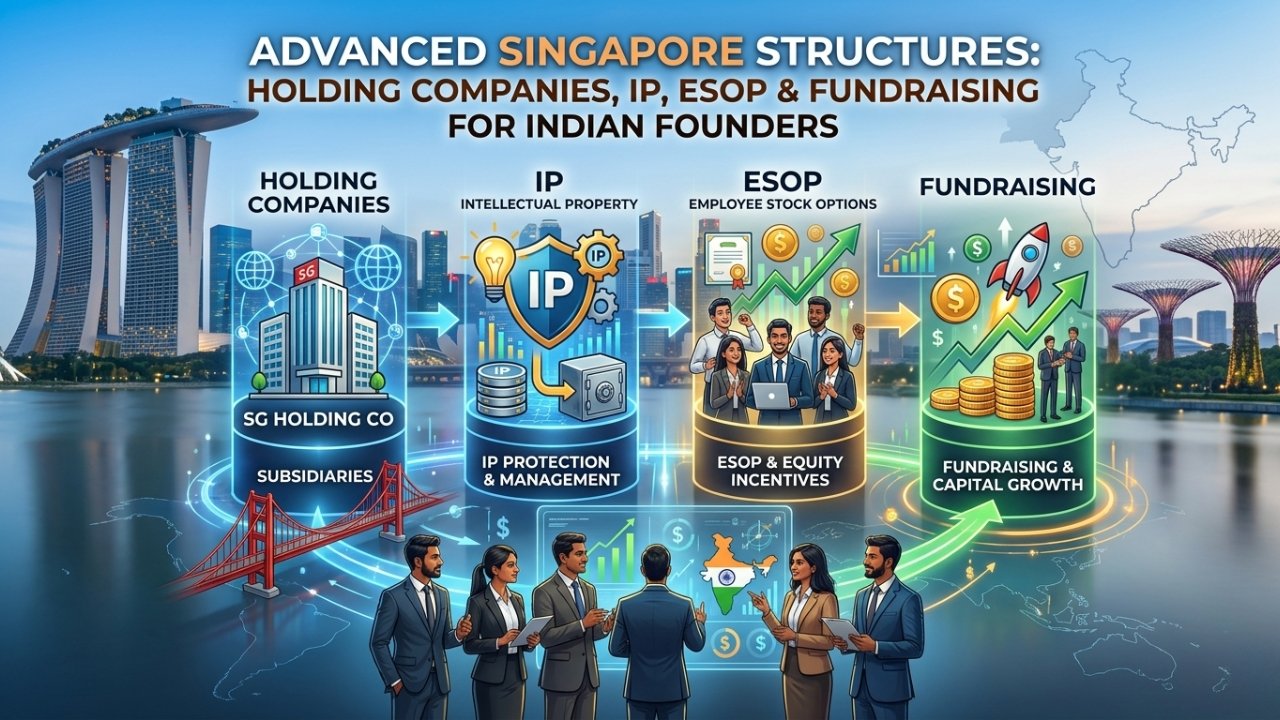
Once you know how to register a company in Singapore from India, the next decision is structure. A Singapore holding company can own your Indian company, hold your IP, run one ESOP pool for staff in every country and take money from foreign VCs. Each of those steps has Singapore tax effects and Indian FEMA rules, and this guide takes them in order.
Key facts
- Singapore taxes company profits at 17%, does not tax capital gains, and deducts no tax on dividends paid to shareholders.
- IP income can qualify for the IP Development Incentive at 5%, 10% or 15% on a share of qualifying income. R&D done in Singapore earns a 250% deduction, and the Enterprise Innovation Scheme gives 400% on up to SGD 400,000 a year until YA 2028.
- Under the India-Singapore DTAA, royalties your Indian company pays to the Singapore parent are taxed in India at 10% instead of the 20% domestic rate.
- A flip needs FEMA filings on both sides, and resident individuals face limits on controlling a foreign company that has its own subsidiary. Confirm the structure with your AD bank first.
- Every year you file the annual return with ACRA and the tax return with IRAS in Singapore, then the APR by 31 December and the FLA return by 15 July in India. See our Singapore company formation page for how we handle both sides.
This guide is written specifically for Indian founders building global companies who want to go beyond incorporation basics and architect a structure that serves them at Series A, Series B, and beyond.
Singapore Holding Company: Why It Exists and How It Works
A holding company structure in Singapore places a parent entity incorporated in Singapore above your operating subsidiaries in India, the US, or any other market. The Singapore entity owns shares in the subsidiaries. It does not trade directly; it holds.
Why founders build this structure
Tax efficiency on dividends and capital gains. Singapore does not tax capital gains, and dividends received by a Singapore holding company from foreign subsidiaries are generally exempt from tax under the one-tier tax system. If you eventually sell your India business or list a subsidiary, gains flow up to the Singapore parent without being taxed again.
Investor preference. Most institutional investors particularly US-based VCs and growth funds prefer to hold equity in a Singapore entity over an Indian private limited company. Singapore’s legal system is English common law, its courts are fast, and shareholder agreements are predictable and enforceable.
Simplified cross-border ownership. Operating in five countries with a holding company in each creates a compliance nightmare. A Singapore holding company as the central owner of all subsidiaries simplifies equity tables, investor reporting, and group-level audits.
Banking and treasury. Singapore holding companies can maintain USD, EUR, and SGD accounts easily. Banks in Singapore DBS, OCBC, UOB are well-capitalised and comfortable with multi-currency, multi-subsidiary structures.
How to set up a Singapore holding company
The mechanics are straightforward. You incorporate a Singapore private limited company (Pte. Ltd.), ensure shareholding reflects the founder group, then have that entity acquire or subscribe for shares in your Indian entity. The Indian subsidiary typically runs operations employing people, signing contracts, earning revenue while the Singapore parent holds intellectual property, raises capital, and is the entity through which equity is issued to investors.
The entire setup can be completed within 1–2 weeks for the Singapore entity. The India side involves additional regulatory steps under the Foreign Exchange Management Act (FEMA), specifically pricing the valuation and filing with the Reserve Bank of India (RBI).
IP Holding Structure: Tax Benefits and Practical Mechanics
Intellectual property is often the most valuable asset a technology company owns. Trademarks, patents, proprietary software, trade secrets, and brand names these have enormous economic value, and where they are held determines how they are taxed.
Why Singapore is ideal for IP holding
An IP holding company in Singapore benefits from several overlapping advantages.
The IP Development Incentive (IDI). Singapore’s Economic Development Board can approve a concessionary tax rate of 5%, 10% or 15% on a share of the income a company earns from commercialising IP that came out of its own R&D. The share follows the OECD nexus approach, so it depends on how much of the R&D the company did itself. The separate Development and Expansion Incentive offers the same rates for new high-value projects and expansions, not for IP income as such. For a company earning significant royalty income, the difference versus India’s 25%+ corporate tax rate is material.
Lower withholding tax on royalties paid to Singapore. The India-Singapore Double Taxation Avoidance Agreement (DTAA) allows royalties paid by an Indian entity to a Singapore entity to be taxed at a reduced rate of 10% rather than India’s standard 20% withholding tax rate. The royalties received by the Singapore entity are then taxed at Singapore’s standard corporate rate of 17%, or at 5%, 10% or 15% under an incentive.
R&D deductions. Singapore allows a 250% tax deduction (the 100% base plus a 150% enhanced deduction) on staff costs and consumables for qualifying R&D carried out in Singapore, and the Enterprise Innovation Scheme raises this to 400% on the first SGD 400,000 a year until YA 2028, with IP registration costs also covered. Founders who build IP while based in Singapore can cut their tax bill sharply during the R&D phase.
Practical IP migration: what it involves
Moving IP from India to Singapore requires careful structuring. The most common approaches are.
- Develop New IP in Singapore from Day One. For pre-revenue startups, it is cleanest to create the IP-owning entity in Singapore and have it commission development work from the Indian subsidiary. The Indian entity gets paid for its R&D services; IP ownership vests in Singapore from the start.
- License the IP from India to Singapore. Where IP already exists in an Indian entity, a licensing arrangement can allow the Singapore entity to commercialise it globally while royalties flow back to India.
- Migrate Ownership via a Formal Transfer. Transferring IP assets from India to Singapore needs a formal valuation at arm’s length, transfer pricing documentation in India and a check of the FEMA reporting with your AD bank. This is more complex but achievable, particularly for early-stage companies where IP value is still low.
Important: IP structuring has increased scrutiny globally under OECD BEPS (Base Erosion and Profit Shifting) rules. Singapore is fully BEPS-compliant. Ensure your Singapore entity has genuine economic substance meaning actual staff or management activity and is not a pure shell holding IP.
ESOP and Share Schemes for Singapore Startups
Employee Stock Option Plans (ESOPs) are a core tool for attracting and retaining talent at startups. Singapore’s framework for ESOP structures in Singapore startups is flexible, tax-efficient, and globally recognised.
Why structure your ESOP via Singapore
When your Singapore holding company issues options over its shares, employees globally whether in India, Singapore, or elsewhere can participate in the same option pool. This is far simpler than maintaining separate ESOP pools in each subsidiary, which creates valuation complexity and cross-border tax headaches.
The Employee Share Option Plan (ESOP) framework in Singapore
Singapore does not tax the grant of options. Employees are taxed only when they exercise their options and receive shares specifically, on the difference between the exercise price and the market value of shares at the time of exercise. This is treated as employment income in Singapore.
Under the Qualified Employee Equity-Based Remuneration (QEEBR) scheme, employees can apply to IRAS to defer paying the tax on their gains for up to five years, with interest charged on the amount deferred. This helps staff who keep their shares instead of selling them to pay the tax.
Key ESOP design decisions for Indian founders
Option pool size. Institutional investors at Series A typically expect a 10–15% ESOP pool on a fully diluted basis. Create this pool at or before your fundraising round.
Vesting schedule. The market standard is a 4-year vest with a 1-year cliff meaning no options vest until the employee completes one year, after which 25% vest immediately and the remaining 75% vest monthly over the subsequent three years.
Strike price. Options should be priced at fair market value (FMV) at the time of grant. For early-stage companies, this is typically a fraction of the last-round price per share. Third-party 409A-equivalent valuations are advisable once you raise institutional capital.
Indian employees. For employees based in India exercising options in a foreign company, there are FEMA implications. RBI has liberalised rules under the Overseas Portfolio Investment (OPI) framework, but employees should take professional advice on their individual tax and compliance obligations.
Share Vesting for Founders
Beyond employee ESOPs, founders should also implement reverse vesting on their own shares from day one. This protects the company and co-founders if someone exits early and is a standard requirement for institutional investors.
Fundraising: Why VCs Prefer Singapore Entities
The preference among institutional investors particularly US VC firms, Southeast Asian growth funds, and global family offices for Singapore-incorporated entities is not accidental. It reflects structural realities about ease of investment, legal predictability, and exit optionality.
Why fundraising via Singapore entity works better.
- Convertible notes and SAFEs work smoothly via Singapore. Singapore law is compatible with standard US investor instruments. SAFEs (Simple Agreements for Future Equity) and convertible notes from US VCs are well understood under Singapore law and can be executed quickly.
- Shareholder agreements are enforceable. Singapore’s common law courts consistently uphold shareholder rights, drag-along provisions, anti-dilution clauses, and liquidation preferences. Investors know what they are getting.
- No FDI restrictions on most sectors. Unlike India, Singapore does not restrict foreign direct investment in most technology sectors. Investors can hold any percentage of your Singapore entity without regulatory approval.
- MAS-regulated environment creates trust. The Monetary Authority of Singapore’s regulatory environment is respected globally. Singapore entities are bankable and investable from Day One.
- Faster round closure. A typical Singapore priced round closes faster than an equivalent Indian round due to simpler cap table management, no RBI filing timelines blocking completion, and standardised documentation (NDA, SHA, SSA).
Practical fundraising mechanics
If you raise from a Singapore-based VC, the investment flows directly into your Singapore entity. If you raise from a US investor, they typically wire USD into your Singapore USD bank account. The Singapore entity then on-lends or injects capital into the Indian subsidiary as Foreign Direct Investment (FDI) a well-understood and RBI-compliant process.
India-Singapore Flip Structure Explained
The India-Singapore flip structure also called a “flipping” is the process of restructuring an India-headquartered company so that the parent entity becomes a Singapore private limited company. This is one of the most common structures among Indian SaaS and deep-tech founders preparing for global fundraising.
How the flip works
- A new Singapore Pte. Ltd. is incorporated with the founders as shareholders, mirroring the existing Indian shareholding structure.
- The Indian private limited company becomes a wholly owned subsidiary of the Singapore entity. This is achieved by the founders transferring their shares in the Indian company to the Singapore entity.
- The share transfer is valued by a registered valuer (mandatory under FEMA) and approved at fair market value.
- FEMA filings are made through your AD bank: Form FC-TRS for the transfer of Indian shares to the Singapore company, and ODI reporting on Form FC for the Singapore shares the founders receive in exchange.
- The Singapore entity becomes the group holding company, through which future fundraising, IP management, and investor equity will flow.
Who should consider a flip?
The flip is most practical at the pre-Series A stage when.
- Valuation is still manageable, keeping transfer taxes low
- You have not yet taken institutional Indian capital (which complicates transfers)
- You are targeting US or global VC investors who prefer non-Indian holding companies
The flip becomes significantly more complex and expensive after Series A, particularly if you have Indian institutional investors already on the cap table. Execute early or plan around it.
Check one rule before anything else. Under the Overseas Investment Rules 2022, a resident individual may make ODI only in an operating foreign company outside financial services that does not have a subsidiary or step-down subsidiary where that individual has control. In a classic flip, founders living in India control a Singapore company that owns the Indian company, which can run into this rule. Have the structure confirmed by your AD bank and a FEMA adviser before you sign.
Tax implications of the flip for founders
The share transfer is treated as a deemed sale by Indian founders, potentially triggering capital gains tax under Indian income tax law. Where unlisted shares have been held for more than 24 months, the long-term capital gains rate applies, which is 12.5% for transfers from 23 July 2024. Professional structuring at the point of the flip including accurate FMV computation and timing can materially reduce this liability.
Multi-Country Structures Using Singapore as Hub
Singapore’s strength as a global business hub is not limited to the India-Singapore axis. Founders building companies across Southeast Asia, the Middle East, the US, or Europe increasingly use Singapore as the central hub for a multi-country operating structure.
The hub-and-spoke model
The Singapore holding company sits at the centre. Below it are wholly owned operating subsidiaries in each country.
- India Pvt. Ltd. engineering, R&D, back-office operations
- US LLC or C-Corp sales, marketing, US customer contracts
- UAE Free Zone entity Middle East operations, regional sales
- UK Ltd. European operations, fintech licensing where required
Each subsidiary employs local staff, signs local contracts, and complies with local regulations. The Singapore holding company owns 100% of each, maintains the consolidated P&L, holds IP, and is the entity through which investors hold equity.
Transfer pricing and intercompany agreements
In a multi-entity structure, transactions between group companies such as management fees, IP licensing, intercompany loans, or shared services must be priced at arm’s length. Singapore follows OECD transfer pricing guidelines and requires proper intercompany agreements backed by transfer pricing documentation for groups above defined revenue thresholds.
This is not optional. IRAS (Inland Revenue Authority of Singapore) audits transfer pricing arrangements, and the Indian Income Tax Department has dedicated Transfer Pricing Officers who review related-party deals. Engage a transfer pricing specialist once your group revenue exceeds $5–10 million.
Banking for multi-country structures
Singapore’s banking infrastructure supports multi-currency, multi-entity treasury management. DBS, OCBC, and Standard Chartered Singapore can hold accounts in SGD, USD, EUR, GBP, and INR, issue cross-border payments, and provide trade finance products. Many founders also use fintech alternatives Aspire, Airwallex, Wise Business for day-to-day multi-currency operations before banking relationships with major banks are established.
Frequently Asked Questions
Can I set up a Singapore holding company after incorporating in India?
Yes. A flip puts a new Singapore company above your existing Indian company: founders transfer their Indian shares to it in exchange for Singapore shares. You need a valuation, Form FC-TRS for the Indian shares and ODI reporting through your AD bank. Resident individuals cannot hold ODI in a foreign company that has a subsidiary they control, so confirm the structure first. It is simplest before your valuation rises.
What corporate tax does a Singapore holding company pay?
The headline rate is 17%. A pure investment holding company cannot use the start-up tax exemption, but it gets the partial exemption: 75% of the first SGD 10,000 and 50% of the next SGD 190,000 of chargeable income are exempt. Singapore has no capital gains tax, and companies approved under the IP Development Incentive can pay 5%, 10% or 15% on part of their qualifying IP income.
Can Indian founders issue ESOPs to Indian employees through a Singapore company?
Yes. Employees in India can receive options in a foreign parent company. FEMA applies when they acquire the shares, and Indian income tax usually arises when they exercise the options. In Singapore, the gain on exercise is employment income only for staff working there. Draft the plan with both sets of rules in mind, and ask employees to take their own tax advice before exercising.
How long does it take to raise capital through a Singapore entity?
A priced round through a Singapore entity typically closes within 4–8 weeks from term sheet to completion, if due diligence raises no major issues. SAFE or convertible note rounds can close faster, sometimes within 1–2 weeks. Indian rounds often take longer because of extra regulatory filings. If the money then goes into your Indian subsidiary, that step is FDI and needs its own reporting.
Is the India-Singapore DTAA still useful after the 2016 protocol?
Yes, for income flows. Since the 2016 protocol, gains on Indian company shares acquired from 1 April 2017 are taxable in India, so the old capital gains exemption has gone. The treaty still caps Indian tax on dividends paid to Singapore at 10% or 15% and on royalties at 10%. Treaty benefits need a tax residency certificate and real business reasons for the structure.
What are the annual compliance requirements for a Singapore holding company?
File the annual return with ACRA, keep proper accounting records, prepare financial statements, and file the corporate income tax return with IRAS. A private company can skip the AGM if it sends its financial statements to members on time. An audit is needed unless the company, and its group, qualify as small. Our Singapore compliance checklist sets out the deadlines.
Do I need a local director or resident partner in Singapore?
Yes, you need at least one director who is ordinarily resident in Singapore, such as a citizen, permanent resident or qualifying pass holder. You do not need a local shareholder or partner: Indian founders can own 100% of the shares. Many founders appoint a nominee director, which ACRA accepts, until one of them moves to Singapore on an EntrePass or Employment Pass.
What FEMA and ODI filings apply when I set up in Singapore from India?
Before you remit, file Form FC through your AD Category-I bank and get a Unique Identification Number. After that, file the Annual Performance Report by 31 December and, for Indian companies and LLPs, the FLA return to RBI by 15 July each year. Individuals invest under the Liberalised Remittance Scheme, within USD 250,000 per financial year.
More Singapore guides
Setting up in Singapore? Our Singapore company formation page explains the process and the services we offer. Other guides in this series:
- Singapore vs Dubai vs USA Which Country is Best for Indian Startups? (2026 Comparison)
- Singapore Company Costs Registration, Annual Maintenance & Hidden Fees Explained (2026)
- FEMA & RBI Rules for Indians Owning a Singapore Company ODI, Reporting & Profit Repatriation
- How to Open a Business Bank Account in Singapore Banks, Documents & Remote Options (2026)
- Singapore Company Compliance Checklist ACRA, XBRL, Annual Returns & Penalties (2026)
- Singapore Corporate Tax Guide for Indian Entrepreneurs CIT, GST, DTAA & Incentives (2026)
- How to Register a Company in Singapore from India Complete Step-by-Step Guide (2026)
All Singapore articles: Singapore guides.