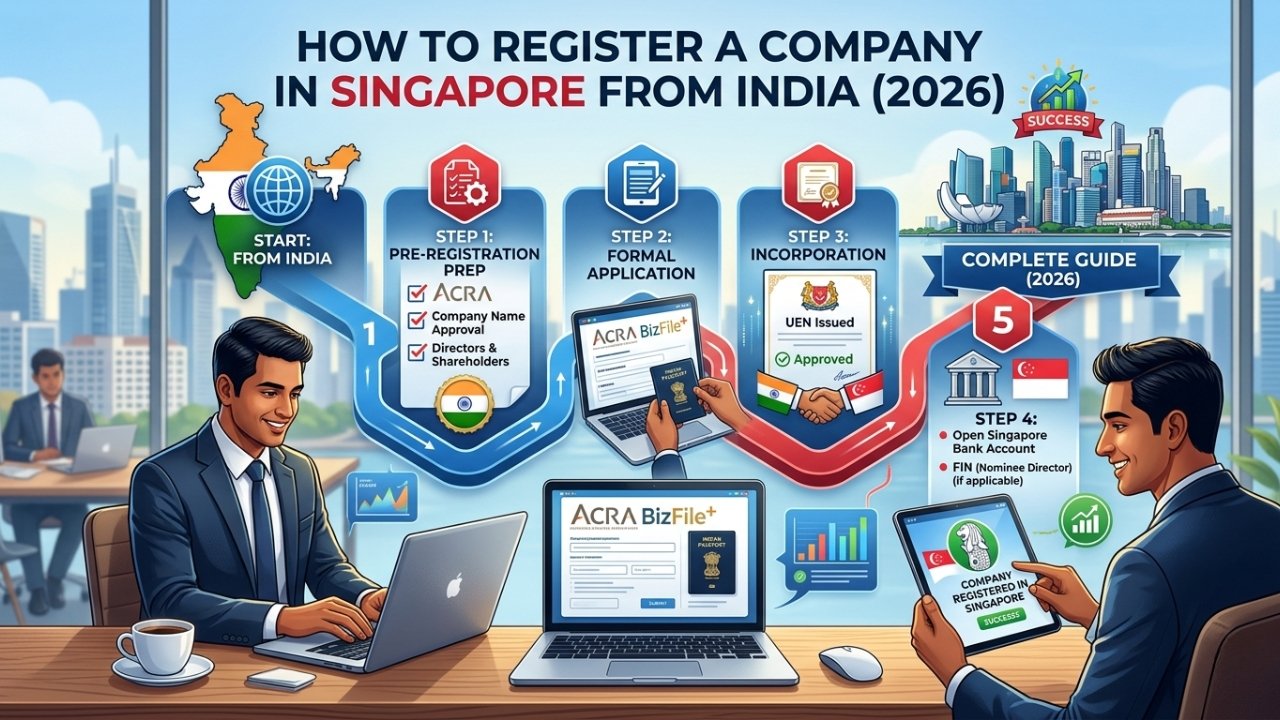
Registering a company in Singapore from India means incorporating a legal business entity most commonly a Private Limited (Pte Ltd) company with the Accounting and Corporate Regulatory Authority (ACRA) of Singapore, without needing to be physically present in the country. Indian entrepreneurs and NRIs can own 100% of a Singapore company, do the entire process remotely, and typically complete incorporation in 1–3 business days.
Singapore consistently ranks among the world’s top destinations for company incorporation and for good reason. It offers a stable legal framework, low corporate tax rates (17% flat, with startup exemptions), zero capital gains tax, and a business-friendly regulatory environment. For Indian founders, it also opens doors to global banking, international investors, and access to the ASEAN market.
This guide covers everything you need to know: eligibility, business structures, the step-by-step incorporation process, required documents, remote setup, and the most common mistakes to avoid.
Who Can Register a Company in Singapore? Eligibility for Indians
Yes Indians can absolutely register a company in Singapore. Singapore law permits foreigners, including Indian nationals (both resident in India and NRIs), to own 100% of a Singapore-incorporated company. There are no nationality-based restrictions on business ownership.
Here’s what you need to know about eligibility.
- 100% foreign ownership is allowed. You do not need a Singaporean co-founder or local partner to own or control the company.
- You must appoint at least one locally resident director. Singapore’s Companies Act requires every company to have a minimum of one director who is ordinarily resident in Singapore either a Singapore Citizen, Permanent Resident, or an EntrePass/Employment Pass holder. This is the one condition Indians must address when incorporating remotely.
- Shareholders can be entirely foreign. One or more Indian individuals or companies can hold all shares.
- A registered local address is mandatory. You need a Singapore-based registered office address (not a P.O. Box). Many incorporation service providers offer this.
Is it legal for Indians to own a Singapore company?
exchange control restrictions or nationality-based limits on company ownership. Operating a Singapore Pte Ltd as an Indian resident is entirely lawful under both Singapore law and Indian law (subject to RBI/FEMA compliance on outward remittances from India).
Which Business Structure is Best for Foreigners?
Singapore offers several business entities. For most Indian entrepreneurs, the Private Limited Company (Pte Ltd) is the clear winner but here’s a quick comparison.
| Structure | Foreign Ownership | Liability | Recommended For |
|---|---|---|---|
| Private Limited (Pte Ltd) | 100% allowed | Limited | Most businesses; startups, SMEs, holding companies |
| Sole Proprietorship | Not allowed for non-residents | Unlimited | Not suitable for Indians based in India |
| Partnership | Not allowed for non-residents | Unlimited | Not suitable for Indians based in India |
| Limited Liability Partnership (LLP) | Allowed, but requires resident partner | Limited | Professionals (consultants, lawyers) |
| Branch Office | Parent company owns it | Parent liable | Large Indian companies expanding to SG |
| Representative Office | Not a separate legal entity | N/A | Market research only; cannot generate revenue |
Why Pte Ltd is the Best Choice for Indians
- Limited liability your personal assets in India are protected from business debts
- Separate legal identity the company can own assets, enter contracts, and sue/be sued in its own name
- 100% foreign ownership no local partner required
- Tax benefits new startups enjoy a partial tax exemption for the first three years
- Investor-friendly venture capitalists and institutional investors strongly prefer Pte Ltd structures
- Easy to transfer shares and bring in future co-founders or investors
Step-by-Step Process to Register a Company in Singapore from India
Here is the complete incorporation process broken down into clear steps.
Step 1: Choose and Reserve Your Company Name
Your first task is to select a unique company name that complies with ACRA’s guidelines. The name must not be identical or too similar to an existing company, must not contain restricted words (like “Bank,” “Finance,” or “Medisave” without regulatory approval), and must not be offensive or misleading.
Name reservation is done via ACRA’s online portal, BizFile+. Once submitted, approval typically takes 15 minutes to a few hours (sometimes up to 2 days if it requires manual review). A reserved name is valid for 120 days.
Tip: Use ACRA’s name search tool on BizFile+ before applying to avoid conflicts.
Step 2: Select Your Company’s Primary Business Activity (SSIC Code)
You must classify your business under Singapore’s Standard Industrial Classification (SSIC) code system. Choose the code that most accurately reflects your primary revenue-generating activity. You can list a secondary activity too. This affects your GST registration obligations and certain industry-specific licences.
Step 3: Appoint a Locally Resident Director
As mentioned, Singapore law requires at least one director who is ordinarily resident in Singapore. If you (an Indian national living in India) are the sole owner, you have two options.
- Option A Nominee Director Service: Hire a professional nominee director through your incorporation agent. This is a common, fully legal practice. The nominee usually signs an indemnity deed with you and does not run the business day to day, but in law they are a full director with the same duties as any other. Costs typically range from SGD 800–1,800 per year.
- Option B Relocate to Singapore: If you plan to move to Singapore, you can apply for an EntrePass or Employment Pass to become a resident director yourself.
Step 4: Determine Shareholders and Share Structure
Decide how many shares to issue, at what par value, and who the shareholders are. For a simple single-founder company, you might issue 100 ordinary shares at SGD 1 each, making your paid-up capital SGD 100 (the legal minimum is SGD 1; source: ACRA). If there are multiple Indian co-founders, distribute shares accordingly.
Key points.
- A Singapore Pte Ltd can have 1 to 50 shareholders
- Shareholders can be individuals or corporate entities
- An Indian company can be a shareholder of a Singapore Pte Ltd
Step 5: Appoint a Company Secretary
Every Singapore Pte Ltd must appoint a qualified company secretary within 6 months of incorporation. The company secretary must be a Singapore resident. This role handles statutory filings, annual returns, and compliance. Most incorporation service providers bundle this service.
Step 6: Choose a Registered Office Address
Your company must have a physical registered address in Singapore (not a P.O. Box). The registered address is publicly listed with ACRA. Incorporation service providers typically offer a registered address as part of their package, which satisfies this requirement for most startups.
Step 7: Prepare and Submit Incorporation Documents
Your incorporation agent or you (via BizFile+) will prepare and file the following.
- Company Constitution (formerly called Memorandum and Articles of Association)
- Consent to Act as Director form (signed by all directors)
- Particulars of shareholders, directors, and company secretary
- Declaration of compliance
All documents are submitted digitally via BizFile+. There is no wet-ink signature required for most documents. Directors and shareholders authenticate via SingPass (for Singapore residents) or via digital means for overseas individuals.
Step 8: Pay the Incorporation Fee
ACRA charges SGD 315 in total (SGD 15 for the name application plus SGD 300 to register the company; source: ACRA fees), approximately INR 19,500 as of 2026. This is paid online at the time of filing. If you use an incorporation agent, they will typically include this fee within their overall service charge.
Step 9: Receive Your Certificate of Incorporation
Once ACRA processes and approves your application, you receive a Certificate of Incorporation via email. This is usually issued within 15 minutes to 1 hour for straightforward applications, though it can occasionally take 1–3 business days. Your company now legally exists.
ACRA also issues.
- A Unique Entity Number (UEN) Singapore’s equivalent of a CIN
- A Business Profile (BizFile extract) an official document showing your company details
Step 10: Open a Corporate Bank Account
With your Certificate of Incorporation and other documents in hand, you can now open a Singapore corporate bank account. Popular options for Indian entrepreneurs include DBS, OCBC, UOB (traditional banks), and digital banking alternatives like Airwallex, Aspire, or Wise Business.
Note: Traditional banks often require an in-person visit. Digital banking platforms like Aspire and Airwallex offer fully remote account opening, making them a practical first choice for India-based founders.
Documents Required for Singapore Company Registration
Here is a complete checklist of documents you will need as an Indian national.
For Each Individual Director/Shareholder
- Passport copy (clear scan of photo page) valid for at least 6 months
- Proof of residential address (utility bill, bank statement, or Aadhaar issued within 3 months)
- Contact details (email, phone number)
For the Company.
- Proposed company name (with 1–2 alternatives)
- Proposed SSIC code(s)
- Registered office address in Singapore (provided by your agent)
- Share structure details (number of shares, par value, shareholding percentage)
- Company Constitution (a standard template is usually provided by your incorporation agent)
If a Shareholder is a Corporate Entity (Indian Company).
- Certificate of Incorporation of the Indian company
- Memorandum and Articles of Association
- Board resolution authorising the investment
- Proof of registered address
- KYC documents of ultimate beneficial owners (UBOs)
Can I Register a Singapore Company Remotely from India?
Yes, completely. This is one of Singapore’s greatest advantages for Indian entrepreneurs. The entire incorporation process can be completed without ever setting foot in Singapore.
ACRA’s BizFile+ system is fully online. Incorporation agents facilitate everything remotely from document collection to filing. The signed documents can be executed electronically or via a simple wet-ink signature on scanned copies, depending on your agent’s process.
The only step that may require your physical presence is opening a traditional bank account at DBS, OCBC, or UOB. Many Indian founders handle this with a short trip to Singapore (2–3 days). However, this is not mandatory at incorporation stage several digital banks and fintechs (Aspire, Airwallex, Wise, Currenxie) allow fully remote corporate account opening for Singapore companies.
Quick answers
- Do I need to visit Singapore to incorporate? No.
- Do I need a Singapore SIM card or phone number? No.
- Can I sign documents from India? Yes.
- Can I open a bank account remotely? Yes, with digital banks.
Timeline: How Long Does Company Registration Take?
| Stage | Typical Timeframe |
|---|---|
| Name reservation approval | 15 minutes – 2 business days |
| Document preparation | 1–3 days (agent dependent) |
| ACRA incorporation filing | Submitted online |
| Certificate of Incorporation issued | 15 minutes – 3 business days |
| Corporate bank account (digital) | 3–7 business days |
| Corporate bank account (traditional bank) | 2–4 weeks |
Total time to have a fully operational company with a bank account: approximately 1–3 weeks for a digital banking setup, or 3–5 weeks if using a traditional Singapore bank.
Common Mistakes to Avoid
Choosing the wrong business structure.
Many Indian founders look at a sole proprietorship because it seems simpler, then find that a non-resident owner must appoint a locally resident authorised representative and gets no limited liability. For most, a Pte Ltd is the better fit.
Ignoring the resident director requirement.
Trying to skip the nominee director and listing only an India-based director will cause ACRA to reject the application. Budget for a nominee director service from day one.
Using a residential address as the registered office.
Singapore’s registered address must be a commercial address unless you have an approved Home Office scheme. Always use your agent’s registered address service.
Not planning for FEMA/RBI compliance in India.
When you remit funds from India to your Singapore company as equity investment, this constitutes an Overseas Direct Investment (ODI) under RBI/FEMA guidelines. You need to file Form ODI with your authorised dealer bank in India. Failure to comply can result in penalties. Consult a CA in India before transferring capital.
Choosing an agent based only on price.
Some very low-cost providers cut corners on nominee director quality, registered address legitimacy, or compliance support. Research reviews and ensure the provider is reputable.
Letting the company secretary appointment lapse.
You must appoint a company secretary within 6 months. Missing this is a statutory violation in Singapore.
Not registering for GST when required.
If your Singapore company’s taxable turnover exceeds SGD 1 million per year, GST registration is mandatory. Many Indian founders using Singapore as a holding or IP company never reach this threshold, but those selling to Singapore customers should track it.
Assuming a Singapore company automatically solves Indian tax issues.
A Singapore company is taxed in Singapore, but if the management and control of the company is exercised from India, Indian tax authorities may treat it as an Indian tax resident under Place of Effective Management (POEM) rules. Always seek professional tax advice.
DIY vs. Using a Professional Incorporation Agent
| Factor | DIY via BizFile+ | Using an Incorporation Agent |
|---|---|---|
| Cost | SGD 315 (ACRA fee only) | SGD 800–2,500 (all-inclusive) |
| Time investment | High | Low |
| Knowledge required | Significant | Minimal |
| Nominee director arrangement | Self-sourced | Provided by agent |
| Registered address | Self-sourced | Typically included |
| Company secretary | Self-sourced | Typically included |
| Recommended for | Singapore residents, serial entrepreneurs | First-time foreign founders |
For most Indian entrepreneurs registering remotely, using a reputable incorporation agent is strongly recommended. The all-inclusive cost is modest relative to the complexity avoided, and agents handle the nominee director and registered address the two requirements that are hardest to solve independently from India.
Frequently Asked Questions
Can a 100% Indian-owned company operate in Singapore legally?
Yes. Singapore allows 100% foreign ownership of private limited companies. There are no restrictions on the nationality of shareholders. Thousands of Indian-owned Pte Ltd companies operate successfully in Singapore.
What is the minimum paid-up capital required to register a company in Singapore?
Just SGD 1 (approximately INR 62). Singapore has no minimum capital requirement for private limited companies. Most founders start with SGD 1 or SGD 100 in paid-up capital and increase it later if needed.
Do I need to travel to Singapore to register a company?
No. The entire incorporation process is done online via ACRA’s BizFile+ portal. You can complete registration from India. The only exception may be traditional bank account opening, which some banks require in-person.
Can I be the director of my Singapore company if I live in India?
You can be a shareholder and an additional director, but Singapore law requires at least one director to be ordinarily resident in Singapore. You cannot serve as the sole director while residing in India.
Is there a double taxation issue between India and Singapore?
India and Singapore have a comprehensive Double Taxation Avoidance Agreement (DTAA). This prevents the same income from being taxed in both countries. The DTAA covers dividends, royalties, interest, and capital gains, making the Singapore India structure tax-efficient when structured correctly.
Can my Singapore company have an Indian company as its shareholder?
Yes. Indian companies can be shareholders of Singapore companies. This constitutes Overseas Direct Investment (ODI) under Indian law and requires RBI compliance through your authorised dealer bank.
What are the ongoing compliance requirements for a Singapore Pte Ltd?
Annual requirements include filing annual returns with ACRA, holding an Annual General Meeting (or passing a written resolution in lieu), maintaining proper accounting records, filing corporate income tax returns with IRAS, and ensuring your nominee director and company secretary remain in place.
How much does it cost to maintain a Singapore company annually?
Typical ongoing annual costs: Registered address (SGD 300–600), Company secretary (SGD 300–600), Nominee director (SGD 800–1,800), Accounting/bookkeeping (SGD 500–2,000), Annual return filing (included in ACRA fees, approximately SGD 60). Total: approximately SGD 2,000–5,000 per year for a simple company.
Can I open a Singapore company just to receive international payments?
Yes, this is one of the most common use cases for Indian entrepreneurs particularly freelancers, SaaS founders, and consultants who want to accept USD, EUR, and GBP payments via Stripe, Wise, or PayPal (which have better support for Singapore entities than Indian ones). This is entirely legal.
How do I find a reliable company formation agent for Singapore?
Look for agents registered with ACRA as Registered Filing Agents (RFAs). Reputable names include Osome, InCorp, Sleek, Rikvin, and BoardRoom. Verify reviews on Google and Trustpilot, confirm what’s included in the package (nominee director, registered address, company secretary), and check for any hidden fees.