
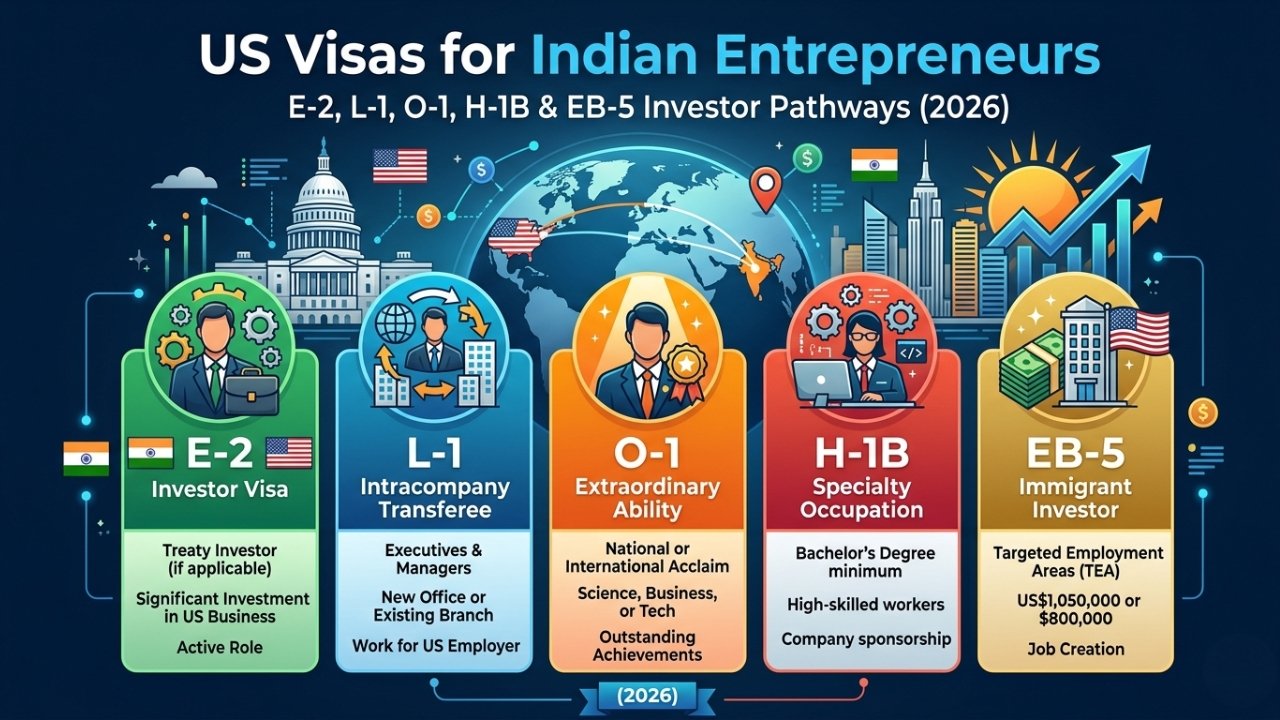
The E-2 Treaty Investor Visa the most Googled US visa guide Indian entrepreneurs is completely unavailable to Indian citizens. India has no E-2 treaty with the United States. If an immigration consultant is pitching you the E-2 without disclosing this, walk away. Read on to understand what actually works.
Why Indian Entrepreneurs Face a Unique Challenge {challenge}
Building a business in the United States is one of the most compelling goals for Indian startup founders, investors, and business owners. The US offers the world’s largest consumer market, a deep venture capital ecosystem, and unmatched access to global talent. But getting there legally and sustainably is harder for Indian nationals than for citizens of many other countries.
The core challenge is this: the most straightforward entrepreneur visa available in the US is treaty-based, and India simply doesn’t have the right treaties in place. This narrows the field considerably, forcing Indian entrepreneurs to rely on a smaller set of visa categories each with its own complexity, cost, and processing timeline.
This guide cuts through the noise. Whether you’re a startup founder looking to expand to Silicon Valley, a business owner with an existing Indian company, or a high-net-worth individual exploring investor immigration, this is your definitive breakdown of every viable US visa pathway in 2026.
The E-2 Visa: Why It’s Off the Table for Indians {e2}
What Is the E-2 Treaty Investor Visa?
The E-2 Treaty Investor Visa is a non-immigrant visa that allows nationals of certain countries to enter and work in the US based on a substantial investment in a US business. It’s highly popular among entrepreneurs from qualifying countries because it:
- Has no minimum investment threshold set in law (though USCIS typically looks for $100,000+)
- Can be renewed indefinitely in two-year increments
- Allows spouses to obtain open work authorization
- Doesn’t require a job offer you invest in and run your own business
It sounds perfect. And for citizens of over 80 treaty countries including the UK, Germany, Japan, South Korea, Canada, and Australia it largely is.
The Hard Truth: India Has No E-2 Treaty
Indian citizens are categorically ineligible for the E-2 visa. This is not a processing issue, a documentation problem, or something an immigration attorney can work around. India simply does not have a bilateral trade and commerce treaty with the United States that includes E-2 provisions.
This is the single most common misconception among Indian entrepreneurs researching US immigration. Multiple online forums, some unqualified consultants, and even certain immigration websites fail to clearly state this fact.
If you hold only Indian citizenship, you cannot apply for an E-2 visa. Full stop.
The Workaround (With Major Caveats)
Some Indian entrepreneurs obtain citizenship or long-term residency in an E-2 treaty country such as Grenada, Turkey, or Portugal specifically to become eligible. Grenada’s Citizenship by Investment program, for example, costs approximately $150,000 and takes 4–6 months, after which the applicant can apply for an E-2 as a Grenadian citizen.
This path exists, but it comes with significant cost, complexity, and scrutiny. US consular officers are aware of this strategy and apply heightened scrutiny to applicants whose only connection to an E-2 country is a recently acquired investment citizenship. It is not a path to pursue casually or without expert legal counsel.
Bottom line: Unless you already hold citizenship in an E-2 treaty country, this visa is not your starting point. Move on to the options that actually apply.
L-1 Intracompany Transfer Visa: The Most Practical Path {l1}
Why L-1 Is the #1 Choice for Indian Business Owners
If you own or operate an established company in India and want to expand to the United States, the L-1 intracompany transfer visa is your most direct and reliable option. It was designed precisely for this scenario: a multinational enterprise transferring a key employee (which can be the owner/founder) from an overseas office to a US office.
Two Types of L-1 Visas
L-1A Managers and Executives
The L-1A is for individuals who have worked in a managerial or executive capacity at the foreign company for at least one continuous year within the past three years. This category is highly valuable because L-1A holders are eligible to apply for an EB-1C green card one of the fastest employment-based green card pathways without needing a PERM labor certification.
Key eligibility criteria:
- You must have worked for the Indian entity for at least 1 year in the past 3 years
- The role must be genuinely managerial or executive (supervising staff or managing an essential function)
- The US entity must have a qualifying relationship with the Indian company (parent, subsidiary, branch, or affiliate)
L-1B Specialized Knowledge Workers
The L-1B applies to employees with specialized knowledge of the company’s products, services, research, equipment, techniques, or management. It’s less common for founders but relevant for technical co-founders or senior engineers.
Setting Up the US Company First
To use the L-1A or L-1B, you generally need a qualifying US entity. For entrepreneurs coming to establish a new US office, USCIS offers the New Office L-1 a one-year initial visa to set up the US operations, after which you can apply for a standard three-year extension once the business is operational.
The new office must have:
- Physical premises (a real office space, not just a registered address)
- A credible business plan demonstrating the viability of US operations
- Evidence that the Indian parent entity is functioning and profitable
Processing Times and Costs (2026)
| Route | Processing Time | Government Fee |
|---|---|---|
| Standard processing | 3–6 months | ~$1,385 |
| Premium processing | 15 business days | ~$2,805 additional |
Attorney fees typically range from $3,000 to $8,000 depending on complexity.
Who L-1A Is Best For
The L-1A is ideal if you:
- Already run a profitable Indian company (even a small one with a few employees)
- Want to establish or expand into the US market
- Are interested in eventually obtaining a green card through the EB-1C category
- Can credibly demonstrate a managerial or executive role
Critical note: USCIS scrutinizes L-1A petitions carefully, especially from small Indian companies where the founder wears many hats. Your petition must clearly establish that your role is managerial in nature not just a working-level employee who also happens to own shares. Document your organizational structure, the employees you supervise, and the strategic decisions you make.
O-1 Extraordinary Ability Visa: For Exceptional Founders {o1}
What Is the O-1 Visa?
The O-1A visa is for individuals with extraordinary ability in business, science, education, arts, or athletics. “Extraordinary ability” means you’re among the small percentage at the very top of your field. It sounds daunting, but for accomplished Indian entrepreneurs especially those with notable exits, investor recognition, media coverage, or academic achievements the O-1A is genuinely worth exploring.
The Eight Criteria (You Need to Meet At Least Three)
USCIS evaluates O-1A petitions against eight evidentiary criteria. You must satisfy at least three,
- Awards or prizes Receipt of nationally or internationally recognized prizes or awards for excellence
- Membership Membership in associations that require outstanding achievement as judged by recognized experts
- Press coverage Published material in professional or major trade publications or major media about your work
- Judging Participation as a judge of others’ work in the same field
- Original contributions Original scientific, scholarly, or business contributions of major significance
- Authorship Authorship of scholarly articles in professional journals or major media
- Critical employment Employment in a critical or essential capacity for distinguished organizations
- High salary or remuneration Commanding a high salary relative to others in the field
For Indian startup founders, criteria 1 (startup awards, accelerator recognitions like YC or Techstars), 3 (press coverage in TechCrunch, Business Standard, The Hindu BusinessLine), 4 (judging at hackathons, startup competitions), and 5 (verifiable business impact patents, significant user growth, IP) are the most commonly achievable.
O-1 vs. L-1: Which Should You Choose?
| Factor | O-1A | L-1A |
|---|---|---|
| Requires Indian company | No | Yes |
| Based on personal achievements | Yes | No |
| Green card pathway | EB-1A (self-petition possible) | EB-1C (employer-sponsored) |
| Renewal flexibility | Renewable in 1-year increments | 3-year extensions |
| Petition sponsor | Any US employer or agent | Must be the related company |
The O-1A is better suited for founders who don’t have an established Indian company but have a strong personal achievement record. It’s also more flexible because it doesn’t tie you to a single employer in the same way the L-1 does.
Building Your O-1 Case
The O-1A petition lives or dies on evidence. Before filing, work backwards from the eight criteria and audit your own record.
- Compile all press mentions (Indian and international)
- Gather letters from investors, co-founders, and industry leaders attesting to your contributions
- Document any awards, fellowship selections, or accelerator admissions
- Preserve evidence of judging roles, speaking invitations, and advisory board memberships
Many Indian entrepreneurs underestimate how competitive their profile is. If you’ve raised Series A or beyond from recognized VCs, been featured in top-tier press, or have meaningful patents, you likely have a stronger case than you think.
H-1B Specialty Occupation Visa: The Lottery Option {h1b}
What Is the H-1B?
The H-1B visa is the US’s primary work visa for skilled foreign nationals in “specialty occupations” fields requiring at least a bachelor’s degree or equivalent in a specific discipline. It is the most well-known US work visa and the most frustratingly limited one for Indian nationals specifically.
Why H-1B Is Problematic for Entrepreneurs
The H-1B has two fundamental issues for Indian startup founders.
Issue 1: The Lottery
USCIS receives far more H-1B petitions each year than the 85,000 annual cap (65,000 regular cap + 20,000 for US master’s degree holders). The result is a random lottery. In recent years, lottery selection rates for Indian applicants have hovered around 25–35%. You may file a perfectly complete petition and simply not be selected through no fault of your own.
Issue 2: Employer Control
The H-1B is employer-sponsored. You cannot self-petition. This means you need a US employer willing to sponsor you, pay the filing fees, and employ you in a qualifying specialty occupation role. As a founder, this creates a structural problem: you need a US entity to sponsor you, that entity needs to be your employer, and USCIS scrutinizes “self-employed H-1B” scenarios where the visa holder effectively controls the sponsoring company.
This doesn’t make H-1B impossible for entrepreneurs, but it requires careful structuring often with a board of directors or outside investors maintaining meaningful control over the US entity, with the founder as an employee of the company rather than its sole controller.
Who H-1B Makes Sense For
H-1B is most practical for Indian entrepreneurs who:
- Are joining an early-stage US startup as a co-founder or senior technical employee (and have a co-founder/entity to sponsor them)
- Already have US employer interest and are willing to pursue the lottery route
- Hold a US master’s degree (improving lottery odds slightly)
- Are planning H-1B as a bridge to another status (green card, O-1 upgrade)
H-1B Cap Exemptions
Certain employers are exempt from the H-1B cap entirely: universities, non-profits affiliated with universities, and government research organizations. If you’re founding a research-focused startup with academic ties, this may open an alternative route.
Processing and Timeline
The H-1B lottery registration opens in March each year, with selections announced in April. Approved petitions have an October 1 start date. Premium processing is available for approved petitions, bringing adjudication to 15 business days once selected.
Key point: Given the lottery and employer-control issues, H-1B should generally be a secondary or backup option for Indian entrepreneurs not a primary strategy.
EB-5 Immigrant Investor Program: The Direct Green Card Route {eb5}
What Is EB-5?
The EB-5 Immigrant Investor Program is the United States’ primary investor green card pathway. Unlike the visa categories above, EB-5 is an immigrant visa it leads directly to lawful permanent residence (a green card) for the investor and their immediate family members.
For Indian entrepreneurs who want not just the right to work in the US, but the right to live there permanently, EB-5 is the most direct route.
Investment Thresholds (2026)
Following the EB-5 Reform and Integrity Act of 2022, the investment requirements are.
| Investment Location | Minimum Amount |
|---|---|
| Targeted Employment Area (TEA) rural or high unemployment | $800,000 |
| Non-TEA (standard urban/suburban areas) | $1,050,000 |
A Targeted Employment Area is either a rural area or an area with unemployment at least 1.5 times the national average. Most EB-5 investment projects are structured in TEAs to allow the lower $800,000 threshold.
The Job Creation Requirement
EB-5 doesn’t just require an investment it requires that the investment create at least 10 full-time jobs for qualifying US workers (US citizens, green card holders, or other qualifying immigrants). This is verified during the petition process.
There are two investment models.
Direct Investment: You invest directly in a new commercial enterprise you create or control. You must directly hire 10+ employees. This model gives more control but requires active business management.
Regional Center Program: You invest through a USCIS-designated Regional Center a pooled investment vehicle that aggregates multiple EB-5 investors into larger development projects (hotels, commercial real estate, infrastructure). Job creation can be calculated using indirect/induced economic impact, making the 10-job threshold easier to satisfy. This is the more commonly used model.
Processing Reality for Indian Applicants
Here is where Indian nationals face their most significant structural disadvantage in US immigration: the EB-5 visa backlog for Indian nationals is severe.
Because of high demand from India and per-country visa caps, Indian EB-5 applicants currently face wait times that can exceed 5–10 years before their visa number becomes available even after their I-526E petition is approved. During this waiting period, investors typically maintain non-immigrant status in the US.
The EB-5 retrogression for India means that while the program is legally available, the practical timeline must be factored into any planning decision.
Who EB-5 Is Best For
EB-5 makes sense for Indian investors who.
- Have $800,000–$1,050,000+ available for a US investment
- Want a permanent green card pathway, not just a temporary work visa
- Can maintain another valid US status (L-1, H-1B, O-1) during the waiting period
- Are planning long-term US residence for themselves and their family (EB-5 covers spouse and children under 21)
Important: Always work with a licensed US securities attorney and an experienced EB-5 immigration attorney. Regional Center investments are securities offerings and carry real financial risk. Conduct thorough due diligence on any Regional Center project.
B-1/B-2 Business Visitor Visa: What You Can (and Cannot) Do {b1b2}
The B-1 Business Visitor Visa
The B-1 (or B-1/B-2 combination) is the standard business visitor visa. It allows you to travel to the US for a limited list of legitimate business activities without being “employed” in the US. It is not a work visa, and it cannot substitute for one.
Permitted activities on B-1:
- Attending business meetings, conferences, and negotiations
- Consulting with US business associates
- Conducting market research
- Participating in scientific, educational, or professional conventions
- Negotiating contracts
Not permitted on B-1
- Working for a US employer or being paid from US sources
- Starting or actively operating a US business
- Providing paid services to US clients
- Performing productive work that would otherwise require a work visa
The “Entrepreneur Trap”
Many Indian founders make the mistake of entering the US on a B-1/B-2 visa and then proceeding to effectively run their US operations conducting sales calls, hiring employees, signing contracts on behalf of a US entity, and taking on a functional day-to-day role. This constitutes unauthorized work and can result in visa revocation, a bar on future US visa applications, and in serious cases, inadmissibility findings.
The B-1/B-2 is a useful tool for exploration: attending Demo Day at a US accelerator, meeting potential investors or partners, or exploring the market before you apply for a proper work visa. It is not a path to operating a US business.
Comparison Table: All Visa Pathways at a Glance {#comparison}
| Visa Category | Indian Eligible? | Self-Petition? | Green Card Path | Approx. Timeline |
|---|
| E-2 | ❌ No | Yes (E-2 treaty required) | Not directly | N/A |
| L-1A | ✅ Yes | Via related entity | EB-1C | 3–6 months |
| L-1B | ✅ Yes | Via related entity | EB-2/3 with PERM | 3–6 months |
| O-1A | ✅ Yes | Via agent/employer | EB-1A | 2–4 months |
| H-1B | ✅ Yes | Yes (lottery) | EB-2/3 | Lottery: April; Start: Oct |
| EB-5 | ✅ Yes (backlog) | Yes | Direct green card | 5–10+ years (India backlog) |
| B-1/B-2 | ✅ Yes | N/A | None | 1–3 months |
Which Visa Is Right for Your Situation? {#which}
Scenario A: You run an established Indian company and want to expand to the US
Best option: L-1A (New Office)
Set up a US subsidiary or branch of your Indian company, document your managerial role thoroughly, and file an L-1A petition. Once in the US, operate the business for a year, then extend the L-1A and begin building toward an EB-1C green card.
Scenario B: You’re a serial entrepreneur with significant press, awards, and investor recognition
Best option: O-1A
Audit your achievements against the eight O-1A criteria. If you can meet three, engage an immigration attorney with a strong O-1A track record for a case assessment. O-1A offers flexibility, no employer control issues, and a credible path to the EB-1A self-petition green card.
Scenario C: You have $800K+ to invest and want permanent US residency
Best option: EB-5 (with current non-immigrant bridge status)
File an EB-5 petition through a vetted Regional Center while maintaining L-1A or O-1A status. The EB-5 wait time for Indians is long, but the clock starts from filing begin as early as possible.
Scenario D: You’ve received a technical co-founder or senior executive offer from a US startup
Best option: H-1B (if the employer agrees) or O-1A
If the employer is willing to sponsor, H-1B is viable but subject to the lottery. Alternatively, if your profile supports it, O-1A avoids the lottery entirely and is often preferable for high-achieving individuals.
Scenario E: You want to explore the US market before committing
Best option: B-1/B-2 for market research, then pivot to L-1A or O-1A
Use B-1/B-2 for initial market exploration, investor meetings, and scoping. Do not work. Once you have clarity on your US strategy, apply for the appropriate non-immigrant work visa.
Frequently Asked Questions {faqs}
Can an Indian citizen apply for an E-2 visa if they invest in a US business?
No. The E-2 visa requires you to be a national of a country that has a qualifying treaty of commerce and navigation with the United States. India does not have such a treaty. Investment amount is irrelevant Indian nationals are categorically ineligible.
What is the minimum investment for an L-1A visa?
There is no statutory minimum investment amount for the L-1A. What matters is that the related Indian entity is real and operating, and the US entity has or will have sufficient premises, staff, and business activity to qualify as a genuine office. Practically, most successful L-1A new office petitions involve a meaningful level of capitalization (often $50,000+) to demonstrate serious business intent.
Can I get a green card through my US business as an Indian national?
Yes, through several pathways: EB-1C (for L-1A holders in managerial/executive roles), EB-1A (for O-1A holders with extraordinary ability), EB-5 (investor), or employment-based EB-2/EB-3 (with PERM labor certification). Each has different timelines, with India-specific backlogs making some pathways significantly slower than others.
Is it possible to work on a B-1 visa in the US?
No. The B-1 visa strictly prohibits productive work for a US employer or receiving payment from US sources. Violating this condition is unauthorized work, which carries serious immigration consequences including potential inadmissibility for future US visa applications.
How long can I stay in the US on an L-1A visa?
New office L-1A petitions are initially approved for one year. Established office L-1A petitions are approved for three years, with extensions possible up to a maximum total stay of seven years for managers/executives.
Do I need a US job offer for the O-1A visa?
You need either a US employer or a US-based agent to file the O-1A petition on your behalf. As a founder, your own US company (if it has other shareholders or a board) can serve as the petitioner. An agent arrangement is also possible if you plan to work for multiple clients or in a self-employed capacity.
What happens to my L-1A visa if my Indian company shuts down?
Your L-1A status is contingent on the qualifying relationship between the Indian and US entities. If the Indian parent ceases operations, the legal basis for the L-1A is eliminated. You would need to transition to another visa status such as O-1A or H-1B before or shortly after that occurs.
Final Thoughts
The US visa landscape for Indian entrepreneurs is genuinely complex but it is not impossible. The most important first step is abandoning the search for an E-2 workaround and focusing energy on the pathways that actually apply: the L-1A for business owners with Indian operations, the O-1A for founders with strong personal achievement records, EB-5 for those with significant capital and a long-term horizon, and H-1B as a secondary option.
Each of these pathways requires careful preparation, strong documentation, and without exception qualified immigration legal counsel. US immigration law is not an area for DIY approaches or unverified online advice.
If you’re a serious Indian entrepreneur planning a US move, start with an honest audit of your situation: Do you have an Indian company? What does your achievement record look like? What is your investment capacity? The answers to those three questions will point you to the right visa category more reliably than any generic guide.