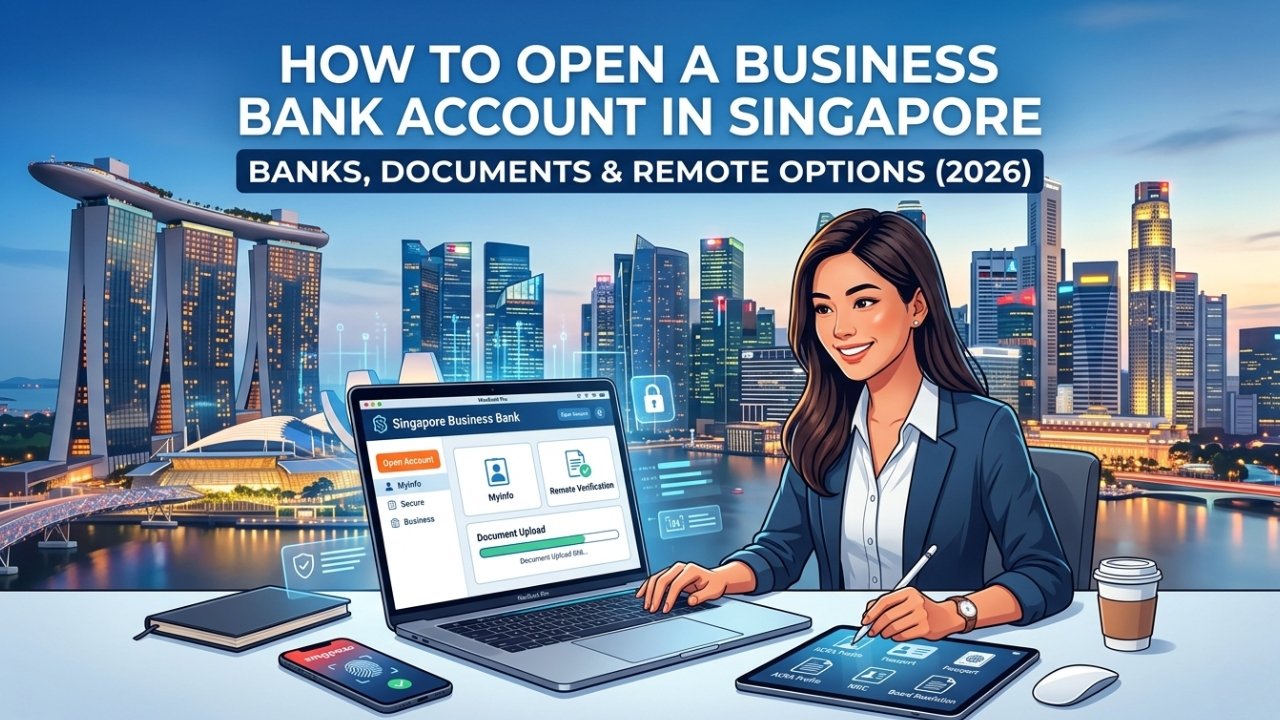
Opening a business Bank Account Singapore is the next step after incorporating your company and often the most frustrating one. Unlike company registration (which is now largely digital and fast), corporate banking in Singapore involves strict compliance checks, in-person requirements, and due diligence processes that can catch first-time foreign founders off guard.
In short: a Singapore business bank account is a dedicated corporate account held in your company’s name, required to receive payments, pay salaries, manage GST, and operate legally. Without it, your Singapore company exists on paper but cannot function commercially.
This guide is specifically written for Indian founders, entrepreneurs, and business owners who have incorporated or are planning to incorporate a Singapore private limited company and need a practical, current overview of the banking landscape.
Which Banks Are Best for Indian-Owned Companies in Singapore?
There is no single “best” bank the right choice depends on your business model, transaction volume, whether you operate remotely, and how urgently you need the account open. Here is a practical comparison of the most commonly used banks by foreign-owned SMEs.
| Bank | Type | Account Opening | Remote Option | Monthly Fee | Best For |
|---|---|---|---|---|---|
| DBS Bank | Local (largest) | In-person or digital (DBS IDEAL) | Limited | SGD 0–35 | Established businesses, MNC subsidiaries |
| OCBC Bank | Local | In-person | No | SGD 0–38 | SMEs, startups with local directors |
| UOB Bank | Local | In-person | No | SGD 0–40 | Trading and manufacturing companies |
| Aspire | Digital / Neobank | Fully online | Yes | Free–SGD 0 | Startups, e-commerce, remote-first companies |
| Airwallex | Digital / Fintech | Fully online | Yes | Free | Multi-currency businesses, India-Singapore trade |
| Wise Business | Digital | Fully online | Yes | Low flat fee | Freelancers, consultants, cross-border payments |
| HSBC Singapore | International | In-person + docs | Partial | SGD 40+ | Companies with global banking needs |
Key insight for Indian founders: Traditional Singapore banks (DBS, OCBC, UOB) require at least one director or authorized signatory to appear in person at a Singapore branch. If all directors are based in India, this becomes a significant bottleneck. Digital banking alternatives like Aspire and Airwallex have changed this dynamic considerably more on that below.
Documents Required for a Corporate Bank Account in Singapore
Regardless of which bank you choose, you will need a standard set of incorporation and KYC (Know Your Customer) documents. Prepare these in advance to avoid delays.
Company Documents
- Certificate of Incorporation issued by ACRA (Accounting and Corporate Regulatory Authority)
- Business Profile from ACRA (Bizfile extract, dated within 3 months)
- Memorandum & Articles of Association (M&AA) or Constitution
- Company Resolution authorizing the opening of the bank account and naming authorized signatories
- Register of Directors and Register of Shareholders
- Ownership structure chart (especially important if there are corporate shareholders)
Director and Shareholder Documents (for each individual)
- Valid passport (for foreigners) or NRIC (for Singaporean residents)
- Proof of residential address utility bill, bank statement, or government-issued document (less than 3 months old)
- Source of funds declaration some banks require this, especially if the initial capital or shareholder funds originate from India
- Professional background / CV for directors (requested by some banks during compliance review)
Business Activity Documents
- Business plan or company profile explaining what the company does
- Contracts, invoices, or LOIs with customers or suppliers (especially for trading companies)
- Website URL (banks routinely check this during due diligence)
- Expected monthly transaction volumes and currencies
Tip for Indian shareholders: If your company is owned by an Indian individual or Indian corporate entity (more than 25% shareholding), banks will typically apply enhanced due diligence. Be prepared to explain the source of investment funds and your business rationale for operating out of Singapore.
Can I Open a Singapore Business Bank Account Remotely from India?
This is the most common question from Indian founders and the answer is: it depends entirely on which bank you choose.
Traditional Banks: In-Person Required
DBS, OCBC, and UOB all formally require at least one director or authorized signatory to be physically present at a Singapore branch. There is no workaround through power of attorney or video calls for standard account opening with these banks. If you plan to use a traditional bank, you or a co-founder must visit Singapore even a short trip of 1–2 days can be used to complete the process.
Digital Banks and Fintech Alternatives: Fully Remote
Several banks and financial platforms now offer fully remote corporate account opening that is legally equivalent to a traditional bank account for most business purposes.
- Aspire Accepts Singapore-incorporated companies with foreign directors entirely online. Application takes 1–3 business days. Comes with a Singapore virtual IBAN, debit card, and multi-currency support.
- Airwallex Excellent for companies with India-Singapore payment flows. Supports INR, SGD, USD, and 10+ other currencies. No monthly fees, remote onboarding.
- Wise Business Transparent fees, strong multi-currency account, ideal for service businesses billing international clients.
Important Caveat
Digital bank accounts from fintechs are not always accepted by all Singapore government agencies, CPF Board, or IRAS (tax authority) for certain filings. If you anticipate needing a traditional bank account in the future (e.g., to apply for government grants, SME loans, or MAS-regulated activities), it is worth opening a digital account immediately for operations while planning a Singapore visit to open a DBS or OCBC account in parallel
Common Challenges in Opening a Business Bank Account in Singapore
Foreign founders consistently encounter the same set of obstacles. Here is an honest breakdown and how to address each one.
Beneficial Owner” Scrutiny for Indian Nationals
Banks are required under MAS (Monetary Authority of Singapore) guidelines to conduct thorough checks on ultimate beneficial owners (UBOs). Indian passport holders are sometimes subject to longer processing times due to FATF compliance frameworks. This is not discriminatory it is standard for high-transaction jurisdictions. Solution: Prepare a clean, documented source-of-funds trail and a well-articulated business profile before approaching the bank.
Nominee Director Complications
Many Indian founders appoint a nominee resident director (as required by law) but are the sole beneficial owners. Banks scrutinize this arrangement carefully. Solution: Be fully transparent about the nominee arrangement. Prepare a nominee director agreement and a UBO declaration. Do not attempt to obscure the actual ownership structure.
Vague Business Activity
Banks reject or delay accounts for companies with unclear business descriptions. “Trading” or “consulting” alone is insufficient. Solution: Define your business specifically “export of pharmaceutical raw materials to Southeast Asia” or “IT services to German automotive clients” and back it with contracts or LOIs.
New Companies With No Transaction History
Freshly incorporated companies with zero revenue and no existing banking relationship are considered higher risk. Solution: Start with a digital bank (Aspire or Airwallex) to build a short transaction history, then approach DBS or OCBC 3–6 months later with statements to show.
Rejected Applications Without Clear Reason
Banks are not legally required to explain why they rejected a corporate account application. This is common and frustrating. Solution: If rejected, wait 30 days and apply to a different bank. Alternatively, work with a corporate services provider who has existing relationships with relationship managers at major banks.
Indian Banks Operating in Singapore
If you prefer banking with an institution you already know from India, several major Indian banks have Singapore branches that offer corporate banking services.
| Bank | Singapore Branch | Corporate Banking | Notes |
|---|---|---|---|
| State Bank of India (SBI) | Yes — Cecil Street | Yes | Preferred by Indian trading companies, INR remittance support |
| Bank of India (BOI) | Yes — Shenton Way | Yes | Smaller operation, known to Indian community |
| Bank of Baroda | Yes | Yes | Focus on trade finance |
| ICICI Bank | Yes | Yes | Good for India-Singapore corridors |
| Axis Bank | Representative office only | Limited | Not a full branch |
Practical consideration: Indian bank branches in Singapore do offer a degree of familiarity and language comfort, and they understand India-Singapore business flows well. However, they are not always the first choice for tech startups or e-commerce companies, as their digital banking infrastructure is less developed compared to DBS or digital-native options. They work very well for trading companies, import-export businesses, and businesses with frequent large INR-SGD transfers.
Timeline & What to Expect
Understanding the realistic timeline helps you plan your incorporation and banking strategy correctly.
| Stage | Typical Duration | Notes |
|---|---|---|
| Company incorporation via ACRA | 1–3 business days | Faster if all documents are ready |
| Gather banking documents | 3–7 days | Especially if documents need notarization or apostille |
| Digital bank (Aspire, Airwallex) application | 1–5 business days | Fully remote |
| Traditional bank (DBS, OCBC, UOB) — application submission | 1 day (in-person visit) | Requires Singapore trip |
| Traditional bank — compliance review and approval | 2–6 weeks | Can be longer if enhanced due diligence is triggered |
| Account operational (first debit card, internet banking) | 1–3 days after approval |
Total realistic timeline for remote founders: If using a digital bank, you can be operational within 1–2 weeks of incorporation. If you require a traditional bank, factor in 4–8 weeks minimum from the date of incorporation.
Frequently Asked Questions
Do I need a physical address in Singapore to open a business bank account?
Yes. Your Singapore company must have a registered address in Singapore (not a PO Box). This is fulfilled during company incorporation through a registered agent or corporate secretarial firm. Banks will verify this address.
Can I use my Singapore company without a bank account?
Technically yes for a short period, but it is not practical. You cannot receive payments, pay expenses, or file taxes properly without an operational corporate account.
Is a minimum deposit required to open a Singapore corporate account?
It varies by bank. DBS and OCBC typically require an initial deposit of SGD 1,000–3,000 and may have minimum average daily balance requirements to waive monthly fees. Digital banks like Aspire generally have no minimum deposit.
Can a 100% foreign-owned Singapore company open a bank account?
Yes. Singapore law permits 100% foreign ownership of private limited companies, and banks can open accounts for such companies. However, the compliance review will be more detailed, and in-person presence (for traditional banks) is typically required.
What if my Singapore company has only Indian directors and no local director?
You are legally required to have at least one ordinarily resident director in Singapore. This is usually fulfilled by appointing a nominee resident director through a corporate services provider. You can still open a bank account, but you must disclose this arrangement clearly.
Are digital bank accounts (Aspire, Airwallex) accepted by Singapore’s IRAS for tax purposes?
Yes for most tax filing and payment purposes, these accounts work fine. IRAS accepts bank transfers from digital banks. However, some government grant applications and MAS-regulated payment schemes may prefer accounts with licensed banks under the Banking Act.
How long does DBS take to approve a corporate account?
DBS is generally the most rigorous of the three local banks. Allow 3–6 weeks for a newly incorporated foreign-owned company. The compliance team may contact you for additional documents during this period.
Can a corporate services provider open the bank account on my behalf?
No a corporate services provider cannot sign on your behalf or submit a bank application as your proxy. However, they can prepare your document package, make introductions to bank relationship managers, and accompany you during the in-person visit.