
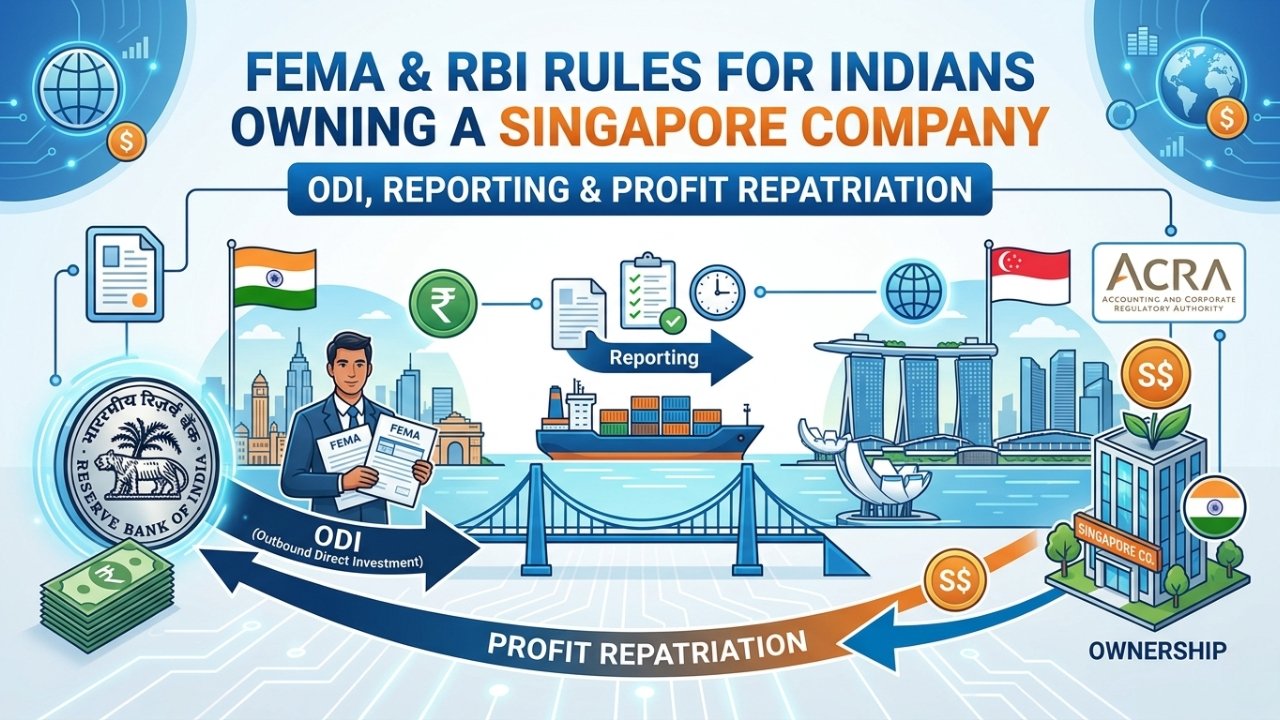
Singapore FEMA ODI (Overseas Direct Investment) is the regulatory framework under the Foreign Exchange Management Act, 1999, that governs how Indian residents and companies can invest in, own, or operate foreign businesses including a Singapore private limited company. Understanding this framework is not optional. Ignoring it exposes you to penalties of up to three times the amount involved, compounding daily.
The good news: owning a Singapore company as an Indian resident is completely legal provided you follow the right steps. This guide covers everything: Form ODI filing, the 400% net worth cap, annual reporting, profit repatriation, the India-Singapore DTAA, and what happens if you don’t comply.
Can an Indian Resident Legally Own a Singapore Company?
Yes an Indian resident can legally own and operate a Singapore company. There is no blanket prohibition under FEMA. However, the investment must be made through the Overseas Direct Investment (ODI) route under FEMA’s Overseas Investment Rules, 2022 (which replaced the older OI Rules effective August 22, 2022).
The key conditions are.
- The Indian investor must be a “person resident in India” as defined under Section 2(v) of FEMA.
- The investment must be reported to the Reserve Bank of India (RBI) through an Authorised Dealer (AD) bank before or immediately after the investment.
- The Singapore entity must be a legitimate operating company not a shell or entity engaged purely in real estate or financial products without RBI approval.
- The total ODI must not exceed the prescribed limit (discussed in the 400% net worth section below).
- The investor must have a clean track record no FEMA violations, no CBI/ED cases
Who can invest?
- Indian individuals (resident individuals)
- Indian companies (proprietary, partnership, LLP, or incorporated companies)
- Registered partnerships
One important note for startups and freelancers: If you are a resident individual investing personal funds into a Singapore company (for example, as a co-founder or sole owner), this is classified as an individual ODI and has its own limit: USD 250,000 per financial year under the Liberalised Remittance Scheme (LRS), unless a higher limit is approved by RBI.
For Indian companies investing in a Singapore subsidiary, the ODI limit is tied to net worth the 400% rule explained below.
Form ODI: Step-by-Step Filing Guide
Before sending any money abroad to fund your Singapore company, you must file Form ODI through your Authorised Dealer (AD) bank typically a scheduled commercial bank like HDFC, ICICI, SBI, or Kotak.
Prepare your documents
You will need.
- Board resolution or personal declaration approving the overseas investment
- Certificate of Incorporation of the Singapore company (from ACRA)
- Memorandum & Articles of Association of the Singapore entity
- Valuation report (if investing in shares of an existing company)
- Audited financial statements of the Indian entity (last 3 years, for corporate investors)
- Details of the proposed investment: amount, percentage stake, purpose
Submit Form ODI Part I to your AD Bank
Part I covers the initial investment details. Your AD bank reviews this, verifies KYC, and forwards it to RBI if the investment requires prior approval (most routine ODIs are under the automatic route).
Automatic Route: Most investments in Singapore (a FATF-compliant, non-grey-listed jurisdiction) qualify automatically no prior RBI permission needed. Your AD bank processes the remittance directly.
Approval Route: Required for investments in financial services, where the Indian entity is in losses, or where the investment exceeds the 400% cap.
Remit funds through your AD Bank
Once Form ODI Part I is acknowledged, funds are remitted via SWIFT. Retain all remittance receipts (A2 form or FIRC Foreign Inward Remittance Certificate on return).
File Form ODI – Part II within 30 days
After completing the investment (shares allotted, capital contribution made), file Part II with your AD bank, attaching the share certificate or proof of shareholding from Singapore.
Submit Annual Performance Report (APR) every year
This is ongoing discussed in the annual reporting section below.
The 400% Net Worth Limit Explained
For Indian companies making ODI, FEMA caps the total overseas investment at 400% of the net worth of the Indian entity as per the last audited balance sheet.
What counts as “net worth”?
Net worth = Paid-up capital + Free reserves (excluding revaluation reserves)
Calculation Example
Component | Amount |
Paid-up share capital | ₹50,00,000 |
General reserves | ₹30,00,000 |
Security premium | ₹20,00,000 |
Revaluation reserve (excluded) | ₹15,00,000 |
Net Worth | ₹1,00,00,000 |
Maximum ODI permitted (400%) | ₹4,00,00,000 |
In this example, the Indian company can invest up to ₹4 crore (approximately USD ~480,000 at current rates) across all foreign entities combined.
Important nuances.
- The 400% cap applies to the aggregate of all ODI not per country or per entity.
- If your Indian entity has existing ODIs in other countries, those reduce available headroom.
- Guarantees issued by the Indian entity on behalf of a foreign entity also count toward the limit.
- The cap is recalculated each year based on the latest audited financials so as your Indian company grows, your ODI capacity grows.
For resident individuals, the limit is USD 250,000 per financial year under LRS this is a remittance cap, not a net worth multiple. All overseas investments, education remittances, travel, and other LRS transactions count toward this USD 250,000 ceiling.
Annual Reporting: APR & FLA Returns
Owning a Singapore company is not a one-time compliance event. You must file two key annual reports.
Annual Performance Report (APR) Form ODI Part III
Who files: Every Indian entity or individual that has made ODI.
When: By December 31 each year, for the preceding financial year (January–December of the Singapore entity’s year).
How to file: Through your AD bank, who forwards to RBI.
What it covers.
- Financial statements of the Singapore entity
- Details of dividends received, profits earned, further investments made
- Compliance certification by a Chartered Accountant
Penalty for non-filing: RBI can block further ODI until APRs are filed. FEMA compounding proceedings can follow.
Foreign Liabilities and Assets (FLA) Return
Who files: Any Indian company that has received FDI or made ODI (including in Singapore).
When: By July 15 each year, for the preceding financial year ending March 31.
How to file: Directly on the RBI’s FLAIR portal no AD bank needed.
What it covers:
- Total ODI made during the year
- Outstanding foreign assets and liabilities
- Dividends and interest received from overseas entities
Penalty for non-filing: Late filing attracts a penalty of ₹10,000 + ₹2,000 per day of delay after the first July 15.
Pro tip: Many Indian business owners who incorporated Singapore companies through agents miss the FLA return because their CA assumes it’s only for FDI-receiving companies. Both FDI and ODI trigger FLA filing obligations.
How to Repatriate Profits to India from Singapore
One of the most common questions from Indian owners of Singapore companies is: “How do I bring the money back?” The process is legally straightforward but must be done correctly.
Dividends
The most common and cleanest method. Your Singapore company declares a dividend to shareholders (you). Singapore has zero dividend withholding tax the full dividend amount reaches you without deduction.
In India: The dividend is taxable in your hands as “Income from Other Sources” at your applicable slab rate. You can claim a Foreign Tax Credit (FTC) under Section 90 of the Income Tax Act if any tax was paid in Singapore (though for dividends, Singapore typically charges none, so FTC may be nil).
Process: Singapore dividends hit your Indian bank account via SWIFT. Declare it in your Indian ITR in the year of receipt.
Salary / Director’s Remuneration
If you are a director or employee of your Singapore company, you can pay yourself a market-rate salary. This is deductible as an expense in Singapore and taxed as salary income in India (with potential credit for Singapore taxes paid).
Important: RBI’s ODI rules require that any salary paid to Indian residents from the Singapore entity must be commercially justifiable not a disguised profit repatriation that bypasses dividend tax.
Royalties or Service Fees
Your Indian entity can provide services to the Singapore company (IT services, consulting, IP licensing) and receive arm’s-length payments. This is a legitimate business-to-business transaction and does not require ODI filings it falls under current account transactions.
Watch out for: Transfer pricing rules apply. Both India and Singapore require inter-company transactions to be at arm’s length, documented with a Transfer Pricing study.
Winding Up / Return of Capital
If the Singapore company is wound up or you sell your stake, the proceeds must be repatriated to India within 90 days of receipt and reported through your AD bank. Failure to repatriate within this window is a FEMA violation.
India-Singapore DTAA & Foreign Tax Credit (Section 90)
India and Singapore have a comprehensive Double Taxation Avoidance Agreement (DTAA), most recently revised and updated. This is one of the most favorable tax treaties India has with any country.
Key benefits of the India-Singapore DTAA.
Capital Gains: As of April 1, 2017, capital gains on shares are taxable in the country of residence of the seller not the source country. So if an Indian resident sells shares of a Singapore company, the gains are taxed in India (not Singapore).
Business Profits: Singapore-sourced business profits of a Singapore company are taxable only in Singapore unless the company has a Permanent Establishment (PE) in India. Running your Singapore company from India without a proper setup can accidentally trigger PE status.
Dividends: Dividends from Singapore to India are taxed at a maximum of 15% in Singapore if paid to a company holding at least 25% of shares; 25% otherwise. However, Singapore in practice charges zero withholding on dividends in most cases.
Interest and Royalties: Covered under Articles 11 and 12 of the DTAA with capped withholding rates.
Claiming Foreign Tax Credit under Section 90
If any tax is paid in Singapore on income that is also taxable in India, you can claim a Foreign Tax Credit (FTC) in India:
- File Form 67 before filing your Indian ITR
- Attach proof of taxes paid in Singapore (tax assessment notice or payment receipt)
- The FTC is limited to the lower of Indian tax on that income or foreign tax paid
Important: Form 67 must be filed before the ITR due date courts have held that late Form 67 disentitles the FTC claim.
Do I Need to Disclose My Singapore Company in India?
Yes absolutely. Non-disclosure is one of the most serious FEMA violations and can also attract Black Money Act proceedings.
Disclosure Obligations.
- In your Income Tax Return (ITR).
Schedule FA (Foreign Assets) must be filled in your ITR if you are an Indian tax resident. You must disclose:
- Name and address of the Singapore company
- Date of acquisition
- Initial investment amount
- Peak balance / value during the year
- Income derived
This applies whether or not you earned any income from the Singapore company during the year.
- Under FEMA via APR.
As covered above, you must file annual APRs through your AD bank.
- Under the Black Money (Undisclosed Foreign Income and Assets) and Imposition of Tax Act, 2015.
Failure to disclose a foreign company in your ITR (Schedule FA) can attract prosecution under the Black Money Act with penalties of up to ₹10 lakh per year of non-disclosure and tax at flat 30% on the undisclosed asset value, plus a penalty equal to 3x the tax.
How to disclose.
- File ITR-2 or ITR-3 (not ITR-1) as these have Schedule FA
- Ensure your CA is aware of the Singapore entity before finalizing returns
- Maintain all documents: incorporation certificate, shareholding records, bank statements of the Singapore entity
Penalties for FEMA Non-Compliance
FEMA penalties are civil in nature (unlike FERA, its predecessor, which had criminal penalties). However, they are significant and should not be underestimated.
Civil Penalties under FEMA Section 13.
Violation | Penalty |
Making ODI without reporting | Up to 3x the amount involved |
Delay in filing APR | ₹10,000 + compounding per day |
Failure to repatriate proceeds within 90 days | Up to 3x the amount not repatriated |
Non-disclosure of foreign assets in ITR | Penalties under Black Money Act (up to 3x tax) |
Failure to file FLA return | ₹10,000 + ₹2,000/day |
Compounding of Offences
Minor FEMA violations can be compounded (settled) with the RBI’s Compounding Authority you pay a compounding fee and receive closure. Compounding is available only for violations that are not willful and do not involve national security concerns.
Process: Apply to RBI with full disclosure of the violation, payment of compounding fee, and undertaking for future compliance.
Key point: RBI has been increasingly strict since 2020. Many Indian entrepreneurs who set up Singapore companies through agents, without proper FEMA reporting, have received show-cause notices. Regularizing early through compounding is far preferable to facing adjudication.
Frequently Asked Questions
Can an NRI (Non-Resident Indian) own a Singapore company without ODI compliance?
An NRI (person resident outside India as per FEMA) is generally not subject to ODI rules those apply to persons resident in India. However, if you are an NRI who returns to India and becomes a resident, your previously-held Singapore company must be reported within the timelines specified under FEMA. Consult a FEMA specialist before your residential status change takes effect.
I already have a Singapore company and never filed Form ODI. What should I do?
You are in violation of FEMA reporting requirements. The recommended path is voluntary compounding approach your AD bank, disclose the investment, file belated Form ODI, and apply to RBI for compounding of the reporting delay. Acting proactively results in significantly lower penalties than being caught.
Does FEMA apply to a Singapore company where I am just a director but not a shareholder?
ODI rules apply to investments equity, debt, guarantees. Being a director without equity does not trigger ODI compliance by itself. However, if you receive director’s fees from the Singapore entity, those must be declared in your Indian ITR.
Can my Singapore company hold shares in an Indian company (reverse investment)?
Yes this is called a “round-tripping” structure and it is heavily scrutinized by RBI and the Income Tax Department. It is not prohibited outright, but you must demonstrate genuine commercial substance in the Singapore entity. Structures that exist purely to channel funds back to India disguised as FDI attract FEMA and anti-avoidance provisions.
Is there a minimum investment requirement for ODI?
No there is no minimum. Even a $1 equity investment in a Singapore company triggers the ODI reporting requirement. The investment amount only becomes relevant for computing penalties and checking the 400% net worth cap.
How does GST apply if my Singapore company pays my Indian entity for services?
Services exported from India to a foreign entity qualify as zero-rated exports under GST no GST is charged, and the Indian entity can claim a refund of input tax credits. Ensure your invoice meets the LUT (Letter of Undertaking) requirements under GST for export of services.
Do I need to pay advance tax in India on Singapore company income?
Yes. If your total Indian tax liability (including income from the Singapore company) exceeds ₹10,000 in a year, you must pay advance tax in installments June 15, September 15, December 15, and March 15. Failure to pay advance tax results in interest under Sections 234B and 234C.
Can my Singapore company pay for my personal expenses and offset it against tax?
No. Personal expenses of a shareholder are not deductible business expenses under IRAS (Singapore’s tax authority) rules or Indian tax rules. Additionally, if your Singapore company pays for your personal costs without accounting for them as a deemed dividend or benefit-in-kind, it creates compliance issues in both jurisdictions.
What happens if I close my Singapore company? Do I still need to file returns in India?
Yes. When your Singapore company is wound up, the proceeds must be repatriated within 90 days and reported through your AD bank via Form ODI. You must also file a final APR for the year of winding up. After closure, your Schedule FA disclosure obligation ends, but retain all records for at least 10 years.
I’m a salaried employee in India but also have 10% equity in a Singapore startup. Does FEMA apply?
Yes even a minority equity stake (any amount) triggers ODI reporting as a resident individual. You must report the investment under LRS (if it was funded from India) or as a sweat equity/ESOP acquisition (different FEMA provisions apply). Many employees in global startups overlook this because the shares were granted, not purchased but FEMA covers deemed investments too.