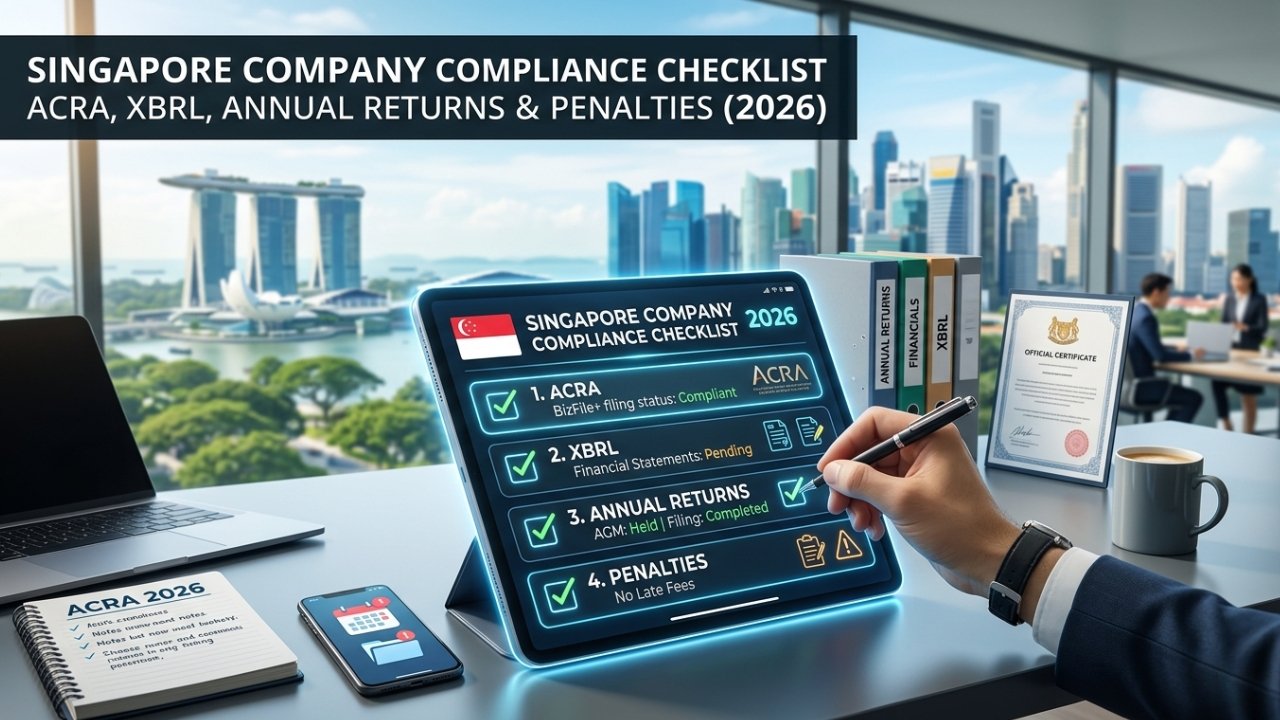
Running a Singapore company comes with a set of ongoing legal obligations that every director and business owner must understand. Singapore’s regulatory framework is transparent and well-structured but missing a deadline or misunderstanding a requirement can result in financial penalties, director disqualification, or even company strike-off.
This guide breaks down every annual compliance requirement for Singapore companies in 2026: what you must file, when you must file it, who is responsible, and what happens if you don’t. Whether you’re a foreign entrepreneur managing a Singapore subsidiary or a local founder scaling your business, this checklist will keep you on the right side of ACRA.
What Is ACRA Filing in Singapore?
ACRA stands for the Accounting and Corporate Regulatory Authority Singapore’s national regulator for businesses, public accountants, and corporate service providers. Every company incorporated in Singapore is legally required to file various documents with ACRA on a regular basis.
ACRA filing is not a single event. It is an umbrella term for several distinct obligations.
- Annual Return (AR) filing
- XBRL financial data submission
- Changes to company particulars (directors, shareholders, registered address)
- Notification of share allotments or transfers
Failure to meet any of these obligations constitutes a breach of the Companies Act (Cap. 50), which can trigger financial penalties for both the company and its directors personally
Annual Return Filing with ACRA Deadlines & Process
The Annual Return (AR) is a statutory document that every Singapore-incorporated company must file with ACRA each year. It confirms that your company’s information on record directors, shareholders, registered address, share capital is accurate and up to date.
Key Deadlines
| Company Type | AGM Requirement | Annual Return Deadline |
|---|---|---|
| Private company (exempt from AGM) | No AGM required | Within 7 months of financial year-end |
| Private company (non-exempt) | Must hold AGM | Within 7 months of financial year-end |
| Public company | Must hold AGM | Within 7 months of financial year-end |
Important: Since 2018, most private companies in Singapore are exempt from holding an Annual General Meeting (AGM) if they send financial statements to shareholders within 5 months of their financial year-end.
What the Annual Return Includes
- Company name, registration number, and registered address
- Business activity (SSIC code)
- Details of all directors and company secretary
- Shareholder register (names, nationalities, shareholding percentages)
- Paid-up capital
- Date of last AGM (if applicable)
- Reference to financial statements
Annual Returns are filed via BizFile+, ACRA’s online portal. The filing fee is SGD 60 for companies with share capital (source: ACRA fees).
XBRL Filing Requirements
XBRL (eXtensible Business Reporting Language) is a standardised digital format for financial reporting. ACRA requires certain Singapore companies to file their financial statements in XBRL format alongside their Annual Return.
Who Must File XBRL?
| Company Type | XBRL Requirement |
|---|---|
| Singapore-incorporated companies (non-exempt, non-listed) | Full XBRL or Simplified XBRL |
| Listed companies on SGX | Full XBRL (Inline XBRL format) |
| Exempt private companies (EPC) with revenue ≤ SGD 5M | Simplified XBRL (from FY2022 onwards) |
| Foreign companies | Not required (file financial statements in PDF) |
| Solvent exempt private companies filing PDF financials | Partial XBRL (financial data highlights only) |
Full XBRL vs. Simplified XBRL
- Full XBRL: Required for non-listed companies with revenue above SGD 500K. Covers the complete primary statements balance sheet, P&L, and notes.
- Simplified XBRL: Applies to smaller exempt private companies. A reduced data set covering key financial highlights only.
XBRL filing is done through the ACRA BizFile+ portal using ACRA’s Preparation Tool or approved third-party software. Most companies outsource this to their corporate service provider or auditor, as XBRL tagging requires technical accounting knowledge.
Corporate Secretary Obligation
Every Singapore company must appoint a corporate secretary within 6 months of incorporation and maintain that appointment at all times. This is a non-negotiable statutory requirement under the Companies Act.
Who Can Be a Corporate Secretary?
- Must be a natural person (not a corporate entity)
- Must be ordinarily resident in Singapore (Singapore citizen, Permanent Resident, or EntrePass/Employment Pass holder)
- Must not be the sole director of the company (the secretary and sole director cannot be the same person)
- For listed companies, the secretary must meet additional professional qualifications
What Does a Corporate Secretary Do?
The corporate secretary is responsible for ensuring your company meets all statutory obligations, including.
- Filing Annual Returns and changes to company particulars with ACRA
- Maintaining statutory registers (directors, shareholders, charges)
- Issuing notices and preparing minutes for board meetings and AGMs
- Ensuring the company’s Registered Office is operational during business hours
- Advising directors on compliance obligations under the Companies Act
Most foreign-owned Singapore companies appoint a professional corporate secretarial firm rather than an in-house employee, as this is both more cost-effective and ensures regulatory expertise.
Director Requirements & Residency Rules
Every Singapore company must have at least one director who is ordinarily resident in Singapore at all times. This is a hard requirement under Section 145 of the Companies Act.
Who Qualifies as an Ordinarily Resident Director?
- Singapore Citizen
- Singapore Permanent Resident (PR)
- EntrePass holder
- Employment Pass holder (subject to MOM approval of their work pass)
Can a Foreigner Be a Director?
Yes Singapore places no limit on the number of foreign directors a company can have. However, at least one director must meet the residency requirement above. Foreign-owned companies typically appoint a nominee local director to satisfy this requirement while maintaining full operational control through their own directors.
Director Disqualifications
A person cannot serve as a director in Singapore if they.
- Are an undischarged bankrupt
- Have been convicted of fraud, dishonesty, or criminal breach of trust offences
- Have been disqualified by a court order
- Are currently disqualified under Section 149 or 154 of the Companies Act
There is no minimum age restriction on directors beyond the general legal capacity requirement (18 years old).
Accounting Standards & Audit Thresholds
Accounting Standards
All Singapore companies must prepare financial statements in accordance with the Singapore Financial Reporting Standards (SFRS) which are closely aligned with International Financial Reporting Standards (IFRS). Smaller companies may apply the simplified SFRS for Small Entities framework.
Financial statements must be prepared within 5 months of the financial year-end for private companies, or 4 months for listed companies.
Do You Need a Statutory Audit?
Not all Singapore companies require a statutory audit. A company qualifies as a small company and is exempt from audit if it meets at least two of the following three criteria for the past two consecutive financial years:
| Criteria | Threshold |
|---|---|
| Annual revenue | Not more than SGD 10 million |
| Total assets | Not more than SGD 10 million |
| Number of employees | Not more than 50 |
Additionally, the company must be a private company throughout the financial year.
Exempt Private Companies (EPCs) companies with no more than 20 shareholders, none of whom are corporations — may also qualify for audit exemption under a separate but overlapping set of rules.
Note: Even if your company is audit-exempt, it must still prepare proper financial statements, maintain adequate accounting records, and file with ACRA.
Singapore Compliance Calendar 2026
Use this month-by-month calendar as a reference. Dates assume a 31 December financial year-end (the most common in Singapore). Adjust accordingly for companies with different year-ends.
| Month | Compliance Task | Deadline / Notes |
|---|---|---|
| January | Confirm corporate secretary appointment | Ongoing — must never lapse |
| February | Close financial year accounts (Dec FY) | Bookkeeping must be finalised |
| March | Engage auditor (if required) | For non-audit-exempt companies |
| April | Prepare unaudited / audited financial statements | Within 5 months of FY-end (31 May) |
| May | Send financial statements to shareholders | Triggers AGM exemption for private companies |
| May | File Annual Return with ACRA | Deadline: 31 July (7 months from FY-end) |
| May | Prepare XBRL data | Tag alongside financial statements |
| June | Submit XBRL filing with Annual Return | File via BizFile+ |
| July | Final deadline: Annual Return & XBRL | 31 July — no extensions |
| August | Update director / shareholder changes | File within 14 days of any change |
| September–November | Mid-year review of company particulars | Directors, registered address, share capital |
| December | Financial year-end | Prepare for next cycle |
| Ongoing | Maintain statutory registers | Always up to date |
| Ongoing | Renew Employment Passes for foreign directors | Coordinate with MOM |
Reminder: Companies with a non-December financial year-end should calculate their deadlines from their own FY-end date. The 5-month rule for financial statements and 7-month rule for Annual Returns apply universally.
Penalty Matrix: What Happens If You Miss Deadlines?
Singapore takes corporate compliance seriously. ACRA enforces penalties consistently, and ignorance of the law is not accepted as a defence. Here is a clear breakdown of what you face for non-compliance.
Annual Return Filing Penalties
| Offence | Penalty |
|---|---|
| Late filing of Annual Return | SGD 300 if filed up to 3 months late; SGD 600 if more than 3 months late, charged automatically when you file (ACRA) |
| Non-filing of Annual Return | SGD 5,000 (company) + SGD 1,000/month continuing offence |
| Director personally liable for non-filing | SGD 5,000 fine or imprisonment up to 12 months |
Failure to Maintain Corporate Secretary
Failure to Hold AGM (Where Required)
| Offence | Penalty |
|---|---|
| Failure to hold AGM | Company and every officer in default: fine up to SGD 5,000 |
Accounting & Audit Failures
| Offence | Penalty |
|---|---|
| Failure to keep proper accounting records | Fine up to SGD 5,000 and/or imprisonment up to 12 months |
| Failure to prepare financial statements on time | Fine up to SGD 5,000 per director |
| Filing false or misleading financial statements | Fine up to SGD 50,000 and/or imprisonment |
XBRL Non-Compliance
| Offence | Penalty |
|---|---|
| Failure to file XBRL with Annual Return | Same penalties as Annual Return non-filing |
| Filing incorrect XBRL data | Compounding notice + possible criminal prosecution |
Strike-Off and Disqualification
Persistent non-compliance particularly repeated failure to file Annual Returns can result in ACRA issuing a notice to strike the company off the register. Once struck off, the company ceases to exist as a legal entity. Directors of struck-off companies may also face disqualification from acting as directors in any Singapore company for up to 5 years.
How Comply Globally Keeps You Compliant
Managing Singapore compliance across multiple deadlines, regulatory bodies, and filing formats is time-consuming for any business especially for foreign founders operating across time zones.
Comply Globally manages ongoing compliance for Singapore companies, including:
- Registered Corporate Secretary a Singapore-resident professional secretary who fulfils your statutory obligations and remains your primary point of contact with ACRA
- Annual Return Preparation & Filing we prepare, review, and submit your Annual Return on BizFile+ before your deadline
- XBRL Financial Tagging & Submission our accounting team handles full and simplified XBRL tagging in compliance with ACRA’s latest taxonomy
- Nominee Director Services a Singapore-resident director to satisfy the local residency requirement while keeping you in full operational control
- Compliance Calendar Alerts you receive proactive reminders for every filing deadline relevant to your company
- Ongoing Regulatory Monitoring we track changes to Singapore’s Companies Act, ACRA guidelines, and XBRL taxonomy so you never need to
With Comply Globally managing your Singapore compliance, your ACRA and IRAS deadlines are tracked for you, which lowers the risk of late-filing penalties and of personal liability for your directors, and frees your team to focus on growing the business.
Frequently Asked Questions
What is the difference between an Annual Return and a tax filing in Singapore?
Annual Returns are filed with ACRA and confirm your company’s corporate details and financial statements. Tax filings (Estimated Chargeable Income and Corporate Income Tax Return) are filed separately with the Inland Revenue Authority of Singapore (IRAS). These are two distinct obligations with different deadlines and different regulators.
When does my Singapore company need to file its first Annual Return?
Your company must file its first Annual Return within 18 months of incorporation. After that, it must file annually within 7 months of its financial year-end.
Can I file the Annual Return myself, or do I need a corporate secretary?
Technically, a director can file through BizFile+ personally. However, in practice, most companies use their corporate secretary, who is already managing the company’s statutory records and is best placed to ensure the return is accurate and timely.
What is an Exempt Private Company (EPC) and does it change my filing obligations?
An EPC is a private company with 20 or fewer shareholders, none of whom are corporate entities. EPCs may qualify for audit exemption and simplified XBRL filing, reducing compliance costs. They still must file Annual Returns and maintain proper accounting records.
Do I need an auditor if my Singapore company is small?
If your company qualifies as a “small company” under the Companies Act (meeting at least two of: revenue ≤ SGD 10M, assets ≤ SGD 10M, employees ≤ 50), you are exempt from statutory audit. However, you must still prepare proper financial statements and may be required to file XBRL data.
My Singapore company had no activity this year. Do I still need to file?
Yes. Even dormant companies must file Annual Returns with ACRA each year. Dormant companies may qualify for simplified filing but are not exempt from the obligation entirely.
How much does annual compliance for a Singapore company typically cost?
Ongoing compliance costs for a typical small Singapore company range from SGD 1,500 to SGD 4,000 per year, covering corporate secretarial services, Annual Return filing, and basic accounting. Costs increase if statutory audit is required or if the company has complex share structures. XBRL preparation, if outsourced, typically adds SGD 300–800 annually.
What happens if my corporate secretary resigns and I don’t replace them?
You have 6 months to appoint a new corporate secretary. If the position remains vacant beyond 6 months, the company and its directors become personally liable for a fine of up to SGD 1,000. ACRA also monitors companies without a corporate secretary on record, which can trigger compliance reviews.
Can ACRA penalise directors personally for company compliance failures?
Yes. Singapore law treats many compliance failures as offences by both the company and its officers (directors and secretary). Directors can face personal fines and, in serious cases, criminal prosecution and imprisonment. This is why maintaining proper corporate governance is critical for every Singapore company.
My company’s financial year-end is not December. How do I calculate my deadlines?
All deadlines in Singapore are calculated from your financial year-end, not the calendar year. If your FY ends on 31 March, your financial statements are due by 31 August (5 months later) and your Annual Return is due by 31 October (7 months later). Comply Globally sets up a personalised compliance calendar for every client based on their specific FY-end.