
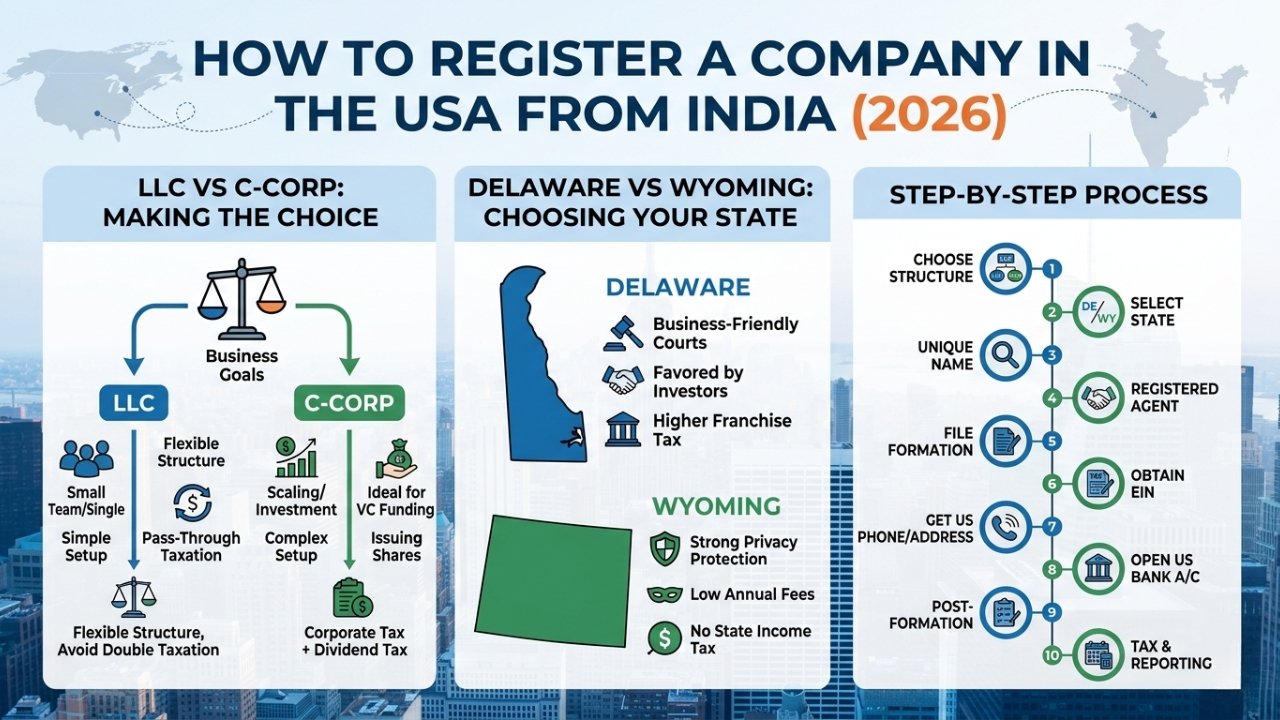
Indians can own 100% of a US company and register it from India remotely, without visiting the USA, without a visa, and without a US bank account (initially). The two main choices are an LLC (usually the better fit for operating businesses) and a C-Corp (the standard for VC-backed startups). Delaware and Wyoming are the two states most founders compare.
Can Indians Start a Business in the USA?
There is no US law that requires you to be a US citizen, a permanent resident, or even physically present in the United States to own a company there. The United States is one of the most open business environments in the world for foreign entrepreneurs.
Here’s what the law actually says:
- No citizenship requirement foreigners can own 100% of a US LLC or C-Corp.
- No residency requirement you do not need a US visa, Green Card, or address.
- No need to visit the USA the entire incorporation process can be completed online, remotely, from India.
- No US bank account required at the time of incorporation though you’ll need one soon after.
Thousands of Indian founders have built US companies this way from bootstrapped SaaS businesses to Y Combinator-backed startups. This is a well-worn path.
The only restriction worth knowing: S-Corps are not available to non-resident foreigners. But S-Corps are irrelevant for most Indian entrepreneurs anyway LLC and C-Corp cover all the use cases you’ll need.
LLC vs C-Corp The #1 Decision You Must Get Right
This is the most important decision you’ll make in the entire process. Get it wrong, and restructuring later is painful and expensive. Here’s a clear breakdown.
LLC (Limited Liability Company)
An LLC is a flexible legal structure that combines the liability protection of a corporation with the tax simplicity of a partnership.
Best for.
- Service businesses, agencies, freelancers, consultants
- SaaS or product businesses that are self-funded or bootstrapped
- Businesses where profits will be distributed to owners (not reinvested at scale)
- Holding companies and real estate businesses
Key advantages.
- Pass-through taxation profits/losses flow directly to the owners’ personal tax returns. The LLC itself pays no US federal income tax.
- Flexible ownership structure no restrictions on number or nationality of members.
- Less paperwork no board meetings, no stock issuance, simpler annual compliance.
- Lower setup and maintenance costs.
Key disadvantage for Indian owners the Single-Member LLC trap.
If you are the sole owner of an LLC (a “single-member LLC”), the IRS treats it as a disregarded entity for US tax purposes. This means the LLC’s income is treated as your personal income and as a non-resident alien, you may have US tax filing obligations even if the money never touches US soil. This is manageable, but you must work with a US CPA who understands international tax.
Cannot raise VC funding US venture capital funds, Y Combinator, and most institutional investors will not invest in an LLC. They require a C-Corp (specifically a Delaware C-Corp). If there is any chance you’ll raise institutional money, skip the LLC entirely.
C-Corp (C Corporation)
A C-Corp is a traditional corporation structure the standard legal vehicle for high-growth, venture-backed startups.
Best for.
- Startups planning to raise venture capital or angel funding
- Companies planning to issue stock options to employees (ESOP)
- Businesses planning to go public (IPO) eventually
- Any company planning to raise from US investors
Key advantages.
- Investor-ready by default VCs, accelerators, and angel investors overwhelmingly prefer Delaware C-Corps. It’s the industry standard.
- Can issue multiple classes of stock common shares, preferred shares, founder shares, employee options. This is essential for fundraising.
- No restriction on number of shareholders.
- Strong, predictable corporate law especially in Delaware.
Key disadvantage.
- Double taxation C-Corps pay corporate income tax on profits, and then shareholders pay personal income tax on dividends. However, for most early-stage startups that reinvest all profits, this is rarely a practical issue.
- More compliance annual board meetings (can be done on paper), stock ledger maintenance, more paperwork.
- Higher cost Delaware franchise taxes, registered agent fees, and filing costs are higher than Wyoming.
The Decision Matrix LLC vs C-Corp
| Question | If YES → |
|---|---|
Are you planning to raise VC funding? | C-Corp (Delaware) |
Will you apply to Y Combinator, Techstars, or an accelerator? | C-Corp (Delaware) |
Do you want to issue ESOPs to employees? | C-Corp (Delaware) |
Is this a service business, agency, or consulting firm? | LLC (Wyoming) |
Is this a bootstrapped SaaS with no VC plans? | LLC (Wyoming) |
Do you want maximum tax simplicity? | LLC (Wyoming) |
The rule of thumb: If there’s a 20% or higher chance you’ll raise institutional money in the next 3 years, start with a Delaware C-Corp. Restructuring from an LLC to a C-Corp later is possible but costs $5,000–$15,000 in legal fees and is a tax event.
Delaware vs Wyoming Which State Should You Choose?
You don’t need to operate in a state to incorporate there. Most Indian-owned US companies incorporate in either Delaware or Wyoming, regardless of where the business actually operates.
Delaware
Delaware is the undisputed gold standard for corporate law in the United States.
Why Delaware.
- More than 66% of Fortune 500 companies are incorporated in Delaware (source: Delaware Division of Corporations).
- The Delaware Court of Chancery is a dedicated business court with centuries of case law giving investors, lawyers, and founders maximum legal predictability.
- All major US VC term sheets assume Delaware C-Corp. If you’re talking to US investors, this is the only state they’ll accept without pushback.
- Most startup attorneys, accelerators, and investor agreements are pre-written for Delaware law.
Costs
- State filing fee: ~$90–$110 (one-time)
- Annual franchise tax: minimum $175 under the Authorized Shares method or $400 under the Assumed Par Value Capital method, plus a $50 annual report fee, due by 1 March. The bill rises with authorised shares, and the Assumed Par Value Capital method often gives a lower figure (source: Delaware Division of Corporations)
- Registered agent: ~$50–$200/year
Best for: Any startup that will raise VC funding, apply to accelerators, or issue stock to employees.
Wyoming
Wyoming is the usual low-cost alternative for small businesses and LLCs, mainly because of its low annual fees and owner-friendly LLC laws.
Why Wyoming
- No state income tax Wyoming has zero state corporate or personal income tax.
- Low fees Wyoming LLC annual fees start at just $60/year.
- Strong privacy laws Wyoming does not publicly disclose member names in LLC filings.
- No minimum capital requirements.
- Charging order protection strong asset protection for LLC members.
Costs
- State filing fee: ~$100 (one-time)
- Annual report fee: $60/year (minimum)
- Registered agent: ~$50–$100/year
Best for: Service businesses, agencies, bootstrapped SaaS, holding companies, and any business not planning institutional fundraising.
Delaware vs Wyoming Summary
| Factor | Delaware | Wyoming |
|---|---|---|
| Best entity type | C-Corp | LLC |
| VC fundraising | ✅ Required | ❌ Not suitable |
| Annual costs | Higher (~$500+) | Lower (~$160+) |
| Privacy | Moderate | High |
| State income tax | None (for out-of-state business) | None |
| Legal ecosystem | World-class | Strong |
Step-by-Step: How to Register a US Company from India
Here is the complete process, in order.
Choose Your Entity Type and State
Use the decision matrix above. For most Indian founders reading this.
- Raising VC → Delaware C-Corp
- Bootstrapped business → Wyoming LLC
Choose a Company Name
Your company name must be unique in the state you’re filing in. Rules.
- For an LLC: name must include “LLC” or “Limited Liability Company”
- For a C-Corp: name must include “Inc.”, “Corp.”, “Corporation”, or “Incorporated”
- Check name availability on the state’s Secretary of State website:
- Delaware: corp.delaware.gov
- Wyoming: wyobiz.wyo.gov
Also check.
- USPTO trademark database (trademarks.uspto.gov) ensure your name isn’t trademarked
- Domain name availability secure the .com before filing
Appoint a Registered Agent
Every US company must maintain a registered agent a person or company with a physical US address in the state of incorporation, available during business hours to receive legal notices and government correspondence on your behalf.
You cannot be your own registered agent if you live in India. You must hire a registered agent service.
Popular registered agent services:
- Northwest Registered Agent (~$125/year), a widely used option
- Registered Agents Inc (~$200/year)
- Stripe Atlas includes registered agent as part of their incorporation service
Cost: typically $50–$200/year.
File the Formation Documents
- LLC → File Articles of Organization with the Secretary of State
- C-Corp → File Articles of Incorporation (also called Certificate of Incorporation in Delaware) with the Secretary of State
Articles of Organization (LLC) typically include:
- Company name
- Registered agent name and address
- Member names (may be optional in Wyoming)
- Purpose of the LLC
- Management structure (member-managed vs manager-managed)
Articles of Incorporation (C-Corp) typically include:
- Company name
- Registered agent name and address
- Number of authorized shares
- Par value of shares
- Name and address of incorporator
You can file directly on the Secretary of State website, or use a service like:
- Stripe Atlas ($500 one-time, includes EIN and bank account setup; popular with Indian founders)
- Clerky (popular with Y Combinator companies)
- Doola, Firstbase, or Northwest (more affordable alternatives)
Processing time: 1–10 business days standard; 24-hour expedited available in Delaware for an extra fee.
Draft an Operating Agreement or Corporate Bylaws
- LLC → Draft an Operating Agreement (required in most states; defines ownership percentages, management rights, profit distribution, voting rights)
- C-Corp → Adopt Corporate Bylaws and hold an initial board meeting (can be done via written consent, no physical meeting needed)
For a C-Corp, you’ll also need to.
- Issue founder shares
- Set up a cap table (spreadsheet tracking who owns what percentage)
- Consider a vesting schedule for founder shares (standard: 4 years, 1-year cliff)
Apply for an EIN (Employer Identification Number)
An EIN is your company’s federal tax ID number like a PAN for your US company. You need it to open a US bank account, hire employees, file taxes, and sign most contracts.
(See Section 6 below for the full EIN application process for foreign owners.)
Open a US Business Bank Account
With your EIN and formation documents in hand, you can open a US business bank account remotely. Traditional banks (Chase, Bank of America) generally require you to visit a branch in person difficult from India.
Recommended for Indian founders (can be opened remotely)
- Mercury (mercury.com) free, fully remote, excellent for startups
- Relay good for small businesses
- Brex for venture-backed startups with higher balances
Register for Any Required US State Taxes
If your company has employees, physical operations, or significant sales in any US state, you may need to register for state sales tax, payroll tax, etc. For a purely online business with no US employees and no US physical presence, this typically does not apply in the early stages.
Documents Required for US Company Registration
Here is a complete list of documents you’ll need.
For filing
- Completed Articles of Organization (LLC) or Articles of Incorporation (C-Corp)
- Registered agent consent form
- Payment for state filing fee (credit card accepted online)
For your records (prepare after filing)
- Operating Agreement (LLC) or Corporate Bylaws (C-Corp)
- EIN confirmation letter (IRS Form CP-575 or SS-4 approval)
- Initial meeting minutes or written consent (C-Corp)
- Stock/membership certificates (optional but recommended)
For bank account opening
- Certificate of Formation / Certificate of Incorporation (issued by the state)
- EIN confirmation letter
- Operating Agreement or Bylaws
- Passport (for identity verification)
- Proof of address in India
You do not need
- A US address (your registered agent’s address suffices)
- A US phone number (though helpful)
- A US Social Security Number (SSN) an EIN is sufficient
EIN Application for Foreign Owners (Form SS-4)
The Employer Identification Number (EIN) is issued by the IRS (Internal Revenue Service the US equivalent of India’s Income Tax Department).
How to apply as a foreign owner.
Unlike US citizens and residents, you cannot apply for an EIN online if you don’t have a US Social Security Number (SSN) or Individual Taxpayer Identification Number (ITIN). You must apply by.
Method 1: Fax (Common for foreign applicants)
- Complete IRS Form SS-4 (download from irs.gov)
- Fax to the IRS at +1-855-215-1627 (international fax)
- Processing time: 4–6 weeks (the IRS faxes back your EIN confirmation)
Method 2: Mail
- Mail Form SS-4 to: Internal Revenue Service, Attn: EIN International Operation, Cincinnati, OH 45999, USA
- Processing time: 8–12 weeks
Method 3: Phone (Same day)
- Call the IRS at +1-267-941-1099 (not toll-free; international callers)
- Available Monday–Friday, 6 AM to 11 PM Eastern Time
- A representative will ask you to verbally complete Form SS-4 and issue the EIN immediately on the call
Method 4: Use a service like Stripe Atlas or Doola
- They handle the EIN application as part of their incorporation package, using their own processes to expedite it.
Key fields on Form SS-4 for foreign owners
- Line 7b: Enter “N/A” for SSN if you don’t have one
- Line 9a: Select the entity type (LLC or Corporation)
- Line 10: Reason for applying “Started new business”
- Line 11: Date business started
- Responsible party: The individual (you) responsible for the company use your name and Indian address
Registered Agent What It Is and Why You Need One
What Is a Registered Agent?
A registered agent (also called a “statutory agent” or “agent for service of process”) is a person or entity designated to receive:
- Legal documents (lawsuits, subpoenas)
- Official government correspondence
- Annual report reminders
- Tax notices from the state
Every US state requires every registered company to maintain a registered agent with a physical address in that state during normal business hours.
Why You Can’t Skip This
If you fail to maintain a registered agent.
- Your company can be administratively dissolved (canceled) by the state
- You may miss critical legal notices, resulting in default judgments against you
- You’ll lose your good standing certificate, which is required to open bank accounts and sign contracts
What to Look for in a Registered Agent Service
- Physical address in your state of incorporation (not a PO box)
- Reliable document scanning and forwarding they should email you scanned copies of all documents received
- Reasonable annual fee ($50–$200/year is normal)
- Good customer service you’ll interact with them occasionally
Recommended services
- Northwest Registered Agent (~$125/year)
- Registered Agents Inc (~$200/year)
- If using Stripe Atlas, they provide a registered agent through their partner
After Registration What Comes Next?
Once your company is registered and has an EIN, here’s what to do.
Immediate (first 30 days).
- Open a US business bank account (Mercury, Relay, or Brex)
- Set up a US business address (optional use a virtual mailbox service like Anytime Mailbox or iPostal1)
- Get a US business phone number (optional Google Voice is free)
- Register a domain name and set up a business email
Within 90 days.
- Hire a US CPA familiar with international tax (non-negotiable do not skip this)
- Understand your Indian tax obligations money earned by your US company may have Indian tax implications depending on your structure (consult a CA in India too)
- Set up accounting software (QuickBooks, Xero, or Wave for beginners)
- Apply for Stripe or Paddle for payment processing
Ongoing annual compliance.
- File annual reports with the state (Delaware: due March 1; Wyoming: due first day of your anniversary month)
- Pay Delaware franchise tax (due March 1)
- File US federal tax returns:
- LLC: Form 5472 + Form 1120 (proforma) if single-member foreign-owned LLC
- C-Corp: Form 1120
- Renew your registered agent
- Maintain corporate records (meeting minutes, resolutions)
Important for Indian tax residents
- You must disclose your foreign company ownership in your Indian ITR (Income Tax Return) under Schedule FA (Foreign Assets)
- Failure to disclose is a serious violation under FEMA and Black Money Act
Common Mistakes Indian Entrepreneurs Make
Mistake 1: Choosing LLC when they plan to raise VC funding
If there is any real chance of raising institutional money, go Delaware C-Corp from day one. Restructuring is expensive and disruptive.
Mistake 2: Not hiring a US CPA.
International tax is complex here because four sets of rules apply at once: Indian tax law, US tax law, the DTAA (India-US Double Taxation Avoidance Agreement) and FEMA. One missed filing can be expensive; the IRS penalty for not filing Form 5472 alone is $25,000 (source: IRS Form 5472 instructions).
Mistake 3: Ignoring Indian compliance.
Your Indian income tax obligations don’t disappear because you have a US company. Depending on your situation, you may need to file disclosures, pay taxes in India on distributions, and comply with RBI/FEMA rules on overseas investments.
Mistake 4: Using a personal account for business transactions.
Always keep US company finances completely separate from personal finances. Commingling funds can destroy your limited liability protection (“piercing the corporate veil”).
Mistake 5: Missing annual compliance deadlines.
Delaware franchise tax, state annual reports, and federal tax filings all have hard deadlines. Missing them results in penalties, loss of good standing, and potential dissolution of your company.
Mistake 6: Choosing a state based on where they want to “operate.”
For an online business with no US employees or physical presence, the state of incorporation has no relation to where you operate. Choose based on legal and tax considerations, not geography.
Frequently Asked Questions
Do I need to visit the USA to register a company?
No. The entire process from choosing a name to receiving your EIN can be completed remotely from India. You’ll never need to set foot in the USA just to register.
Can a foreigner own 100% of a US company?
Yes. There is no restriction on foreign ownership of US LLCs or C-Corps. Non-residents can own 100% of either entity type.
What is the difference between Articles of Organization and Articles of Incorporation?
Articles of Organization is the formation document for an LLC. Articles of Incorporation (or Certificate of Incorporation) is the formation document for a Corporation (C-Corp). Both are filed with the Secretary of State and are the legal documents that bring your company into existence.
How long does it take to register a US company from India?
State filing: 1–10 business days (24 hours with expedited filing in Delaware). EIN: same day (by phone) to 4–6 weeks (by fax). Total time using a service like Stripe Atlas: typically 1–2 weeks.
How much does it cost to register a US company?
DIY: $200–$500 total for first year (state fees + registered agent).
Using a service: $500–$1,000 (Stripe Atlas is $500 and includes registered agent and bank account setup).
Ongoing annual costs: $200–$600/year depending on state and service providers.
Do I need a US address to register a company?
No personal US address is needed. Your registered agent’s address is used for the company’s official address. If you need a mailing address, you can use a virtual mailbox service.
What taxes does a US company pay?
Federal corporate income tax: 21% (C-Corp). LLCs are pass-through no entity-level US federal tax. State income taxes vary Wyoming has none, Delaware has none on income earned outside Delaware. You’ll also have Indian tax obligations depending on your residency and structure.
Can my Indian company own a US company?
Yes. An Indian company (Private Limited) can be a shareholder or member of a US C-Corp or LLC. This requires compliance with FEMA’s Overseas Direct Investment (ODI) regulations. Consult a CA and US attorney.
Summary Your Action Plan
| Step | Action | Time |
|---|---|---|
| 1 | Decide LLC vs C-Corp | Day 1 |
| 2 | Choose state (Delaware or Wyoming) | Day 1 |
| 3 | Choose a company name | Day 1 |
| 4 | Hire a registered agent | Day 1–2 |
| 5 | File formation documents | Day 2–3 |
| 6 | Apply for EIN | Day 3–4 |
| 7 | Open US bank account | Week 2 |
| 8 | Hire US CPA | Week 2–4 |
| 9 | Set up accounting | Week 2–4 |
| 10 | Understand Indian compliance | Week 2–4 |