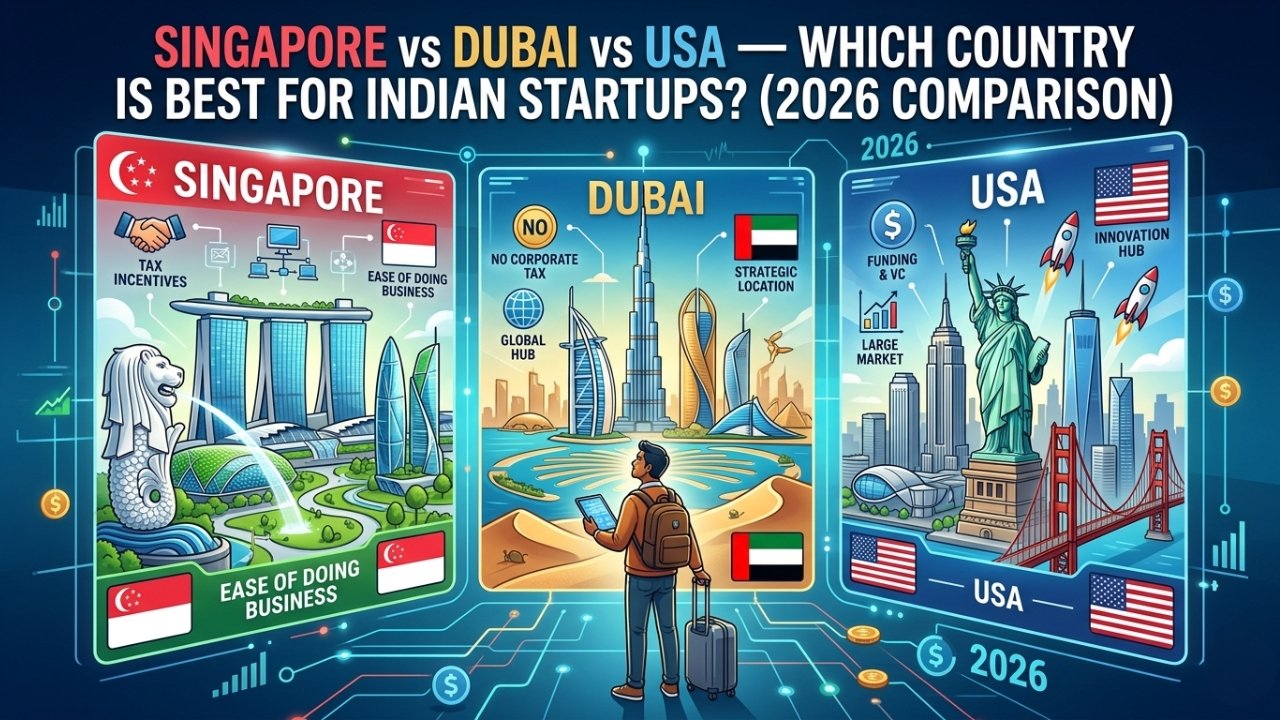
Registering your startup outside India is no longer a move reserved for well-funded unicorns. In 2026, thousands of early-stage Indian founders are incorporated in Singapore, Dubai, and the USA to access global capital, reduce tax friction, and build credibility with international customers.
But “going global” is not a one-size-fits-all decision. The best jurisdiction for a SaaS startup raising a Series A from US VCs is not the same as the best one for a crypto protocol or a family-run export business.
This guide compares four major incorporation destinations across 12+ factors so you can match the right country to your specific business model, funding goals, and operational reality.
Head-to-Head Comparison: Singapore vs Dubai vs USA vs India (2026)
| Factor | 🇸🇬 Singapore | 🇦🇪 Dubai / UAE | 🇺🇸 USA (Delaware/Wyoming) | 🇮🇳 India |
|---|---|---|---|---|
| Corporate Tax Rate | 17% (effective ~8–10% for startups) | 9% federal (Free Zone: 0%) | 21% federal + state taxes | 22–25% |
| Capital Gains Tax | None | None | 0–20% (federal) | 10–20% |
| Personal Income Tax | Up to 24% | 0% | Up to 37% | Up to 30% |
| Time to Incorporate | 1–3 business days | 3–7 business days | 1–2 business days | 7–15 business days |
| Minimum Share Capital | SGD 1 | AED 1,000–50,000 (varies by Free Zone) | None (Delaware LLC) | No minimum (Pvt Ltd) |
| VC / Investor Preference | Very High (Asia/global VCs) | Moderate (MENA focus) | Very High (US VCs strongly prefer) | Low for global rounds |
| Banking Access | Excellent (global banks) | Good (growing fintech ecosystem) | Excellent (US banking + Stripe, Brex) | Moderate (forex restrictions) |
| Crypto / Web3 Friendliness | High (MAS licensed framework) | Very High (VARA, ADGM regulated) | Moderate (regulatory uncertainty) | Low (30% tax + heavy scrutiny) |
| Residency Requirement | 1 local director required | Depends on Free Zone (some remote) | None (fully remote) | 2 resident directors required |
| Annual Compliance Cost | SGD 1,500–4,000/year | AED 8,000–20,000/year | USD 500–2,000/year | INR 25,000–75,000/year |
| IP / Patent Regime | Excellent (IP Box tax incentives) | Good (DIFC, ADGM frameworks) | Excellent (US patent system) | Improving (but slower courts) |
| Ease of Dissolution | Easy (strike-off in weeks) | Moderate | Easy (especially LLCs) | Complex (lengthy process) |
Singapore: Strengths & Who It’s Ideal For
Singapore has been the go-to incorporation destination for Indian founders since the mid-2010s and for good reason. It combines a stable, transparent legal system with Asia’s most connected financial ecosystem.
Key Strengths
Zero capital gains tax
is perhaps Singapore’s most powerful draw. When you exit whether through acquisition or IPO there is no capital gains tax on the sale of shares. For founders building for a long-term exit, this can mean the difference between retaining 100% of their proceeds versus losing 20%+ to Indian or US tax authorities.
The India-Singapore DTAA (Double Taxation Avoidance Agreement)
makes cross-border structuring tax-efficient for Indian founders, particularly those who want to retain a subsidiary in India while holding the parent company in Singapore.
ACRA (Accounting and Corporate Regulatory Authority)
registration is fast, digital, and globally respected. Tier-1 banks such as DBS, OCBC, HSBC and Citibank know the structure well, though a foreign-owned company should still expect detailed KYC before an account opens.
MAS (Monetary Authority of Singapore
provides one of Asia’s clearest regulatory frameworks for fintech, digital assets, and payment businesses. If you’re building in financial services, a Singapore base gives you licensing pathways that are simply unavailable in India.
Ideal For Indian Founders Who
- Are raising from Southeast Asian, Japanese, or global VCs
- Are building SaaS, fintech, or B2B products with Asian market focus
- Want a tax-efficient holding structure with an Indian subsidiary (Flipkart model)
- Plan to relocate to Singapore themselves (EntrePass and Employment Pass routes available)
- Are building for a long-term acquisition exit and want zero capital gains tax
One Watch-Out
Singapore requires at least one locally resident director either a Singapore citizen, PR, or Employment Pass holder. You will need to hire a nominee director service (SGD 1,200–2,500/year) unless you relocate.
Dubai / UAE: Strengths & Who It’s Ideal For
Dubai has quietly become a serious option for startups. The UAE’s 2023 introduction of a 9% federal corporate tax did raise eyebrows but Free Zone companies meeting specific criteria continue to enjoy a 0% corporate tax rate on qualifying income (source: UAE Ministry of Finance).
Key Strengths
0% personal income tax
remains unchanged. If you relocate to Dubai, your salary, dividends, and personal income are taxed at zero a compelling proposition compared to India’s 30% slab or Singapore’s 24%.
Multiple Free Zones
including DIFC (Dubai International Financial Centre), ADGM (Abu Dhabi Global Market), DMCC (Dubai Multi Commodities Centre), and IFZA give founders enormous flexibility in choosing a regulatory environment tailored to their industry. DIFC and ADGM, in particular, operate under English Common Law, making them familiar to international lawyers and investors.
Web3 and crypto regulation is maturing fast.
Dubai’s VARA (Virtual Assets Regulatory Authority) has created one of the world’s most defined licensing frameworks for crypto exchanges, digital asset managers, and NFT platforms. Founders exiting India’s hostile crypto tax environment (30% flat tax + 1% TDS) are actively choosing Dubai as their operating base.
The 10-year UAE Golden Visa
available to startup founders and investors provides long-term residency stability without requiring constant visa renewals.
Ideal For Indian Founders Who.
- Are building in crypto, Web3, or digital assets and need a regulated environment
- Want to personally relocate and eliminate income tax
- Are targeting the Gulf, MENA, or Africa markets
- Are running a trading, import-export, or commodity-linked business (DMCC is built around commodity trading)
- Want a simpler lifestyle with lower cost of living than Singapore for similar tax benefits
One Watch-Out
UAE banking has historically been complex for Indian founders, with compliance-heavy KYC processes. This is improving, but expect more friction in opening accounts compared to Singapore or the US. Also, Free Zone companies cannot directly do business within the UAE mainland without a local sponsor so if your customers are in the UAE itself, you’ll need a mainland company or a local partner.
USA (Delaware / Wyoming): Strengths & Who It’s Ideal For
If your goal is to raise from US venture capital, there is effectively one answer: incorporate as a Delaware C-Corporation. This is not a preference it is a near-requirement. US institutional VCs, including Y Combinator, a16z, and Sequoia Capital, will typically only invest in Delaware C-Corps due to the state’s well-established corporate law, predictable court system (Court of Chancery), and standard SAFE/equity documentation ecosystem.
Key Strengths
The Delaware advantage is real and deep
Over two-thirds of the Fortune 500 are incorporated in Delaware (Delaware Division of Corporations), and US venture investors usually expect a Delaware C-Corp. This isn’t tax optimization Delaware has no corporate income tax for companies that don’t operate in the state. It’s about legal clarity. Delaware’s General Corporation Law (DGCL) is backed by decades of corporate case law, meaning investor protections, board rights, and exit mechanics are all well-understood by every party.
YC, Stripe Atlas, and Clerky
have made Delaware C-Corp formation accessible to international founders. Indian founders can now incorporate in Delaware remotely in 1–2 business days, open a Mercury or Relay bank account online, and be collecting USD revenue within a week.
Wyoming LLCs
are increasingly popular for founders who want US incorporation without the complexity of corporate structure particularly bootstrapped businesses, crypto projects, and solo operators. Wyoming has no state income tax, no franchise tax, and strong charging order protection.
Access to US payment infrastructure
Stripe, Brex, Ramp, Mercury, PayPal, and the full US fintech stack is significantly easier for US-incorporated entities than for Indian companies.
Ideal For Indian Founders Who
- Are targeting US customers and want to build credibility instantly
- Plan to raise from US VCs (this is essentially a prerequisite)
- Are applying to YC, Techstars, or other US accelerators
- Are building developer tools, SaaS, or enterprise software with US enterprise customers
- Want access to the US talent pool and stock option frameworks (ISOs for US employees)
One Watch-Out
US corporations come with significant compliance obligations for Indian founders. As a non-resident founder of a US C-Corp, you face Form 5472 reporting (the IRS penalty for not filing is $25,000; IRS Form 5472 instructions), FBAR and Form 5471 filings where they apply, and potential CFC (Controlled Foreign Corporation) rules in India. US corporate tax (21%) plus state taxes applies on US-sourced income. You will need a US-based CPA with international experience budget at least USD 3,000–8,000/year for accounting and compliance.
India: When Should You Stay Domestic?
Incorporating in India as a Private Limited Company (Pvt Ltd) under the Companies Act, 2013 is not a consolation prize. For many business models, it remains the right and optimal choice.
Stay in India If
Your customers are Indian.
If you’re building for India whether that’s B2C consumers, Indian SMBs, or government contracts an Indian entity is simpler, more trusted by customers, and avoids the regulatory complexity of operating through a foreign entity.
You’re raising from Indian VCs or angel networks.
Indian VC funds (Sequoia India, Accel India, Blume, Kalaari) are fully comfortable with Indian Pvt Ltd structures and often prefer them for early cheques.
You’re in a regulated sector.
Healthcare, edtech, lending, insurance, and media businesses often require Indian entity registration to obtain sector-specific licenses (NBFC, insurance broker, etc.) that cannot be held by foreign companies.
You’re bootstrapped and early.
The compliance overhead of a foreign entity nominee directors, FEMA compliance, transfer pricing reports is genuinely burdensome if you’re a solo founder with no revenue yet.
You want ESOP advantages.
Indian Pvt Ltd structures, while less flexible than US C-Corps for ESOPs, have been improved significantly under recent MCA rules and offer 45-day exercise windows and more favorable tax treatment post-2023 amendments.
Decision Framework: Which Country Fits YOUR Business?
Use this framework to cut through the noise.
Where Are Your Investors?
- US VCs only → Delaware C-Corp, no exceptions
- Asian/global VCs → Singapore
- MENA VCs or crypto investors → Dubai
- Indian VCs → India Pvt Ltd
Where Are Your Customers?
- US enterprise/SaaS customers → Delaware or Singapore
- Southeast Asia / global B2B → Singapore
- Gulf + Africa → Dubai Free Zone
- India → India Pvt Ltd (+ possible parent in Singapore)
What Is Your Tax Priority?
- Minimize personal tax → Dubai (0% income tax)
- Minimize capital gains on exit → Singapore or Dubai
- Minimize corporate tax on profits → Dubai Free Zone or Singapore (IP Box)
- Simplest compliance → India (if revenue is domestic)
What Is Your 3-Year Plan?
- IPO on NASDAQ → Delaware C-Corp, flip from Indian entity early
- Acquisition by Asian tech company → Singapore holding structure
- Lifestyle business with tax efficiency → Dubai + relocate personally
- Domestic scale-up → India Pvt Ltd
Can You Set Up in Multiple Countries? (Yes Here’s How)
Multi-jurisdiction structures are common among Indian founders and often optimal. The most popular architecture is the Singapore-India or Delaware-India structure:
The Holdco-Opco Structure
[Singapore Holdco] or [Delaware C-Corp]
|
| 100% ownership
↓
[India Private Limited — Operating Subsidiary]
How it works: The foreign parent company (Singapore or Delaware) owns 100% of the Indian subsidiary. The Indian subsidiary employs the team, holds Indian contracts, and handles INR operations. Revenue from global customers flows into the parent entity in Singapore or the US, while Indian customers pay the Indian subsidiary.
Why founders love it:
- Investors write cheques into the Singapore/US parent (globally recognized)
- Indian team gets standard Indian employment and ESOP structures
- Global revenue stays outside India’s higher tax environment
- Founders can flip to this structure even after incorporating in India (RBI approval required under FEMA)
The Dubai Personal + India Opco Structure
Some founders keep their Indian operating company but personally relocate to Dubai for 0% income tax. In this case:
- The Indian company continues operating normally
- The founder draws a structured salary/dividend that minimizes Indian tax exposure
- New ventures or holding entities are created in Dubai
Important: Indian tax residency rules (182 days) apply. Proper tax planning with a CA experienced in NRI taxation is essential before attempting this structure.
Compliance Note
Multi-jurisdiction structures require Transfer Pricing documentation to justify arm’s-length transactions between the parent and Indian subsidiary. Budget INR 1.5–3 lakh/year for this compliance layer.
Frequently Asked Questions
Can an Indian founder incorporate in Singapore without relocating?
Yes. You can incorporate a Singapore company as a 100% foreign-owned entity without living there. However, you must appoint at least one locally resident director typically a nominee director service provider. This costs approximately SGD 1,200–2,500 per year. You do not need to be physically present for the incorporation.
Will US VCs fund a Singapore company?
Most US VCs prefer Delaware C-Corps and may ask you to reincorporate (called a “flip”) before they invest. However, Singapore is increasingly accepted by Tier-2 US VCs, strategic investors, and family offices particularly if you have Asian revenue traction. Always confirm this with your target investors before choosing jurisdiction.
Is the Dubai Free Zone 0% tax legitimate and permanent?
Yes Free Zone companies that meet qualifying income criteria (essentially, income from outside the UAE mainland) continue to be taxed at 0% under the Qualifying Free Zone Person (QFZP) rules introduced alongside the 9% federal corporate tax in 2023. This is a deliberate policy choice by the UAE to maintain Free Zone competitiveness. However, tax laws can change work with a UAE tax advisor to ensure your structure qualifies annually.
How do I “flip” my Indian company to a Singapore or Delaware entity?
A flip involves restructuring so that the foreign entity becomes the parent of your Indian company. This typically requires: (a) issuing shares in the foreign entity to your existing Indian shareholders in exchange for their Indian shares, (b) RBI approval under FEMA’s Overseas Direct Investment (ODI) or Automatic Route rules, (c) valuation reports from a SEBI-registered merchant banker. The process typically takes 3–6 months and costs INR 3–8 lakh in legal and advisory fees. YC and many Singapore law firms specialize in this.
Which jurisdiction is best for an Indian SaaS startup raising a Series A?
If targeting US VCs: Delaware C-Corp with an Indian subsidiary (for your team). If targeting Asian VCs: Singapore Holdco with Indian subsidiary. Series A investors in both jurisdictions are comfortable with these structures the key is to set up the correct structure before your Series A, not during it.
What are the FEMA implications of incorporating outside India?
Under FEMA (Foreign Exchange Management Act), Indian residents investing in or setting up foreign companies must comply with the Overseas Direct Investment (ODI) regulations. There are automatic route provisions for investments up to certain thresholds, but you must file Form ODI with your AD (Authorised Dealer) bank. Failure to comply can result in penalties. Always engage a CA with FEMA expertise before incorporating abroad.
Is Wyoming LLC a good option for Indian founders?
Wyoming LLCs are excellent for specific use cases: bootstrapped digital businesses, crypto projects, solo consultants, or founders who want US banking without the C-Corp complexity. However, Wyoming LLCs cannot issue preferred shares and are not suitable for VC fundraising. If there’s any possibility you’ll raise institutional capital, start with Delaware C-Corp instead.
How long does it take to open a business bank account in Singapore?
With a Singapore-incorporated entity and nominee director in place, business bank account opening typically takes 2–6 weeks at traditional banks (DBS, OCBC, UOB). Digital business accounts through Aspire, Airwallex, or Wise Business can be opened in 3–7 business days. Traditional banks require in-person verification for at least one director your nominee director can often fulfill this requirement.