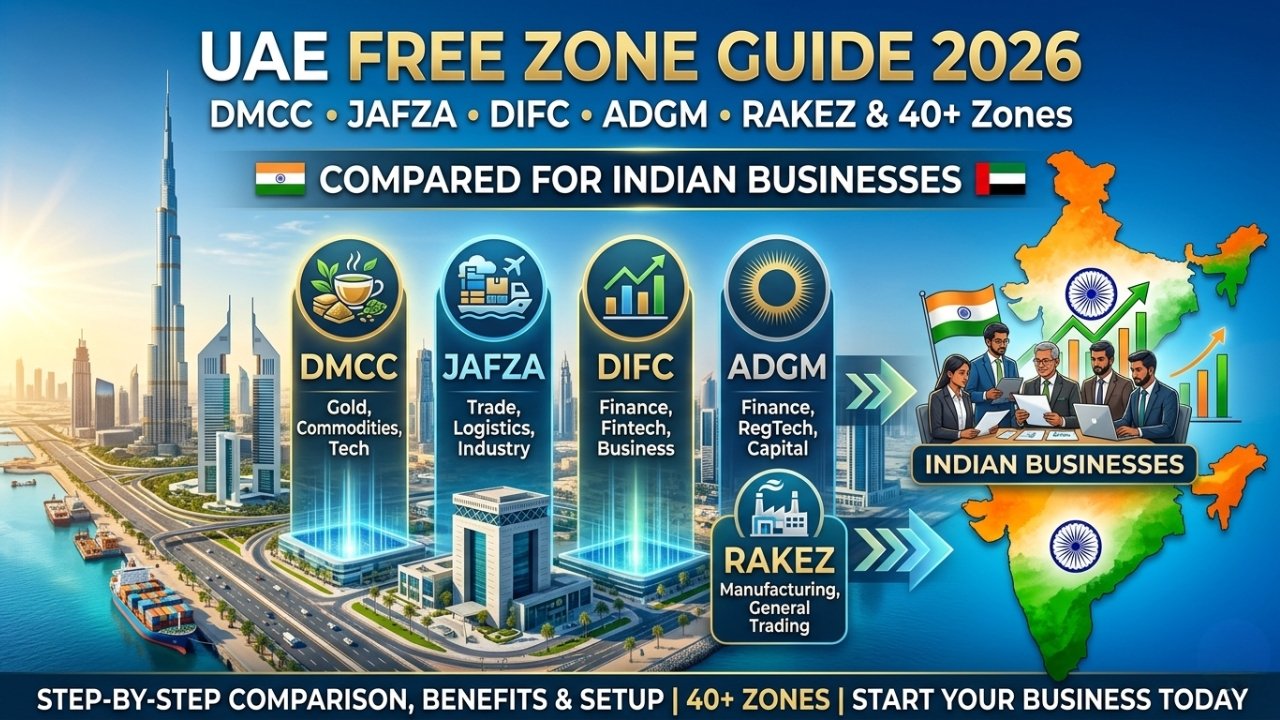
A UAE free zone company can work well for an Indian entrepreneur or business owner, but choosing the wrong free zone means paying to restructure, losing months, and struggling to open a bank account.
With over 40 free zones across Dubai, Abu Dhabi, Sharjah, Ras Al Khaimah, and other emirates, the decision is genuinely complex. DMCC is not the same as JAFZA. DIFC is not interchangeable with ADGM. And the cheapest option (RAKEZ or SHAMS) may not be the right one for your business model.
This is the most comprehensive UAE free zone comparison guide for Indian businesses in 2026 covering costs, visa allocations, sector suitability, QFZP eligibility, banking track records, and the newly opened Bharat Mart at JAFZA.
Why Free Zones Matter for Indian Businesses
UAE free zones were purpose-built to attract foreign capital and talent. For Indian entrepreneurs, they offer a genuinely unique combination of advantages unavailable in most other global jurisdictions.
- 100% foreign ownership — no local sponsor required (unlike UAE mainland until 2021)
- 0% corporate tax on qualifying income (subject to QFZP rules under the new 9% CT regime)
- 0% personal income tax — your UAE salary, dividends, and capital gains stay with you
- 100% profit repatriation — move money back to India (or anywhere) freely
- No import/export duties within the free zone
- Streamlined visa processing — residence visas for founders, employees, and family
- Strong banking sector with USD/AED/EUR multi-currency accounts (expect detailed checks; see the banking section)
- Geographic arbitrage — 3.5 hours from Mumbai, serving Africa, GCC, South Asia, and Europe
Since the UAE-India CEPA (Comprehensive Economic Partnership Agreement) came into force, bilateral trade has grown sharply, and free zone companies carry a large share of it.
How UAE Free Zones Work The Basics
A UAE free zone is a designated economic area governed by its own regulatory authority, separate from mainland UAE laws. Each free zone has.
- Its own licensing authority (e.g., DMCC Authority, JAFZA, DIFC Authority)
- Its own legal framework (most follow UAE Commercial Companies Law; DIFC and ADGM use English Common Law)
- Defined permitted activities — you can only conduct business within your licensed scope
- Physical or flexi-desk office requirements varies widely by zone
Key limitation: Free zone companies generally cannot directly trade or provide services to UAE mainland customers without a mainland distributor or a separate mainland entity. This is often misunderstood by Indian entrepreneurs.
The new UAE Corporate Tax (9%) introduced in June 2023 applies to free zone companies too but Qualifying Free Zone Persons (QFZP) can still access a 0% rate on qualifying income if they meet specific substance and activity requirements.
The Master Comparison Table: 10 Major Free Zones
| Free Zone | Emirate | Min. Setup Cost (AED) | Min. Visa Allocation | Best For | QFZP Eligible | Banking Ease (Indian) | Key Differentiator |
|---|---|---|---|---|---|---|---|
| DMCC | Dubai | 18,000–25,000 | 1–3 | Commodities, Crypto, Gold | ✅ Yes | ⭐⭐⭐⭐ | Major commodities hub |
| JAFZA | Dubai | 25,000–50,000 | 3–5 | Logistics, Trading, Manufacturing | ✅ Yes | ⭐⭐⭐⭐ | Bharat Mart opened 2026 |
| DIFC | Dubai | 50,000–150,000 | 2–4 | Financial Services, VC, Fintech | ✅ Yes | ⭐⭐⭐⭐⭐ | English common law courts |
| ADGM | Abu Dhabi | 30,000–100,000 | 2–4 | Family Offices, Asset Mgmt | ✅ Yes | ⭐⭐⭐⭐⭐ | SPV/Family Office specialist |
| IFZA | Dubai | 12,500–17,000 | 1–6 | General Business, Startups | ✅ Yes | ⭐⭐⭐ | Fast, flexible setup |
| RAKEZ | Ras Al Khaimah | 8,000–15,000 | 1–2 | Solopreneurs, Budget Startups | ✅ Yes | ⭐⭐⭐ | Cheapest option in UAE |
| Dubai South | Dubai | 15,000–20,000 | 1–3 | E-Commerce, Aviation, Logistics | ✅ Yes | ⭐⭐⭐ | Adjacent to Al Maktoum Airport |
| DIC / DMC | Dubai | 20,000–30,000 | 2–4 | IT, Software, Media, Tech | ✅ Yes | ⭐⭐⭐⭐ | Tech/media cluster |
| SHAMS | Sharjah | 5,750–11,500 | 1–2 | Freelancers, Content Creators | ⚠️ Limited | ⭐⭐ | Cheapest in UAE overall |
| SAIF Zone | Sharjah | 12,000–20,000 | 2–4 | Light Manufacturing, Trading | ✅ Yes | ⭐⭐⭐ | Industrial + airport access |
Costs approximate as of Q1 2026. Exclude government fees, medical, Emirates ID. Always confirm with the free zone authority or a registered agent.
DMCC Best for Commodities, Crypto & Gold Trading
Full Name: Dubai Multi Commodities Centre Location: Jumeirah Lakes Towers (JLT), Dubai Established: 2002 Regulator DMCC Authority
Why DMCC Dominates
DMCC says it has won fDi’s Global Free Zone of the Year award nine years in a row and has over 26,000 member companies from 180 countries (source: DMCC).
For Indian businesses, DMCC is particularly compelling because of its deep integration with India’s commodities and gold trading ecosystem. India is the world’s second-largest gold consumer, and DMCC’s Dubai Gold & Commodities Exchange (DGCX) directly interfaces with Indian markets.
DMCC Best For
- Commodities trading gold, silver, diamonds, petrochemicals, agricultural goods
- Crypto and digital assets DMCC has a dedicated Virtual Assets regime with VARA licensing pathway
- Tea trading DMCC operates the Dubai Tea Trading Centre, a major hub for Indian tea exporters
- Cotton and textile trading strong Indian diaspora presence in JLT supports networks
- Holding companies DMCC’s legal framework supports multi-layer structures
DMCC Costs (2026)
| Item | Cost (AED) |
|---|---|
| License fee (trading) | 10,500–15,000/year |
| Registration fee | 8,500 (one-time) |
| Flexi-desk (virtual office) | 5,000–8,000/year |
| Physical office (min. 200 sq ft) | 35,000–60,000/year |
| Visa allocation (flexi-desk) | 1–3 visas |
First-year all-in cost estimate: AED 30,000–55,000 (₹6.5–12 lakhs)
DMCC for Indians Key Considerations
The Indian community in JLT is enormous you’ll find Indian-run accounting firms, legal advisors, banks, and trade associations within walking distance of DMCC Authority.
DMCC also has a crypto-friendly stance if you’re building a Web3 company or digital asset business, DMCC offers a pathway to VARA (Virtual Assets Regulatory Authority) licensing that JAFZA or RAKEZ cannot match.
QFZP Eligibility: Yes DMCC companies can qualify for 0% corporate tax on qualifying income, provided they meet substance requirements (actual operations, staff, and adequate premises in the UAE).
JAFZA Best for Logistics & Trading (Bharat Mart 2026!)
Full Name: Jebel Ali Free Zone Authority Location: Jebel Ali, Dubai (adjacent to Jebel Ali Port, one of the world’s largest container ports) Established: 1985 Regulator: JAFZA / DP World
Why JAFZA Works for Trade
JAFZA is the original UAE free zone established nearly 40 years ago and it remains a first choice for companies involved in physical goods, logistics, and trading. Its adjacency to Jebel Ali Port (which handles over 14 million TEUs annually) gives JAFZA-registered companies direct access to sea freight.
Bharat Mart JAFZA’s Game-Changer for Indians in 2026
In a landmark development for Indian-UAE trade, Bharat Mart officially opened at JAFZA in early 2026. Developed in partnership between DP World and the India-UAE Business Council, Bharat Mart is a dedicated India-focused trade hub within JAFZA, designed to.
- Showcase and distribute Indian manufactured goods across the GCC, Africa, and Europe
- Provide Indian MSMEs with ready-to-use warehousing and exhibition space
- Offer B2B matchmaking between Indian suppliers and global buyers
- Provide bonded storage for re-export without customs duties
For Indian manufacturing, FMCG, textile, pharmaceutical, and engineering goods companies, Bharat Mart at JAFZA is the most significant new infrastructure of 2026.
JAFZA Best For
- Import/export and re-export trading leveraging Jebel Ali Port
- Manufacturing and light industrial JAFZA has warehouse and factory units
- FMCG and consumer goods distribution serving GCC supermarkets and retailers
- Automotive major international auto brands base regional operations at JAFZA
- Oil & gas equipment significant energy sector cluster
- Indian MSMEs expanding globally via Bharat Mart
JAFZA Costs (2026)
| Item | Cost (AED) |
|---|---|
| License fee (trading) | 15,000–20,000/year |
| Warehouse unit (minimum) | 30,000–80,000/year |
| Flexi-desk office | 10,000–15,000/year |
| Visa allocation (warehouse) | 3–10 visas |
First-year all-in cost estimate: AED 60,000–120,000 (₹13–26 lakhs)
JAFZA is not the cheapest option, but for businesses moving physical goods, the port access alone justifies the premium.
DIFC Best for Financial Services & Fintech
Full Name: Dubai International Financial Centre Location: Downtown Dubai (Gate Village, Gate Avenue) Established: 2004 Regulator: DIFC Authority + DFSA (Dubai Financial Services Authority)
Why DIFC Is in a Different League
DIFC is not just a free zone it is an international financial centre operating under English Common Law with its own independent court system (DIFC Courts). This makes it legally comparable to London, New York, Singapore, or Hong Kong for financial and commercial disputes.
For Indian financial services businesses, fintech companies, investment firms, and family offices, DIFC offers something no other UAE free zone can match: legal predictability under a globally recognized framework.
DIFC Best For
- Financial services firms asset managers, brokers, investment advisors (requires DFSA licensing)
- Fintech startups DIFC runs an Innovation Hub and the FinTech Hive accelerator
- Venture capital and private equity DIFC has a large cluster of VC and PE firms
- Law firms and consultancies serving financial sector clients
- Family offices particularly for UHNWI Indian families structuring global wealth
- Holding companies for businesses with international operations
DIFC Costs (2026)
| Item | Cost (AED) |
|---|---|
| Commercial license (non-regulated) | 15,000–25,000/year |
| DFSA regulated firm license | 100,000–500,000+ (highly variable) |
| Office space (min. requirement) | 100,000–500,000+/year |
| Visa allocation | 2–4 (non-regulated); higher for regulated |
First-year all-in cost estimate: AED 150,000–300,000+ (₹32–65 lakhs) for regulated firms
DIFC is expensive by free zone standards but if you need DFSA regulation, access to international institutional capital, or the credibility of an English common law jurisdiction, it’s the only choice.
DIFC Courts Why This Matters for Indians
Indian businesses sometimes face contract enforcement challenges when dealing with counterparties from diverse legal backgrounds. DIFC Courts operate in English, use English common law precedent, and their judgments are enforceable in Dubai and, through treaties and court-to-court arrangements, in a number of other countries. For high-value commercial contracts, that matters.
ADGM Best for Family Offices & Asset Management
Full Name: Abu Dhabi Global Market Location: Al Maryah Island, Abu Dhabi Established: 2015 Regulator: ADGM Registration Authority + FSRA (Financial Services Regulatory Authority)
ADGM vs DIFC The Key Difference
Both ADGM and DIFC operate under English Common Law. The key difference is positioning and client base.
- DIFC = more entrepreneurial, startup-friendly, larger fintech ecosystem, stronger VC presence
- ADGM = more conservative, institutional, favored by sovereign wealth funds, family offices, and global banks
Abu Dhabi’s sovereign wealth (ADIA, Mubadala, ADQ) gravitates toward ADGM. If your business serves institutional capital in Abu Dhabi, ADGM is where you need to be.
ADGM Best For
- Family offices and wealth management ADGM has a dedicated Private Wealth Centre
- Fund management and administration streamlined fund structuring regime
- Fintech with Abu Dhabi government clients FSRA’s RegLab sandbox
- SPVs and holding structures competitive SPV registration fees
- Islamic finance ADGM’s Sharia-compliant product framework
ADGM Costs (2026)
| Item | Cost (AED) |
|---|---|
| Commercial license | 10,000–20,000/year |
| FSRA regulated license | 50,000–200,000+ (activity-dependent) |
| Office space (Al Maryah Island) | 80,000–300,000+/year |
| SPV registration | 5,000–10,000 |
First-year all-in cost estimate: AED 80,000–200,000 (₹17–43 lakhs)
IFZA Best for Fast, Affordable Setup
Full Name: International Free Zone Authority Location: Dubai Silicon Oasis (Dubai) Established: 2018 Regulator: IFZA Authority
Why IFZA Has Exploded in Popularity
IFZA has become one of the more popular choices for Indian entrepreneurs in recent years because it combines Dubai’s prestige address with fast setup times, flexible visa allocation, and competitive pricing.
Most IFZA companies are set up within 3–5 working days with documents entirely processed online.
IFZA Best For
- Consultancies and service businesses marketing, IT, HR, management consulting
- E-commerce businesses where you need a UAE entity but physical goods are stored elsewhere
- Digital nomads and remote workers IFZA’s freelance permit is popular
- Indian startups testing the UAE market before committing to JAFZA or DMCC
- Holding companies for simpler structures without DIFC/ADGM’s premium
IFZA Costs (2026)
| Item | Cost (AED) |
|---|---|
| License + 1 visa package | 12,500–15,000/year |
| License + 3 visas package | 16,500–19,000/year |
| License + 6 visas package | 22,000–26,000/year |
| Flexi-desk (included in license) | Included |
First-year all-in cost estimate: AED 15,000–25,000 (₹3.2–5.4 lakhs) competitive for a Dubai address.
IFZA Caveats
IFZA is excellent for service businesses and digital companies, but it’s not ideal for companies dealing in physical goods (no warehouse access), financial services (no DFSA pathway), or businesses that need a prestigious address for institutional clients (use DIFC or ADGM for that).
RAKEZ Best Budget Option for Startups
Full Name: Ras Al Khaimah Economic Zone Location: Ras Al Khaimah (1 hour from Dubai) Established: 2017 (merger of RAK FTZ and RAKIA) Regulator: RAKEZ Authority
A Low-Cost Free Zone in the UAE
RAKEZ suits solopreneurs, freelancers, and early-stage startups that need a UAE free zone license but have limited capital. Setup costs start at AED 8,000, among the lowest in the UAE.
Ras Al Khaimah is a real emirate with real infrastructure it’s not a paper exercise. RAK has its own airport, a growing industrial base (it’s the ceramic tile capital of the region), and easy commuting distance to Dubai.
RAKEZ Best For
- Freelancers and solopreneurs needing UAE residency + business license
- Startups with under AED 20,000 to invest in company setup
- Service businesses with no physical goods requirements
- Industrial/manufacturing businesses RAKEZ has industrial zones with factory units
- Educational businesses RAKEZ has a dedicated education zone
RAKEZ Costs (2026)
| Item | Cost (AED) |
|---|---|
| Freelancer permit | 8,000–12,000/year |
| Business license (1 visa) | 12,000–15,000/year |
| Business license (3 visas) | 15,000–20,000/year |
| Physical office (small) | 15,000–30,000/year |
First-year all-in cost estimate: AED 10,000–18,000 (₹2.2–3.9 lakhs) one of the most affordable options.
RAKEZ Caveats
The trade-off for low cost is prestige and ecosystem. RAKEZ doesn’t have the networking opportunities of DMCC’s JLT, the institutional relationships of DIFC, or the port access of JAFZA. If your business requires client-facing credibility in Dubai, RAKEZ’s RAK address may raise questions. For back-office operations, holding companies, and early-stage ventures, it’s excellent value.
Dubai South Best for E-Commerce & Aviation
Full Name: Dubai South (formerly Dubai World Central) Location: Near Al Maktoum International Airport, Dubai Established: 2006 Regulator: Dubai South Authority
Why Dubai South Is Gaining Momentum
Dubai South was built around Al Maktoum International Airport, which is planned to become one of the world’s largest airports once the expansion is complete. The airport expansion (announced 2024, ongoing through 2030s) is transforming Dubai South from a sleepy free zone into a major logistics hub.
Dubai South Best For
- E-commerce businesses co-location with Amazon, Noon, and other major platforms
- Aviation and aerospace MRO (maintenance, repair, overhaul) facilities
- Logistics and last-mile delivery ideal location for GCC distribution
- Exhibitions and events Dubai South is adjacent to Expo City Dubai
Dubai South Costs (2026)
| Item | Cost (AED) |
|---|---|
| E-commerce license | 12,000–18,000/year |
| Warehouse (min. 200 sq m) | 40,000–80,000/year |
| Flexi-desk | 8,000–12,000/year |
First-year all-in cost estimate: AED 20,000–35,000 (₹4.3–7.6 lakhs) for service; significantly more for warehouse operations.
Dubai Internet City & Dubai Media City
DIC (Dubai Internet City) and DMC (Dubai Media City) are sister free zones under TECOM Group, both located on Sheikh Zayed Road near Palm Jumeirah. They are arguably the most prestigious addresses in the UAE for technology and media businesses.
Dubai Internet City (DIC)
Major tenants include Microsoft, Google, IBM, Oracle, Dell, HP, and hundreds of Indian IT services companies. DIC is the preferred address for Indian IT firms establishing their Middle East headquarters.
- Best for: Software companies, IT services, cloud computing, cybersecurity, AI/ML startups
- Cost: AED 20,000–35,000/year (license + flexi-desk)
- Visa allocation: 2–4 visas (flexi); more with physical office
Dubai Media City (DMC)
Home to BBC, CNN, Reuters, MBC Group, and the UAE’s major advertising and PR agencies.
- Best for: Media companies, advertising agencies, PR firms, publishing, content production
- Cost: AED 20,000–30,000/year
Both DIC and DMC are strongly preferred by multinational companies that want their UAE address to signal credibility to global enterprise clients. For Indian IT companies bidding for GCC government or enterprise contracts, a DIC address carries real commercial weight.
SHAMS Best Sharjah Option
Full Name: Sharjah Media City Location: Sharjah Established: 2017
SHAMS is one of the cheapest free zones in the UAE, with packages starting at AED 5,750 per year. It’s designed for freelancers, content creators, media professionals, and solopreneurs.
- Best for: YouTubers, social media influencers, writers, photographers, freelance consultants
- Cost: AED 5,750–11,500/year (all-in first year)
- Visa allocation: 1–2 visas
- Limitation: Sharjah address; banking can be challenging for newer companies; limited to media/creative/freelance activities
QFZP eligibility is limited SHAMS companies generally don’t qualify for the 0% CT rate given their scale and substance requirements.
SAIF Zone Best Sharjah Manufacturing Option
Full Name: Sharjah Airport International Free Zone Location: Adjacent to Sharjah International Airport Established: 1995
SAIF Zone is Sharjah’s answer to JAFZA — a free zone built around airport access for manufacturing, trading, and logistics companies. It’s particularly popular with Indian light manufacturing businesses (food processing, plastics, packaging) due to its competitive costs and industrial infrastructure.
- Best for: Light manufacturing, food processing, packaging, trading
- Cost: AED 12,000–20,000/year (license); warehouse from AED 25,000/year
- Visa allocation: 2–6 visas depending on facility size
QFZP Eligibility by Free Zone
The UAE’s Qualifying Free Zone Person (QFZP) regime allows free zone companies to pay 0% corporate tax on qualifying income (and 9% on non-qualifying income) even under the new corporate tax law effective June 2023.
To qualify as a QFZP, a company must:
- Be registered in a designated free zone (all major free zones qualify)
- Maintain adequate substance in the UAE (staff, premises, management decisions)
- Derive qualifying income (from free zone transactions or certain international income)
- Not have elected to be taxed under the standard mainland CT regime
- Comply with transfer pricing rules
| Free Zone | QFZP Designaton | Substance Requirements | Notes |
|---|---|---|---|
| DMCC | ✅ Designated | Medium | Physical office recommended |
| JAFZA | ✅ Designated | Medium-High | Warehouse/office required |
| DIFC | ✅ Designated | High | Full office required |
| ADGM | ✅ Designated | High | Full office required |
| IFZA | ✅ Designated | Low-Medium | Flexi-desk may suffice for some |
| RAKEZ | ✅ Designated | Low-Medium | Good for simple structures |
| Dubai South | ✅ Designated | Medium | Physical presence advised |
| DIC/DMC | ✅ Designated | Medium | Tech/media companies qualify |
| SHAMS | ⚠️ Designated but complex | Very Low | Qualifying income narrow |
| SAIF Zone | ✅ Designated | Medium | Manufacturing income qualifies |
Critical note: The QFZP rules are complex and are actively being interpreted by the UAE Federal Tax Authority. Always consult a UAE-qualified tax advisor before structuring your business around 0% CT assumptions.
Free Zone vs Mainland vs Offshore Which Is Right for You?
This is one of the most common questions from Indian entrepreneurs. Here’s the honest breakdown.
Choose a Free Zone When
- Your business operates internationally or within the free zone
- You want 100% ownership without the historically required local sponsor
- You don’t need to directly service UAE mainland retail customers
- You want the clearest path to QFZP (0% CT) status
- You want a UAE residence visa tied to a business entity
Choose UAE Mainland When
- You want to directly sell to UAE consumers or businesses without a local distributor
- You need a trade license to operate across all seven emirates freely
- You’re in a sector that requires mainland presence (real estate brokerage, healthcare retail, etc.)
- You need more than 6 visas from a single entity
Choose Offshore (RAK ICC / JAFZA Offshore) When
- You only need a legal entity for holding assets, IP, or shares in other companies
- You don’t need UAE residence visas
- You want privacy and minimal reporting requirements
- You’re structuring for tax treaty purposes (limited offshore entities have restrictions)
Banking in UAE Free Zones The Indian Perspective
Banking is where many Indian entrepreneurs face the biggest friction. UAE banks follow FATF standards closely and apply detailed due diligence to new corporate accounts with cross-border ownership, including Indian-owned companies, so expect questions on source of funds and your business model.
Best Banks for Indian Free Zone Companies
Established, Indian-Friendly
- Emirates NBD one of the largest UAE banks; dedicated NRI/Indian business desk; good for DMCC, JAFZA, DIFC companies
- ADCB (Abu Dhabi Commercial Bank) strong ADGM presence; good for Abu Dhabi-based entities
- Mashreq Bank fast account opening; good for IFZA and RAKEZ companies
Digital-First Options
- Wio Bank UAE’s first digital business bank; excellent for startups; IFZA and RAKEZ friendly
- Liv. Business (Emirates NBD digital) good for small businesses
International Banks (Selective)
- HSBC UAE for DIFC and ADGM companies with strong financials
- Standard Chartered UAE financial services sector focus
Banking Tips for Indian Business Owners
- DMCC and JAFZA have the strongest banking track records major banks are familiar with their documentation requirements
- DIFC and ADGM companies have the easiest time with international banks given their regulatory oversight
- RAKEZ and SHAMS companies sometimes face more scrutiny plan for a 4–8 week account opening timeline
- Always have 3 months of personal bank statements, source of funds documentation, and a clear business plan when approaching UAE banks
- Indian directors must disclose UBO (Ultimate Beneficial Owner) information under UAE AML laws this is non-negotiable and non-compliance leads to account rejection
Which Free Zone Is Right for Your Business Type?
For Indian IT / Software Companies
First choice: Dubai Internet City (DIC) Alternative: IFZA or DMCC
DIC’s cluster of global tech companies creates genuine networking and business development opportunities. If cost is a concern, IFZA offers a Dubai address at a fraction of DIC’s cost.
For Indian Trading Companies (Import/Export)
First choice: JAFZA Alternative: DMCC (for commodities) or SAIF Zone (for budget)
If you’re moving physical goods, Jebel Ali Port access through JAFZA is hard to replace. For commodity-specific trading (gold, diamonds, petroleum), DMCC’s sector ecosystem is built for it.
For Indian Financial Services / Fintech
First choice: DIFC Alternative: ADGM
Institutional clients and international investors usually expect a financial services firm to hold a DFSA (DIFC) or FSRA (ADGM) licence, with English common law courts behind it.
For Indian Consultancies / Professional Services
First choice: IFZA Alternative: DMCC or DIC
IFZA’s combination of speed, flexibility, and competitive pricing makes it ideal for consulting, marketing, HR, management, and other service businesses.
For Indian Family Offices & Wealth Structures
First choice: ADGM Alternative: DIFC
ADGM’s Private Wealth Centre is specifically designed for family office structuring. Abu Dhabi’s proximity to sovereign wealth and institutional capital makes ADGM the natural choice for UHNWIs.
For Indian Startups on a Tight Budget
First choice: RAKEZ Alternative: IFZA or SHAMS
RAKEZ’s AED 8,000 entry point is one of the lowest in the UAE. Once the business generates revenue, migrating to IFZA or DMCC is straightforward.
For Indian E-Commerce Businesses
First choice: Dubai South Alternative: IFZA
Dubai South’s logistics infrastructure and e-commerce ecosystem (including Amazon and Noon warehousing nearby) is tailor-made for cross-border e-commerce.
For Indian Media / Content Companies
First choice: Dubai Media City (DMC) Alternative: SHAMS
DMC’s industry cluster is valuable for media companies; SHAMS is the budget alternative for individual content creators.
Additional Free Zones Worth Knowing
Beyond the major zones covered above, the UAE has over 40 free zones. Here are additional ones relevant to Indian businesses.
Dubai Healthcare City (DHCC) for Indian healthcare companies, hospitals, clinics, pharma distributors, and medical device companies. DHCC is a free zone built for healthcare businesses.
Dubai Design District (d3) for Indian fashion brands, interior designers, and luxury goods companies. d3 hosts the Dubai Design Week and connects to regional luxury retail.
Meydan Free Zone newer, business-friendly zone in Dubai; growing in popularity for its flexibility and competitive pricing.
Abu Dhabi Airport Free Zone (ADAFZ) for logistics and trade companies serving Abu Dhabi and the Northern Emirates.
Hamriyah Free Zone (Sharjah) industrial zone adjacent to Hamriyah Port; good for Indian heavy industry and manufacturing.
Fujairah Free Zone East coast access to Indian Ocean shipping lanes; relevant for petroleum products and shipping companies.
Ajman Free Zone one of the oldest and cheapest; budget option similar to RAKEZ but smaller ecosystem.
Common Mistakes Indian Entrepreneurs Make When Choosing a Free Zone
Mistake 1: Choosing purely on price
SHAMS and RAKEZ are cheap, but if your business requires frequent client meetings in Dubai, the commute from Sharjah or RAK adds real friction. Choose based on business model, not just cost.
Mistake 2: Ignoring the mainland restriction.
Many Indian entrepreneurs set up a free zone company expecting to sell directly to UAE consumers then discover they need a mainland distributor or a separate mainland company. Understand this before you commit.
Mistake 3: Underestimating banking timelines.
Budget 4–8 weeks for UAE business account opening. This affects cash flow planning significantly.
Mistake 4: Choosing DIFC or ADGM for non-financial businesses.
These zones are built for regulated financial services. A consulting company in DIFC pays 3x the cost of IFZA for no meaningful benefit unless DFSA regulation is required.
Mistake 5: Not planning for QFZP substance.
If you want 0% corporate tax, you need real economic substance in the UAE a staff member, a real office, management decisions made in the UAE. A virtual office and an absentee founder will not satisfy QFZP requirements.
The Bottom Line: Recommended Free Zones by Business Stage
| Stage | Recommended Free Zone | Why |
|---|---|---|
| Testing the market, solo | RAKEZ or SHAMS | Lowest cost, UAE residency |
| Early startup, services | IFZA | Best value in Dubai |
| Growth stage, IT/tech | Dubai Internet City | Ecosystem + credibility |
| Growth stage, trading | JAFZA (or DMCC for commodities) | Port access + Bharat Mart |
| Scaling, financial services | DIFC | Regulatory framework |
| UHNWI, family office | ADGM | Institutional wealth ecosystem |
Frequently Asked Questions
Can I set up a UAE free zone company from India without visiting the UAE?
A: Yes. IFZA, RAKEZ, SHAMS, and several others allow fully remote company setup with document attestation and courier. You’ll need to visit for Emirates ID biometrics (required for residence visa), but the initial company registration can be done remotely.
Which free zone is best for getting a UAE residence visa?
A: All major free zones offer residence visas for company owners and employees. For maximum visa allocation at minimum cost, IFZA’s multi-visa packages offer the best value. For UHNWI-level structures, ADGM offers 10-year Golden Visas.
Can a UAE free zone company have an Indian director?
A: Yes. UAE free zones allow 100% foreign ownership, including 100% Indian ownership, with no mandatory UAE national director or shareholder requirement.
How long does UAE free zone company setup take?
A: IFZA and SHAMS: 3–7 days. DMCC and RAKEZ: 5–10 days. JAFZA: 2–4 weeks. DIFC and ADGM (regulated): 4–12 weeks depending on licensing category.
Do I need to pay UAE corporate tax as a free zone company?
A: Free zone companies are subject to UAE Corporate Tax (effective June 2023) but can qualify for a 0% rate on qualifying income as a QFZP. Non-qualifying income (e.g., income from mainland UAE transactions) is taxed at 9%. Consult a UAE tax advisor for your specific situation.