The Question Every Indian Founder Faces
USA vs Singapore vs UK vs Canada for Indian founders comes down to who funds you and where you sell. Pick a Delaware C-Corp to raise from US VCs or sell to US enterprises, a Singapore Pte Ltd for Asian investors and the lowest headline tax (17%), a UK Ltd for European fintech, and a Canadian corporation for R&D-heavy work. The India-side ODI filings are the same for all four.
Key facts
- Corporate tax: Singapore 17% flat; USA 21% federal plus state tax (none in Wyoming or South Dakota); UK 19% to 25%; Canada 23% to 30% combined. An India-controlled Canadian company usually cannot use the 9% small business rate.
- Government setup fees: UK £100 online; Wyoming LLC $100; Canada federal CAD 200; Singapore S$15 for the name plus S$300 to register; Delaware C-Corp from $109, then from $225 a year.
- Speed: UK usually within 24 hours once every director has verified their identity; Canada federal 1 business day; Singapore 1–2 business days; Delaware 1–5 business days for the state filing.
- Dividends to India: Singapore and the UK deduct no tax on dividends. The US and Canada withhold 15% (company holding 10% or more) or 25% under their treaties with India.
- Founder visas: Singapore has the EntrePass and the UK the Innovator Founder visa. Canada’s Start-up Visa is paused, and the US has no founder visa and no E-2 route for Indian citizens.
- India side, all four: ODI on Form FC through your AD Category-I bank before you remit, then the Annual Performance Report and the FLA return each year (for Indian company or LLP investors). See our USA company formation page for the US route.
Where do you incorporate?
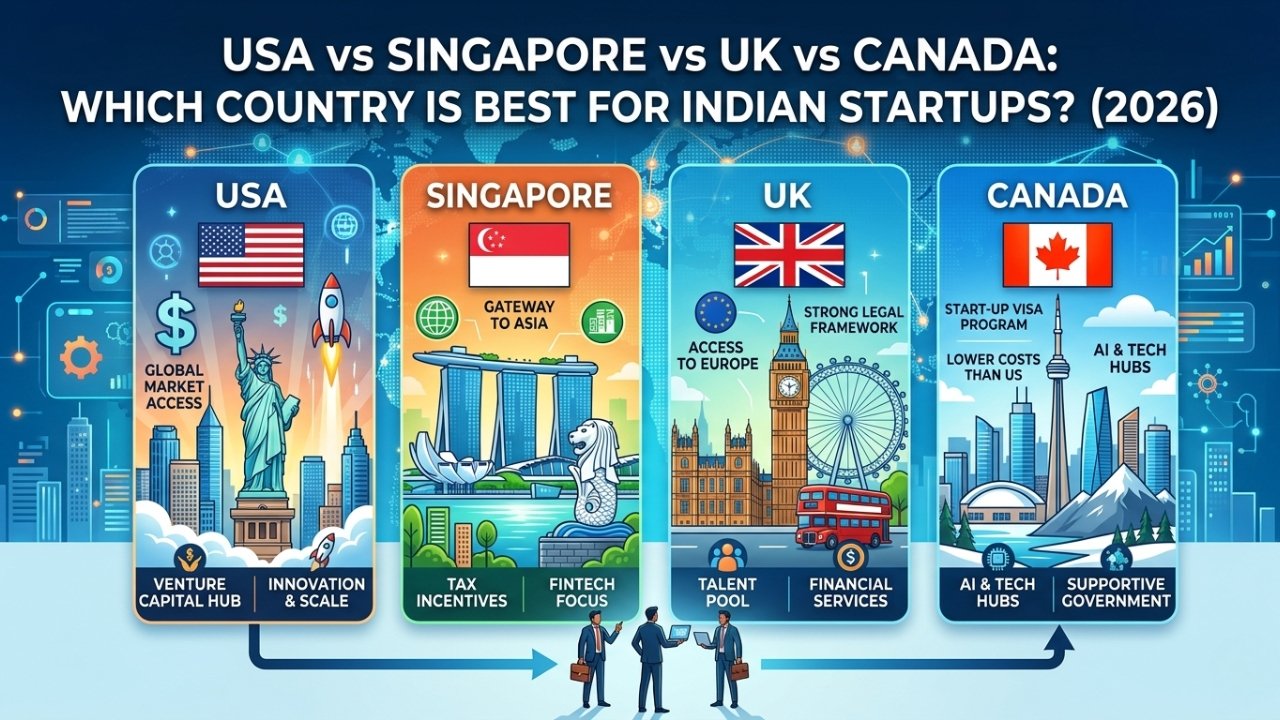
In 2026, Indian startup founders are not short of options. The USA’s Delaware C-Corp remains the gold standard for VC-backed startups. Singapore’s Pte Ltd is the darling of Southeast Asian expansion plays. The UK’s Ltd company structure opens Europe’s door. And Canada’s SR&ED tax incentives are quietly attracting deep-tech founders who need runway, not just prestige.
This guide cuts through the noise. We compare all four jurisdictions across every dimension that actually matters VC fundraising, taxation, market access, banking, compliance costs, and visa pathways so you can make the right call for your specific startup.
Who This Guide Is For
This comparison is written for.
- Indian SaaS founders targeting global markets, currently deciding where to incorporate
- D2C and e-commerce founders weighing logistics, payment rails, and consumer trust
- Deep-tech and biotech startups evaluating R&D tax credits and grant ecosystems
- Founders who have already raised a seed round in India and are now considering a flip or a new holding entity abroad
If you’re still pre-product, this guide still applies but the decision calculus at idea stage is simpler (and leaning toward Singapore or the USA is usually right).
The Four Contenders: A Quick Overview
Before the deep dive, here’s how each country positions itself in the global startup ecosystem.
United States (Delaware C-Corp): Home to Sequoia, a16z, Tiger Global and most of the big-name VC firms. A Delaware C-Corp is the structure US investors expect to see, so choosing it tells them you plan to raise from them.
Singapore (Private Limited / Pte Ltd): A common regional base for Asian holding and tech companies. It is politically stable, tax-efficient and English-speaking, with strong banks, and the Monetary Authority of Singapore (MAS) runs a clear, predictable regime for tech and fintech businesses.
United Kingdom (Private Limited Company / Ltd): Post-Brexit, the UK has doubled down on tech entrepreneurship through initiatives like the Global Talent Visa and SEIS/EIS investor tax relief schemes. London’s fintech ecosystem in particular remains one of the world’s strongest.
Canada (Corporation / Inc.): The dark horse. Canada’s SR&ED (Scientific Research and Experimental Development) programme offers tax credits, refundable in cash for Canadian-controlled private companies, that can fund a startup’s burn rate. Its skilled-worker immigration routes are open, though the Start-up Visa is paused. It is a serious option for deep-tech and AI startups.
Head-to-Head Comparison: Seven Dimensions That Matter
VC Fundraising: Where the Money Lives
This is the most critical factor for most Indian founders, and the answer is almost unambiguous.
USA wins, but only if you’re targeting US VCs.
If your fundraising target is US-based institutional venture capital, you need a Delaware C-Corp. The reason is structural: US institutional LPs invest in funds that are legally constrained from backing non-US entities. Most term sheets from US VCs include a requirement that the company be incorporated in Delaware. Trying to raise from Andreessen Horowitz or Bessemer with a Singapore Pte Ltd will slow you down, require costly restructuring, or simply not work.
A US C-Corp (Delaware is the usual choice) can also issue QSBS (Qualified Small Business Stock). Investors who hold it long enough can exclude gain of up to $15 million per company on stock issued after 4 July 2025 (or 10 times their investment, if higher; $10M for older stock), which makes your cap table more attractive to early-stage US angels.
Singapore is the right answer for Southeast Asian and some India-focused VCs. Firms like Sequoia Southeast Asia, Peak XV (formerly Sequoia India), and many family offices from the GCC specifically prefer Singapore-incorporated entities. If your fundraising is regional rather than strictly US-focused, Singapore’s Pte Ltd is cleaner, faster, and cheaper to maintain.
UK and Canada are weaker for traditional VC fundraising but have niche strengths. The UK’s SEIS and EIS schemes provide meaningful tax relief to UK-based angels (up to 50% income tax relief on SEIS investments), which can make your seed round more attractive locally. Canada’s fundraising ecosystem is thinner but growing, particularly in AI thanks to institutions like BDC Capital and the pan-Canadian AI Strategy.
Verdict: USA (Delaware C-Corp) for US VC. Singapore (Pte Ltd) for Asian VC. UK for angel rounds with UK investors. Canada if you’re explicitly targeting Canadian institutional programs.
Taxation: What You Actually Keep
Taxation is where the conventional wisdom is most often wrong, and where Indian founders leave the most money on the table.
Singapore’s headline corporate tax rate is a flat 17%, and a new company can exempt 75% of its first SGD 100,000 of chargeable income and 50% of the next SGD 100,000 for its first three years. In practice, many Singapore startups pay an effective rate well under 10% in their early years. There is no capital gains tax and no withholding tax on dividends paid to foreign shareholders, a real advantage for Indian founders bringing profits home to India.
The USA has a federal corporate tax rate of 21%, plus state corporate income tax where you do business (Wyoming and South Dakota charge none). Delaware taxes only income from business carried on in Delaware, and a Delaware corporation pays an annual franchise tax from $175 plus a $50 annual report. The US tax system is complex, and Indian founders often face unexpected exposure, particularly on global income once they become US tax residents.
The UK corporate tax rate is 25% for profits above £250,000 (as of 2026), and 19% on profits up to £50,000, with marginal relief in between. HMRC divides these limits by the number of associated companies, so a UK subsidiary of an Indian group can reach 25% sooner. R&D tax relief now runs mainly through the merged R&D Expenditure Credit (RDEC) scheme.
Canada’s federal corporate tax rate is 15%, and provincial tax takes the combined rate to 23% to 30% (Ontario 26.5%). The 9% small business rate on the first CAD 500,000 of active business income is only for Canadian-controlled private corporations (CCPCs), and a company controlled from India is usually not one. SR&ED works the same way: the enhanced 35% credit, refundable in cash, is for CCPCs, while other corporations get a 15% non-refundable credit. Check CCPC status before you count on Canada’s low effective rates.
Verdict: Singapore for tax efficiency with VC optionality. Canada for R&D tax credits, if the company qualifies as a CCPC. USA for access to capital markets despite higher complexity. UK sits in the middle.
Market Access: Selling to Customers
Where you incorporate is not the same as where you sell but they are related in ways that matter.
A US entity dramatically simplifies selling to US enterprise customers. US procurement teams, especially at Fortune 500 companies, are conditioned to work with US-incorporated vendors. SOC 2 compliance (a US framework), US bank accounts, US contracts under US law all of these are expected. A Singapore entity selling to a US corporate buyer will face questions that a Delaware C-Corp simply doesn’t.
For Indian SaaS startups with US enterprise GTM strategies, a Delaware C-Corp is not just a VC requirement it’s a sales requirement.
Singapore is the natural base for Southeast Asian markets. Singapore sits at the geographic and regulatory centre of ASEAN, a 680 million person market that is increasingly digital-first. Singapore companies are a familiar sight to regulators and partners in Indonesia, Vietnam, Malaysia, Thailand and the Philippines, though each of those countries still applies its own foreign-ownership rules.
The UK is still a strong base for selling to European customers, particularly in fintech, healthtech, and legaltech. Despite Brexit, the UK’s financial regulatory framework (FCA-regulated) is trusted across Europe, and London remains Europe’s largest tech hub by venture investment.
Canada’s market access story is primarily about the US, due to the USMCA (formerly NAFTA) trade agreement. For startups that want proximity to the US market with lower operating costs, Canada particularly Toronto and Vancouver offers meaningful advantages.
Verdict: USA for US enterprise sales. Singapore for ASEAN. UK for European regulated industries. Canada for US adjacency with lower costs.
Incorporation Cost & Speed
For early-stage founders, time and money spent on legal setup is time and money not spent on product.
Singapore is quick and inexpensive to incorporate. The Accounting and Corporate Regulatory Authority (ACRA) charges S$15 for the name application and S$300 to register a local company (ACRA fees), and registration on BizFile+ usually takes 1–2 business days once documents are complete. You also need at least one director ordinarily resident in Singapore (many Indian founders use a nominee director) and a resident company secretary within six months. Total first-year costs including a registered address and company secretary typically run SGD 1,000–1,500 (approximately USD 750–1,100). Annual compliance is relatively light.
Delaware C-Corp incorporation typically takes 1–5 business days (expedited options available). State fees are modest: from USD 109 to file a Delaware certificate of incorporation, then from USD 225 a year in franchise tax and annual report fees. The real costs are legal: a proper C-Corp setup with a founders’ agreement, IP assignment, vesting schedules, and initial equity structure will cost USD 3,000–8,000 at a US startup law firm. Many founders use services like Stripe Atlas or Clerky to reduce this cost to USD 500–2,000.
UK Ltd incorporation is usually done online within 24 hours through Companies House, for a filing fee of £100 (source: GOV.UK). Since 18 November 2025 every new director must verify their identity with Companies House (through GOV.UK One Login or an authorised agent) before incorporation, so do this first from India. As with the US, proper legal structuring adds cost: expect £1,000–3,000 for a professionally structured startup.
Canadian incorporation at the federal level (CBCA) is usually done online in 1 business day for CAD 200. A federal corporation needs at least 25% resident Canadian directors (at least one if the board has fewer than four), so founders with no Canadian director often incorporate in Ontario (CAD 300), British Columbia or Alberta, which have no residency rule. Total professional setup costs are similar to the UK: CAD 1,500–4,000 for a properly structured entity.
Verdict: Singapore wins on speed and cost of incorporation. Delaware wins on ecosystem support and standardized documentation. UK and Canada are comparable to each other.
Banking & Payment Infrastructure
A company is only as functional as its ability to move money and this is where many Indian founders hit an unexpected wall.
US banking for a Delaware C-Corp is accessible but not trivial for founders who are not physically in the USA. Mercury, Brex, and Relay have changed this significantly in recent years offering online business bank accounts for US-incorporated companies founded by non-US residents. These fintech banks are now the standard for early-stage Indian-founded US startups.
Singapore banking is excellent DBS, OCBC, and UOB offer business accounts that are trusted globally, and multi-currency capabilities are standard. The challenge: opening a business bank account in Singapore without a locally resident director can be slow.
UK banking is well-developed but incumbent banks (Barclays, HSBC, Lloyds) are notoriously slow for SME account opening. Fintech alternatives like Wise Business, Revolut Business, and Tide have largely solved this problem.
Canadian banking is dominated by the Big Five (RBC, TD, BMO, Scotiabank, CIBC), which are conservative but reliable. Fintech options are growing but less mature than UK or US alternatives.
Verdict: USA (with Mercury/Brex) and Singapore work well for globally mobile Indian founders. UK has good fintech alternatives. Canada’s banking is reliable but less founder-friendly for remote incorporation.
Visa & Founder Relocation
Many Indian founders want to eventually relocate themselves, not just their entity.
USA: The founder visa situation in the US remains challenging. There is no dedicated founder visa. Indian founders typically rely on the O-1A (Extraordinary Ability) or L-1A (Intracompany Transfer) visa, and later on green-card routes such as EB-1C (multinational manager), EB-2 NIW or the EB-5 investor programme. India has no E-2 treaty with the US, so the E-2 investor visa is not open to Indian citizens. The H-1B lottery is not a viable path for founders. Wait times for employment-based green cards from India are historically long (often decades for EB-2/EB-3).
Singapore: The EntrePass is specifically designed for startup founders. You must hold at least 30% of a venture-backed or innovative company registered with ACRA and meet one Ministry of Manpower criterion, such as SGD 100,000 raised from investors. Singapore PR and citizenship pathways, while not automatic, are more predictable than the US for high-skilled professionals.
UK: The Global Talent visa, which needs an endorsement from a Home Office approved body (Tech Nation no longer endorses applicants), and the Innovator Founder visa are the primary routes. The UK is actively competing for global tech talent post-Brexit and the visa system reflects this.
Canada: The Start-up Visa (SUV), which gave permanent residence to founders backed by a designated Canadian VC, angel group or incubator, is paused. IRCC took its last applications on 30 June 2026, and only from holders of a 2025 commitment certificate. Founders now look at Express Entry or a Provincial Nominee Program (PNP), which depend on your own profile.
Verdict: Singapore (EntrePass) and the UK (Innovator Founder) have dedicated founder routes. Canada’s Start-up Visa is paused. The USA is the hardest for Indian founders: no founder visa, no E-2 and long green-card backlogs.
Ecosystem & Network Effects
Ecosystem is about more than capital it’s about customers, talent, advisors, and communities.
The US ecosystem is far larger than the other three. Y Combinator, Techstars and hundreds of other accelerators; Stanford, MIT and the talent around them; and a dense network of repeat founders, operators and investors. If you get into YC or base yourself in the SF Bay Area, that network keeps paying off for decades.
Singapore has a strong ecosystem for a country of its size, anchored by Enterprise Singapore and the Infocomm Media Development Authority (IMDA). The government is an active and sophisticated participant in the startup ecosystem directly funding through grants like the Enterprise Development Grant (EDG) and Startup SG programs.
London is strong in fintech and legaltech, and the London-to-India founder pipeline is well-established. Many Indian founders find London more culturally accessible than Silicon Valley as a first base outside India.
Canada’s ecosystem is growing quickly, particularly in AI (Montreal, Toronto, and the Vector Institute), cleantech (Vancouver), and fintech (Toronto). The government’s pan-Canadian AI Strategy has produced real density in machine learning research.
Verdict: USA for maximum network effect. Singapore for regional Asia + government support. UK for fintech/legaltech and Indian diaspora network. Canada for AI and deep-tech research density.
Delaware C-Corp vs Singapore Pte Ltd for VC Fundraising: Which to Choose
This is the question we get most often, and it deserves its own section.
Choose Delaware C-Corp if
- You are targeting US-based institutional VCs (Tier 1 or Tier 2 US funds)
- Your primary market is the United States
- You plan to list on a US exchange (NASDAQ/NYSE) as an exit
- You have already engaged with US angels or accelerators (YC, Techstars, a16z Scout, etc.)
- Your co-founders are willing to or are already living in the US
Choose Singapore Pte Ltd if
- Your primary investor targets are Southeast Asian VCs, India-focused funds, or GCC-based family offices
- You are building for the ASEAN, Middle East, or South Asian market
- You want a tax-efficient, compliance-light holding structure
- Your co-founders are based in Singapore or are willing to relocate there
- You want to avoid the complexity of US tax reporting as a foreign-founded company
The Flip: Many Indian startups that incorporate in Singapore early find themselves doing a “flip” to a Delaware C-Corp structure once they’re ready for Series A from US VCs. This flip (technically a share swap where Singapore entity shareholders receive shares in a new Delaware entity) costs USD 10,000–25,000 in legal fees and takes 2–4 months. It’s manageable, but it’s better to anticipate it early and structure Singapore cap tables cleanly.
The Verdict: Which Country Is Best for Your Indian Startup?
There is no single right answer, but there are right answers for specific startup profiles.
| Startup Profile | Best Country | Entity Type |
|---|---|---|
| Indian SaaS targeting US enterprise | USA | Delaware C-Corp |
| Consumer app targeting Southeast Asia | Singapore | Pte Ltd |
| Fintech targeting Europe/UK | United Kingdom | Ltd |
| AI/ML deep-tech with R&D-heavy roadmap | Canada | Corporation (federal or provincial) |
| Pre-Series A, raising from Indian/GCC VCs | Singapore | Pte Ltd |
| Targeting US VCs at Series A+ | USA | Delaware C-Corp |
| Founder wants a dedicated founder visa | Singapore or United Kingdom | Pte Ltd (EntrePass) or Ltd (Innovator Founder) |
| Founder wants lowest corporate tax | Singapore | Pte Ltd |
Common Mistakes Indian Founders Make
Mistake 1: Incorporating in the wrong country because their co-founder’s immigration lawyer suggested it. Immigration law and startup corporate law are different fields. A visa pathway and the best entity for fundraising are separate considerations.
Mistake 2: Assuming Singapore is always cheaper than the USA. Annual compliance costs for a Singapore Pte Ltd (company secretary, annual returns, audit thresholds) can surprise founders. Delaware annual costs are also real (under the authorised shares method, franchise tax rises with the number of shares you authorise, so set that number with care).
Mistake 3: Waiting too long to decide. Every month you operate as an unregistered entity, or as an Indian entity that you plan to flip, is a month of IP assignment complexity, employee agreement messiness, and investor concern. Decide early.
Mistake 4: Building your cap table without thinking about the future. Singapore cap tables with complex ESOP structures, convertible notes in Indian rupees, and multiple share classes can make a flip to Delaware expensive and time-consuming. Keep early-stage cap tables clean.
Frequently Asked Questions
Which is better for an Indian founder: USA, Singapore, UK or Canada?
It depends on who funds you and where you sell. A Delaware C-Corp suits founders raising from US VCs or selling to US enterprises. A Singapore Pte Ltd suits Asian and India-focused investors and ASEAN markets, with a flat 17% tax. A UK Ltd suits European fintech and UK angels. Canada suits R&D-heavy teams that can qualify as a CCPC. Without a clear US-first plan, Singapore is the most flexible start.
Which has the lowest corporate tax: USA, Singapore, UK or Canada?
Singapore, at a flat 17%, and a new company exempts 75% of its first SGD 100,000 and 50% of the next SGD 100,000 for three years. The UK charges 19% on profits up to £50,000 and 25% above £250,000. The US charges 21% federal plus state tax, which is nil in Wyoming and South Dakota. Canada’s combined rate is 23% to 30%, as an India-controlled company usually cannot use the 9% small business rate.
Where is it cheapest to set up a company: USA, Singapore, UK or Canada?
On government fees, the UK (£100 online) and a Wyoming LLC ($100) are the cheapest, followed by a Canadian federal corporation (CAD 200). Singapore charges S$15 for the name and S$300 to register, but you also pay for a resident director and a company secretary each year. A Delaware C-Corp costs from $109 to file and from $225 a year. Legal structuring usually costs more than the filing itself.
Which is fastest to register in: USA, Singapore, UK or Canada?
The UK is usually fastest: Companies House registers online within 24 hours once every director has verified their identity. A Canadian federal corporation takes 1 business day online and a Singapore Pte Ltd 1–2 business days. A Delaware or Wyoming filing takes 1–5 business days, and the EIN and bank account take longer. In every case, file your ODI through your AD Category-I bank before you send money from India.
Can I incorporate in Delaware but live in India?
Yes. A Delaware C-Corp does not require its founders or directors to be US residents or citizens. You need a registered agent in Delaware (about USD 100–150 a year) and an EIN, which you request from the IRS by fax, mail or phone if you have no SSN or ITIN. A US business account follows; Mercury and Brex work well for remote founders.
Is a Singapore Pte Ltd suitable for ESOP issuance to Indian employees?
Yes, but there are compliance steps under India’s Foreign Exchange Management Act (FEMA) and the RBI’s overseas investment rules. Employees in India who receive ESOPs from a foreign company must meet Indian reporting requirements, and the Indian entity that employs them has its own filings. Work with a CA who knows both the Indian and Singapore rules before you grant options.
How long does it take to flip from Singapore to Delaware?
Typically 2–4 months from start to close, assuming a clean cap table. Expect USD 10,000–25,000 in US legal fees, plus the cost of keeping or dissolving the Singapore company. Start well before you need the flip finished, for example before a US Series A, because investors will want the new structure in place before they sign.
Does incorporating in Canada help with US market access?
Partly. USMCA gives trade advantages, and shared time zones and proximity help day to day. US enterprise customers and US VCs still prefer a US-incorporated company for contracts and legal familiarity, so many Canadian startups add a US entity once they start selling or raising in the US.
Conclusion
The best country for your Indian startup in 2026 depends entirely on where your capital is coming from, who your customers are, and where you personally want to build your life.
If US venture capital and the US enterprise market are your north star, Delaware is non-negotiable.
If you want tax efficiency, regional optionality, and a clean compliance structure while you find your product-market fit, Singapore is the smartest default.
If deep-tech R&D credits matter more to you right now than prestigious zip codes, and your Canadian company can qualify as a CCPC, Canada deserves serious consideration.
And if you’re building for European regulated industries with a clear London GTM, the UK’s ecosystem and investor base make it the right call.
No jurisdiction is perfect. Every choice involves tradeoffs. The key is making the decision deliberately, with full awareness of the implications for fundraising, taxation, talent, and your own life as a founder.
More USA guides
Setting up in USA? Our USA company formation page explains the process and the services we offer. Other guides in this series:
- US Visas for Indian Entrepreneurs E-2, L-1, O-1, H-1B & EB-5 Investor Pathways (2026)
- USA Company Costs Delaware vs Wyoming, Formation Fees, Annual Costs & Hidden Charges (2026)
- FEMA, RBI & Indian Tax Rules for Indians Owning a US Company ODI, DTAA, Pass-Through & Form 5472
- How to Open a US Bank Account for Your Company Mercury, Relay, Big Banks & Remote Options (2026)
- USA Company Compliance Checklist 2026 for Indian Founders: IRS, State and FEMA Filings
- USA Tax Guide for Indian Entrepreneurs Federal 21%, State Taxes, LLC vs C-Corp, Pass-Through, FIRPTA & DTAA (2026)
- How to Register a Company in the USA from India LLC vs C-Corp, Delaware vs Wyoming, Step-by-Step (2026)
All USA articles: USA guides.