 Comply Globally
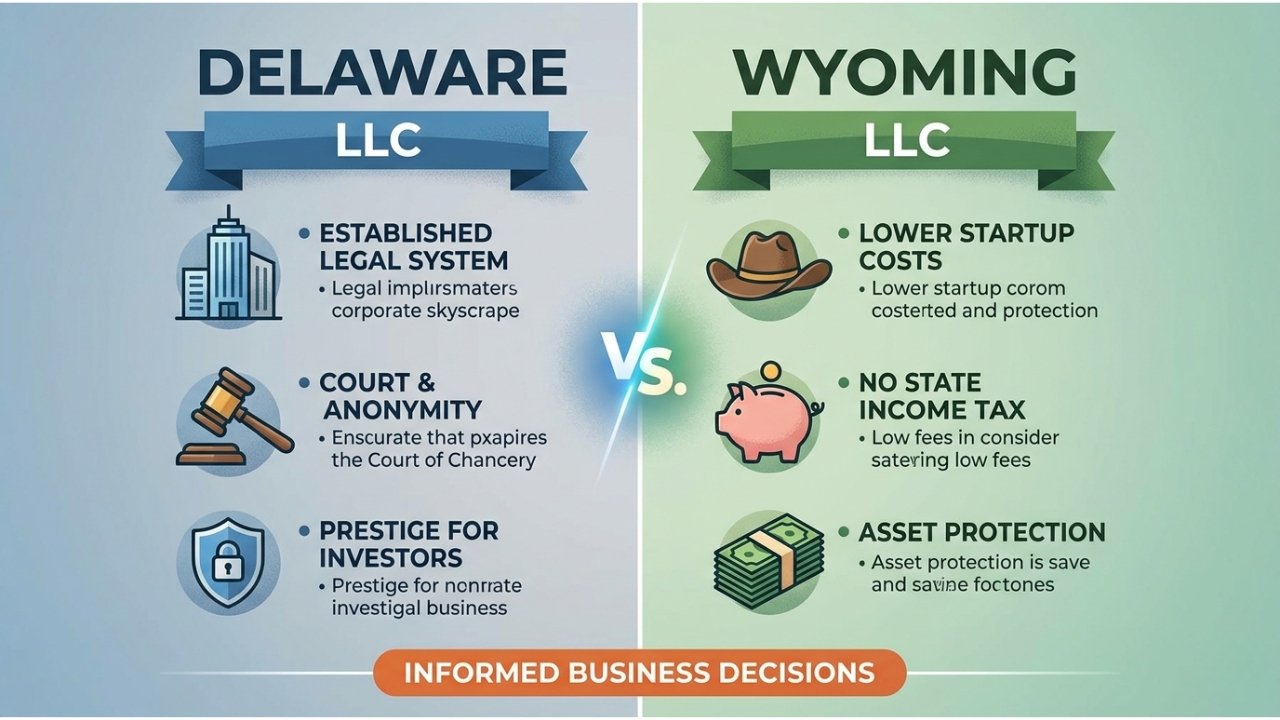
Delaware-vs-wyoming-llc-a-comparison-for-informed-business-decisions Choosing the right state to form your LLC is one of the most consequential early decisions a founder makes. Delaware and Wyoming have emerged as the two dominant favorites each with a distinct philosophy. This guide cuts through the noise so you can choose with confidence.
Why State of Formation Matters
When you form a Limited Liability Company (LLC), you’re not just filing paperwork you’re opting into a legal and tax framework that will govern your business for years. The state you choose determines your annual fees, privacy protections, legal flexibility, and investor credibility, regardless of where you actually operate.
Both Delaware and Wyoming allow non-residents to form LLCs, and both have earned stellar reputations. But they attract very different types of businesses for very different reasons. Understanding those differences is the foundation of a smart choice.
Delaware LLC: The Corporate Establishment’s Choice
Delaware has long been the default home for serious businesses. More than 65% of Fortune 500 companies are incorporated in Delaware, and the state has spent over a century refining its business law infrastructure. This isn’t just reputation it’s a functional ecosystem built for business.
The Court of Chancery
Delaware’s most distinctive advantage is its Court of Chancery a specialized business court with no jury trials and judges who are dedicated experts in corporate law. Disputes are resolved faster, more predictably, and with greater legal sophistication than in most other states. For businesses expecting complex litigation or investor relationships, this is invaluable.
Investor Expectations
Venture capitalists and institutional investors almost universally expect Delaware formation. If you plan to raise outside capital, go public, or be acquired, Delaware is effectively the industry standard. Choosing otherwise can create friction and legal restructuring costs down the road.
Flexible Operating Agreements
Delaware’s LLC Act gives members enormous contractual freedom. You can customize governance, allocate profits asymmetrically, and structure membership rights in sophisticated ways that hold up in court. This makes Delaware particularly attractive for multi-member LLCs with complex arrangements.
✦ Pros
- Prestigious, investor-recognized jurisdiction
- Specialized Court of Chancery
- Highly developed, predictable case law
- Flexible LLC statutes
- Ideal for startups seeking funding
✦ Cons
- $300/year minimum franchise tax
- Registered agent fee required
- Requires foreign registration if operating elsewhere
- Less privacy than Wyoming
- Higher ongoing compliance costs
Wyoming LLC The Privacy & Cost Pioneer
Wyoming was actually the first state in the U.S. to create the LLC structure in 1977. Since then, it has positioned itself as the friendliest state for small business owners, entrepreneurs, and those who value financial privacy. Wyoming charges no state income tax and that applies to LLCs too.
Privacy Protections
Wyoming offers some of the strongest anonymity protections in the country. Members and managers are not required to be listed in public filings. You can use a nominee manager, keeping your identity shielded from public records. For privacy-conscious entrepreneurs, this is a significant advantage.
Low Cost to Form and Maintain
The initial filing fee in Wyoming is just $100, and the annual report fee is only $60 (for businesses with less than $300,000 of assets in Wyoming). Compared to Delaware’s franchise taxes and registered agent fees, Wyoming is dramatically more affordable over time especially for small businesses and solo operators.
Strong Asset Protection
Wyoming has robust charging order protections, meaning creditors generally cannot seize your LLC interest to satisfy a personal debt they can only receive a charging order against distributions. This is one of the strongest single-member LLC protections in the nation.
Side-by-Side Comparison
Factor | DE Delaware | WY Wyoming |
|---|---|---|
Formation Fee | ~$90 (plus registered agent) | $100 flat |
Annual Fee | $300 minimum franchise tax | $60 (assets under $300K) |
State Income Tax | None for LLCs (pass-through) | None |
Member Privacy | Moderate some public disclosure | High no public listing required |
Court System | Specialized Court of Chancery | General civil courts |
Case Law Depth | Extensive, highly developed | Growing but limited |
Asset Protection | Good | Excellent (strongest in nation) |
Investor Preference | Industry standard for VC/PE | Less recognized by investors |
The Foreign Registration Reality
A point that trips up many new entrepreneurs: forming your LLC in Delaware or Wyoming doesn’t exempt you from registering in your home state if you’re actively doing business there. If you live in California and operate a Wyoming LLC, you’ll likely need to file as a foreign LLC in California paying California’s fees on top of Wyoming’s.
This “double registration” requirement means that the cost savings from Wyoming or the legal advantages of Delaware may be partially offset by your home state’s fees. Always factor this into your total cost-of-formation calculation before deciding.