 Comply Globally
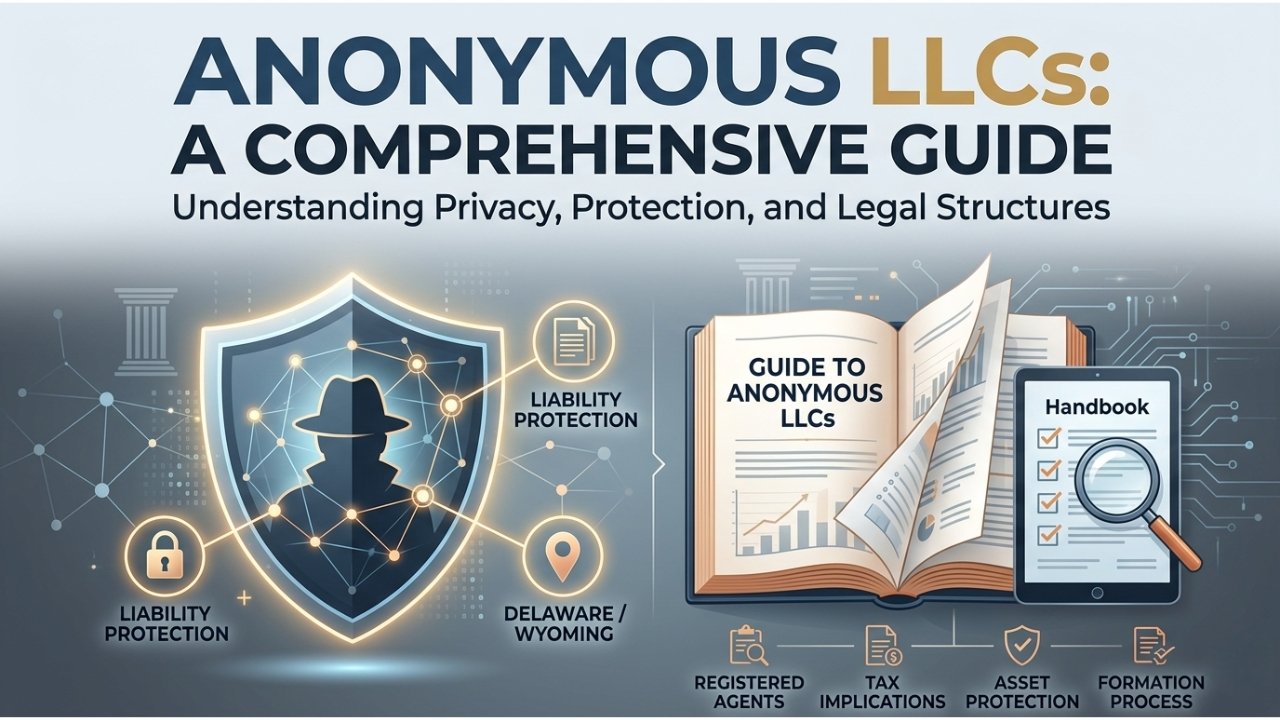
Privacy in business is no longer a luxury it’s a strategic necessity. Whether you’re a real estate investor, a public-facing entrepreneur, or simply someone who values personal security, an anonymous LLC can be one of the most powerful tools in your legal arsenal. This guide breaks down everything you need to know: what anonymous LLCs are, which states offer them, how to form one, and the critical legal and tax considerations that come with them.
What Is an Anonymous LLC?
Anonymous-llcs-a-comprehensive-guide (Limited Liability Company) is a business entity structured so that the identity of its owners referred to as “members” does not appear in publicly accessible government records. In most states, when you form an LLC, the names of the members or managers are filed with the state and become part of the public record. Anyone with internet access can look up who owns the business.
An anonymous LLC sidesteps this by exploiting the disclosure rules (or lack thereof) in certain states. When the state does not require member names to appear on formation documents, ownership information stays out of the public domain. The LLC itself exists as a legal entity, but its human owners remain in the shadows legally and transparently.
It is crucial to understand from the outset: anonymity here refers to public anonymity, not absolute secrecy. The IRS, law enforcement with proper legal authority, and in some cases financial institutions will still be able to access ownership information. Anonymous LLCs are a shield from public exposure, not from legitimate legal or tax obligations.
Why Use an Anonymous LLC?
Personal Privacy & Security
High-net-worth individuals, celebrities, activists, and public figures often hold real estate or business assets in anonymous LLCs to prevent stalkers, disgruntled individuals, or unwanted solicitation. When a news story reports a celebrity’s home address, the owner was often traceable through public LLC records.
Asset Protection
Privacy and liability protection go hand in hand. If litigants or would-be plaintiffs cannot easily determine what assets you own because your name doesn’t appear on the deed or the corporate record it becomes harder to identify you as a worthwhile target for a lawsuit.
Competitive Confidentiality
Business owners sometimes prefer that competitors, vendors, or the general public not know which properties or companies they own. A restaurant group, for instance, might hold each location in a separate anonymous LLC to prevent a competitor from mapping their expansion strategy.
Reducing Unwanted Solicitation
Landlords and real estate investors frequently cite unsolicited offers, spam mail, and cold calls as reasons for choosing anonymous ownership structures. Removing your name from the public record significantly reduces this noise.
Privacy is not the same as secrecy. One protects your safety and autonomy; the other implies wrongdoing. An anonymous LLC is a tool for the former and entirely legal when used properly.
Best States for Anonymous LLCs
Only a handful of U.S. states permit true anonymity in LLC formation meaning they do not require member or manager names on public-facing documents. The four most widely recognized are Wyoming, Delaware, New Mexico, and Nevada.
State | Members Public? | Annual Fee | State Tax | Notable Advantage |
Wyoming | No | ~$62/yr | None | Strong charging order protection; low cost |
Delaware | No | $300/yr | Franchise tax | Prestigious; favored by investors & VCs |
New Mexico | No | None | None | No annual report requirement; cheapest option |
Nevada | No | ~$350/yr | None (income) | Strong privacy statutes; no info sharing with IRS |
Wyoming The Gold Standard
Wyoming is widely regarded as the best all-around state for anonymous LLC formation. It pioneered the LLC structure in 1977 and has continuously refined its laws to favor business owners. Wyoming does not require member or manager names in its Articles of Organization, offers strong charging order protections, has no state income tax, and charges minimal fees. For most individuals, Wyoming is the first recommendation.
New Mexico The Budget Option
New Mexico is uniquely attractive because it charges no annual report fee and requires no annual maintenance filings. This makes it the lowest-cost option for those who simply want privacy without ongoing administrative burden. The trade-off is slightly less established case law and fewer bells and whistles in terms of protective statutes.
Delaware The Prestige Option
Delaware is the corporate capital of America more than half of Fortune 500 companies are incorporated there. It offers robust privacy protections and is especially useful if you plan to raise venture capital or work with institutional investors, who often prefer or require Delaware entities.
How to Form an Anonymous LLC
The process is more straightforward than most people expect. Here is a step-by-step breakdown:
- Choose your privacy-friendly state.Based on your goals cost, prestige, asset protection depth select Wyoming, New Mexico, Delaware, or Nevada.
- Hire a registered agent.A registered agent is a person or service that accepts legal documents on behalf of your LLC. This is required in all states. By using a professional registered agent service, you keep your personal address out of public records.
- Use a nominee organizer (if needed).Some formations require the name of an “organizer” on the Articles of Organization. If your state requires this, you can hire a third-party nominee service to sign these documents on your behalf, keeping your name entirely off the record.
- File Articles of Organization.File with the secretary of state. In Wyoming, New Mexico, Delaware, and Nevada, you do not list member names here only the registered agent’s information and the LLC name.
- Draft an Operating Agreement.This internal document governs how the LLC operates. It can list ownership percentages and member names but is not filed with the state it remains private.
- Obtain an EIN.You’ll need an Employer Identification Number from the IRS for banking and tax purposes. The EIN application does require ownership information, which goes to the IRS not the public.
- Open a business bank account.Use your EIN and formation documents to open a separate business bank account. This is critical for maintaining the “corporate veil” that protects your personal assets.
The Double LLC Strategy
What if you need to operate in a state that requires public disclosure of members? This is where the “Double LLC” or “LLC stack” strategy comes in and it’s one of the most effective privacy structures available.
The structure works as follows:
- Layer 1 (Operating LLC): Form an LLC in the state where you actually do business (e.g., Texas or California). This entity will own the property or conduct the business. Its member is listed as the Wyoming LLC not you personally.
- Layer 2 (Anonymous Holding LLC): Form an LLC in Wyoming (or New Mexico). This Wyoming LLC is the member/owner of the operating LLC. Since Wyoming doesn’t require your name on its formation documents, your identity is still not public.
The result is a two-layer structure where your name appears nowhere in any public record. Even if someone looks up your Texas LLC, they see only “Wyoming Holdings LLC” as the member and looking up that Wyoming entity reveals only a registered agent address.
Pro tip: Many privacy-conscious investors use a different Wyoming LLC for each property they own. This not only preserves anonymity but also creates liability silos a lawsuit against one property cannot reach assets held in a separate LLC.
Legal & Compliance Considerations
The Corporate Transparency Act (CTA)
Effective January 1, 2024, the Corporate Transparency Act significantly changed the landscape for anonymous LLCs. Under the CTA, most U.S. LLCs and corporations are required to file Beneficial Ownership Information (BOI) reports with the Financial Crimes Enforcement Network (FinCEN), a bureau of the U.S. Treasury. These reports identify the real human beings who ultimately own or control the entity.
Crucially, these filings are not public. FinCEN’s database is accessible only to law enforcement, financial institutions with customer due diligence obligations, and certain government agencies. This means the CTA does not eliminate the public anonymity of your LLC it simply ensures the government knows who the beneficial owners are. Consult a qualified attorney to ensure your LLC is properly registered under CTA requirements, as penalties for non-compliance can be significant.
Maintaining the Corporate Veil
An anonymous LLC provides no protection if the corporate veil is pierced. Courts will ignore the LLC structure exposing your personal assets if you commingle personal and business funds, fail to maintain proper records, or use the LLC as an alter ego. Keep separate bank accounts, sign contracts in the LLC’s name, and maintain a proper operating agreement.
Legal Purposes Only
Anonymous LLCs are entirely legal tools for legitimate privacy and asset protection. They cannot and should not be used to evade taxes, defraud creditors, launder money, or circumvent court orders. Misuse of any corporate structure for illegal purposes exposes you to severe criminal and civil liability, and courts will undo the anonymity without hesitation.
Tax Implications
An anonymous LLC does not change your federal tax obligations it only changes how your ownership is disclosed to the public. By default, a single-member LLC is a “disregarded entity” for tax purposes, meaning the LLC’s income flows directly onto your personal tax return (Schedule C or Schedule E). A multi-member LLC is treated as a partnership.
You can elect to have your LLC taxed as an S-Corporation or C-Corporation if that is more advantageous for your situation. None of these elections affect privacy they only affect how income is taxed. Always work with a CPA or tax attorney to determine the optimal tax structure for your specific circumstances.
Limitations & Risks
- Not absolute protection: Judges can compel disclosure in litigation. Law enforcement with a warrant can access FinCEN records. Banks must know who you are under KYC (Know Your Customer) rules.
- Foreign qualification costs: If you form a Wyoming LLC but operate in California, you may need to “foreign qualify” in California, incurring additional fees and depending on California’s rules potentially disclosure requirements.
- Increased complexity: A double LLC structure means two sets of fees, two annual reports, and two entities to maintain. This complexity requires organizational discipline and professional guidance.
- Not suitable for all business types: Regulated industries (financial services, healthcare, real estate brokerage) often have their own licensing and disclosure requirements that override LLC privacy protections.
Frequently Asked Questions
Is forming an anonymous LLC legal?
Yes. Forming an LLC in a state that doesn’t require public disclosure of members is entirely legal. Privacy is a recognized and legitimate purpose for structuring a business this way, provided you comply with all tax laws and the Corporate Transparency Act’s beneficial ownership reporting requirements.
Can I use an anonymous LLC to buy real estate?
Absolutely. This is one of the most common uses. Real estate investors, landlords, and high-profile buyers frequently use anonymous LLCs or the double LLC structure to keep their names off property deeds while still enjoying liability protection and the organizational benefits of LLC ownership.
Do I need a lawyer to form an anonymous LLC?
It is not legally required, but it is highly recommended especially for structuring purposes, the double LLC strategy, or if you operate across multiple states. A business attorney can ensure your structure achieves the privacy and protection you need while remaining fully compliant with state and federal law.
What’s the cheapest way to form an anonymous LLC?
New Mexico is the most cost-effective option, with no filing fee (typically around $50 for state filing) and no annual report requirement. Using a registered agent service typically costs $50–$150 per year. Total cost can be under $200 to set up and maintain annually.
How does the Corporate Transparency Act affect my anonymous LLC?
The CTA requires you to file beneficial ownership information with FinCEN but this information is not public. Your LLC’s public-facing anonymity is preserved; however, you now have a federal reporting obligation. Non-compliance carries fines and potential criminal penalties, so ensure you understand and meet your CTA obligations.
Final Thoughts
An anonymous LLC is not a vehicle for wrongdoing it is a sophisticated, entirely legal privacy tool that thousands of business owners, investors, and entrepreneurs rely on every year. When formed properly, maintained diligently, and used for legitimate purposes, it offers a meaningful layer of public privacy, liability protection, and peace of mind.
The landscape is evolving particularly with the Corporate Transparency Act requiring beneficial ownership reporting to FinCEN but public anonymity remains achievable. Choose the right state, work with qualified professionals, and maintain the corporate formalities that make your LLC bulletproof.
Privacy is a right. An anonymous LLC is simply one of the most legally sound ways to exercise it in the context of business ownership.