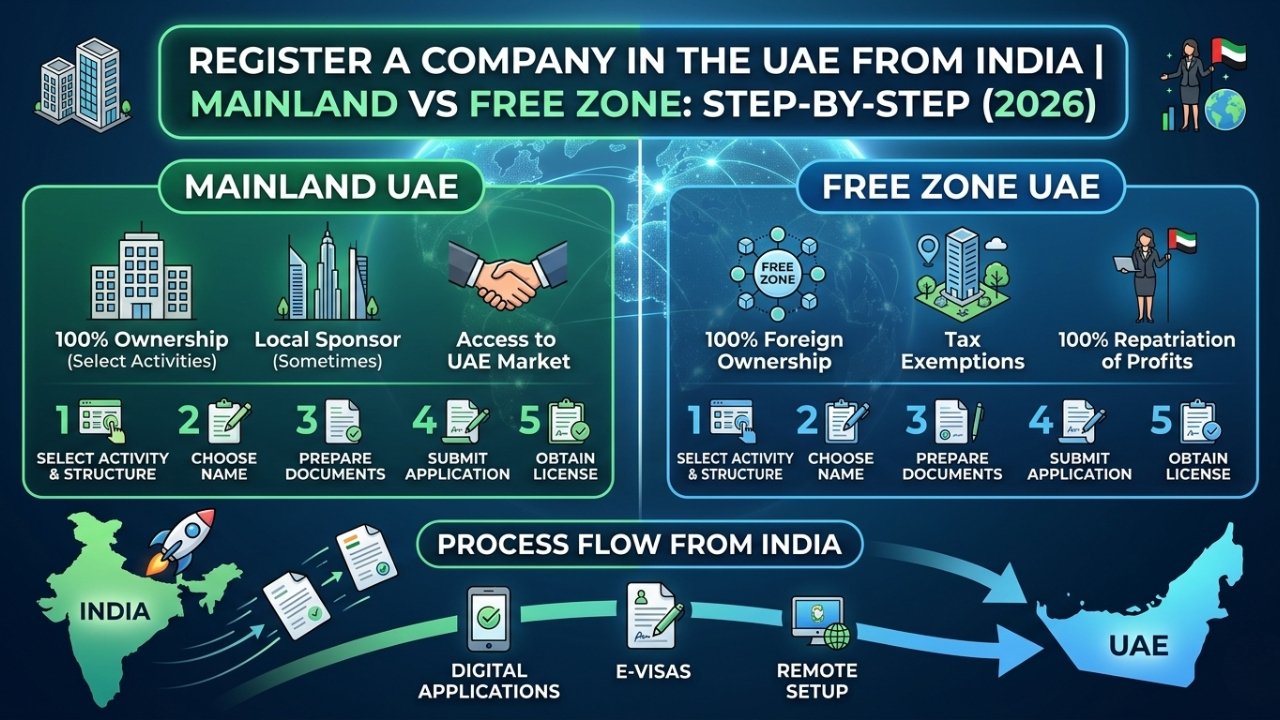
The UAE has become one of the most popular places for Indian entrepreneurs to register a company abroad, and for good reason. Zero personal income tax, a booming consumer economy, proximity to India, a massive Indian diaspora, and since the 2021 Companies Law reforms, 100% foreign ownership on mainland without a local sponsor in most sectors.
If you are an Indian founder, freelancer, or business owner asking “can I start a business in Dubai?” the short answer is yes, and this guide tells you exactly how.
This is the most detailed, up-to-date step-by-step guide to UAE company formation from India in 2026, covering mainland vs free zone, the right emirate, the right structure, the documents you need, and what actually requires you to travel to the UAE.
Can Indians Start a Business in the UAE? (The 2021 Ownership Reform Explained)
Yes, Indians can fully own and operate businesses in the UAE. This was not always straightforward until 2021, most mainland UAE companies required a UAE national to hold at least 51% of the shares, effectively acting as a local sponsor or partner. That system created significant risk for foreign founders.
The UAE Federal Decree-Law No. 32 of 2021 on Commercial Companies fundamentally changed this. 100% foreign ownership on the UAE mainland is now permitted across most business activities. The local sponsor requirement has been abolished for the vast majority of sectors. The exceptions typically strategic sectors like oil, gas, utilities, defence, and certain professional services are defined on a Positive List maintained by each emirate.
This reform makes the UAE a genuinely competitive option against free zones, which already permitted 100% foreign ownership but came with trading restrictions. Today, Indian founders can own 100% of a mainland UAE company, trade directly with UAE customers, bid on government contracts, and operate retail outlets all without a local partner.
One critical practical point: while 100% ownership is legally available, some business activities still require a UAE national service agent (not an equity holder, just an administrative representative) or a professional licence held by a UAE-licensed individual. Confirm your specific activity with an authorised business setup consultant before proceeding.
UAE Mainland vs Free Zone: The Core Difference
This is the most important decision you will make in your UAE company formation process. It affects where you can trade, how you are taxed, your visa allocation, and your cost structure.
UAE Mainland Company
A mainland company is licensed by the Department of Economy and Tourism (DET) in Dubai, the Department of Economic Development (DED) note that in Dubai this was rebranded to DET, while other emirates still use DED or the equivalent authority in each emirate.
Key characteristics of a mainland company.
- Can trade freely anywhere in the UAE, including with government entities and local businesses
- Can bid on federal and emirate government tenders
- Can operate retail outlets, physical offices, or branches anywhere in the UAE without restriction
- Required to have a physical office in the UAE (flexi-desk options exist but must be verifiable)
- Subject to UAE’s 9% corporate tax on profits exceeding AED 375,000 (introduced from June 2023)
- Can sponsor an unlimited number of employee visas (subject to office space requirements)
- UBO (Ultimate Beneficial Owner) registration mandatory within 60 days of incorporation (and update required within 15 days of any change)
Best suited for: Businesses that sell to UAE end consumers, trade in physical goods, provide professional services to UAE companies, want to bid on government contracts, or plan to operate multiple physical locations.
UAE Free Zone Company
There are over 40 free zones in the UAE, each administered by its own authority. Major ones relevant to Indian founders include: DMCC (Dubai Multi Commodities Centre), DIFC (Dubai International Financial Centre), Dubai South, DAFZA (Dubai Airport Free Zone), ADGM (Abu Dhabi Global Market), RAKEZ (Ras Al Khaimah Economic Zone), Sharjah Media City (Shams), and Ajman Free Zone, among others.
Key characteristics of a free zone company.
- 100% foreign ownership (predates the 2021 reforms this was always the case in free zones)
- Zero corporate tax on qualifying income within the free zone (subject to meeting “qualifying free zone person” criteria under the UAE Corporate Tax Law)
- Cannot trade directly with UAE mainland customers without a local distributor or agent this is the key restriction
- Physical presence requirements vary by free zone (some require a proper office; many offer flexi-desk or virtual office options)
- Faster incorporation (often 3–7 days vs 2–4 weeks for mainland)
- Lower setup costs in several free zones, particularly RAKEZ, Shams, and Ajman
Best suited for: Export-oriented businesses, international trading companies, service businesses with global clients, digital businesses, freelancers and consultants whose clients are primarily outside the UAE, and financial/professional services firms (DIFC, ADGM).
The Hybrid Strategy: Free Zone + Mainland Branch
Many Indian founders start with a free zone company and later add a mainland branch once UAE revenues justify the additional cost. A free zone company can appoint a mainland distributor or commercial agent to sell products in the UAE mainland market. This is a legitimate and widely used structure.
Mainland vs Free Zone Comparison Table
| Factor | Mainland (DET/DED Licence) | Free Zone |
|---|---|---|
| Foreign Ownership | 100% (post-2021, most activities) | 100% (always) |
| Trade with UAE Mainland | Unrestricted | Via local distributor only |
| Government Contracts | Yes | No (generally) |
| Corporate Tax | 9% above AED 375K profit | 0% (if qualifying FZ person) |
| Physical Office Required | Yes (can be flexi-desk) | Varies (many offer virtual) |
| Visa Allocation | Based on office size | Based on package |
| Setup Timeline | 2–4 weeks | 3–10 days |
| Setup Cost Range | AED 15,000–50,000+ | AED 5,500–30,000+ |
| UBO Registration | Mandatory within 60 days | Varies by free zone |
| Audit Requirement | Yes (for LLCs above threshold) | Varies |
UAE Company Structures: LLC vs FZE vs FZCO Explained
Understanding the legal entity types available to Indian founders is essential before you begin the formation process.
UAE LLC (Limited Liability Company) Mainland
The LLC is the most common mainland structure. Post-2021 reforms, Indians can own 100% of an LLC in most activities. The LLC requires a minimum of 1 and a maximum of 50 shareholders, a UAE-registered office, and a trade licence from DET (Dubai) or the relevant emirate’s DED.
LLCs are appropriate for: trading, retail, hospitality, construction, most professional services, and any business that needs to contract directly with UAE government entities.
FZE (Free Zone Establishment) Single Shareholder
An FZE is a free zone entity with a single shareholder either an individual or a corporate body. It is the free zone equivalent of a sole proprietorship with limited liability. Most free zones offer this structure and it is the most common for solo Indian founders setting up in the UAE.
FZCO (Free Zone Company) Multiple Shareholders
An FZCO is a free zone entity with two or more shareholders. If you are co-founding a UAE free zone company with a partner, an FZCO is the structure to use. Shareholding, profit distribution, and exit provisions are governed by the free zone’s own company regulations and your shareholders’ agreement.
Branch of a Foreign Company
An Indian company can open a branch office in the UAE either a mainland branch or a free zone branch. The branch is not a separate legal entity; it is an extension of the Indian parent company. This means the Indian parent is liable for the branch’s activities. Branch offices are used by established Indian companies looking to establish a UAE sales presence without creating a separate legal entity. They require a UAE national agent in some cases.
Professional Licence (Sole Establishment)
For individual professionals doctors, engineers, architects, lawyers, accountants a professional licence (sole establishment) allows practice in the UAE. This structure does not provide limited liability and requires the licence holder to be personally qualified in the relevant profession.
Which Emirate Is Best for Indian Business?
The UAE has seven emirates: Dubai, Abu Dhabi, Sharjah, Ras Al Khaimah, Fujairah, Ajman, and Umm Al Quwain. Each has its own DED (or equivalent), its own free zones, and its own cost structure.
Dubai
The most international business hub in the UAE and the default choice for most Indian founders. Dubai offers the largest consumer market, best infrastructure, the most free zones (including DMCC, DIFC, Dubai South, DAFZA, Dubai Silicon Oasis), and the most developed professional services ecosystem. Cost of living and office rents are higher than other emirates.
Best for: B2C businesses, luxury goods, fintech, tech startups, professional services, trading companies.
Abu Dhabi
The UAE capital and the seat of federal government. Abu Dhabi is the largest emirate by land area and GDP. It has a strong government-linked economy, significant oil wealth, and growing ambition to diversify into technology and finance. ADGM (Abu Dhabi Global Market) is a world-class financial free zone modelled on English common law.
Best for: Financial services, sovereign wealth fund-adjacent businesses, government contractors, healthcare, and companies targeting Abu Dhabi government entities.
Ras Al Khaimah (RAK)
RAKEZ (Ras Al Khaimah Economic Zone) is one of the most cost-effective free zone options in the UAE. Trade licences start from approximately AED 5,500 per year. RAK is increasingly popular among Indian founders who want UAE incorporation primarily for global banking, invoicing, and tax residency purposes rather than a large physical UAE presence.
Best for: Cost-conscious founders, international consultants, e-commerce businesses, export-oriented companies, founders seeking UAE tax residency at minimal cost.
Sharjah
Shams (Sharjah Media City) is a popular low-cost free zone particularly favoured by content creators, media companies, and freelancers. Sharjah mainland is also cost-effective. Geographically close to Dubai.
Best for: Media, publishing, creative agencies, freelancers, early-stage founders testing UAE incorporation.
Ajman
Ajman Free Zone is among the most affordable free zone options and offers easy incorporation. Proximity to Dubai makes it practical for businesses with Dubai operations but Ajman incorporation.
Best for: Budget-first setups, trading businesses, founders who need UAE incorporation at the lowest possible cost.
Step-by-Step: How to Register a Company in the UAE from India
Here is the complete UAE company formation process for Indian founders, from decision to trading.
Choose Your Structure and Emirate
Based on the mainland vs free zone analysis above, decide on.
- Mainland or free zone
- Which emirate
- Which specific free zone (if applicable)
- Entity type (LLC, FZE, FZCO, Branch, Professional Licence)
- Business activity (this determines your licence type and any restrictions)
This is the most important step and one where professional guidance pays for itself. The wrong choice a free zone company when you need to sell to UAE mainland clients, or an expensive free zone when RAKEZ would serve equally well is costly and time-consuming to fix.
Reserve Your Trade Name
All UAE companies must have a registered trade name approved by the relevant authority. Trade names must comply with UAE naming conventions no offensive terms, no names identical to existing companies, no names of countries or governments (without approval), and for professional licences, the name typically must include the owner’s name.
For mainland companies, name reservation is done through DET/DED. For free zones, each free zone has its own name reservation process. This typically takes 1–3 business days.
Prepare and Apostille Your Documents
This is the stage that trips up most Indian founders. Documents originating from India must be.
- Notarised by a notary public in India
- Apostilled by the Ministry of External Affairs (MEA) in India
- Attested by the UAE Embassy in India (required for mainland; some free zones waive this)
The documents required for UAE company formation from India typically include.
For individual shareholders
- Passport copy (coloured, all pages including blank pages)
- UAE visa page (if you hold a UAE visa)
- Passport-size photographs (white background)
- Proof of address (bank statement or utility bill, not older than 3 months)
- No Objection Certificate (NOC) from current UAE employer if you are on an existing UAE visa
For corporate shareholders (if an Indian company is investing in the UAE entity)
- Certificate of Incorporation of the Indian company (apostilled)
- Memorandum and Articles of Association of the Indian company (apostilled)
- Board resolution authorising the UAE company formation and nominating authorised signatories (apostilled)
- Passport copies and proof of address for all directors of the Indian company
For the UAE company itself.
- Proposed trade name (2–3 options in priority order)
- Business activity description
- Proposed share capital (varies by licence type and emirate)
- Registered office address in the UAE (office lease or flexi-desk agreement)
Allow 2–4 weeks in India for notarisation, apostille, and UAE Embassy attestation. The UAE Embassy in India has offices in New Delhi, Mumbai, and Chennai.
Submit Your Application
For mainland companies: Applications are submitted to DET (Dubai) or the equivalent emirate DED. You can apply in person, through a registered business setup consultant, or increasingly through online portals like Dubai’s Basher platform. Mainland applications take 1–3 weeks for approval depending on activity type and completeness of documents.
For free zone companies: Each free zone has its own online portal and application process. DMCC, RAKEZ, and Shams all have efficient online systems. Free zone applications often move faster — 3–7 business days for straightforward cases.
Both routes require payment of initial fees at the application stage. These cover name reservation, initial approval, and processing.
Sign the Memorandum of Association (MOA)
For mainland LLC companies, the MOA must be signed before a UAE Notary Public. This requires the presence of the shareholders (or their authorised representatives via Power of Attorney) in the UAE. This is the primary reason most mainland company formations require at least one visit to the UAE.
For free zone companies, MOA signing requirements vary. Some free zones allow remote signing with a UAE Embassy-attested Power of Attorney from India. Others require physical presence.
Do you need to visit Dubai to set up a UAE company? For most mainland structures: yes, at least once, for MOA signing and (later) visa stamping. For several free zones: increasingly possible to complete remotely, though UAE visa stamping always requires physical presence in the UAE.
Receive Your Trade Licence
Once approved and fees paid, you receive your UAE trade licence either a Commercial Licence, Professional Licence, Industrial Licence, or Tourism Licence depending on your activity. The trade licence is the foundational document that permits your business to operate in the UAE.
Trade licences are typically valid for one year and must be renewed annually. Renewal requires a valid office lease, updated documents, and payment of renewal fees.
Open a UAE Corporate Bank Account
A UAE trade licence is necessary (though not always sufficient) to open a UAE corporate bank account. UAE banks have become more stringent on KYC (Know Your Customer) and AML (Anti-Money Laundering) compliance since 2022. Indian founders commonly report that bank account opening is the most time-consuming and unpredictable part of the UAE setup process.
Documents typically required by UAE banks
- Trade licence
- MOA/AOA
- Passport copies of all shareholders and directors
- Proof of business address
- Business plan or description of activities
- 6 months’ bank statements from the applicant’s existing bank
- Source of funds declaration
- Customer/supplier contracts or invoices (if available)
Most major UAE banks Emirates NBD, Mashreq, Abu Dhabi Commercial Bank (ADCB), First Abu Dhabi Bank (FAB), RAK Bank require the account signatories to visit the branch in person for account opening. Remote bank account opening is possible with some fintech alternatives (Wio Bank, Alaan, Pemo for business accounts) but major banks uniformly require in-person visits.
Allow 4–8 weeks from trade licence receipt to a functional bank account. Having a business setup consultant who has existing bank relationships can reduce this significantly.
Register the UBO (Ultimate Beneficial Owner)
This step is mandatory and non-negotiable. The UAE introduced UBO registration requirements under Cabinet Decision No. 58 of 2020. All UAE mainland companies must:
- File a register of their Ultimate Beneficial Owners (individuals who own 25% or more, or who exercise control) with the relevant licensing authority
- Maintain a nominee director register
- Update the UBO register within 15 days of any change in beneficial ownership
- Initial filing must be done within 60 days of incorporation
Non-compliance carries fines of up to AED 100,000. Free zones have equivalent, though separately administered, UBO or beneficial ownership disclosure requirements. Treat this as a priority step immediately after incorporation.
Apply for UAE Residency Visa (If Required)
Your UAE trade licence enables you to sponsor residency visas. As a company owner, you can typically apply for an Investor Visa (2-year or 5-year) or a Partner Visa. Employees of your company can be sponsored on Employment Visas.
UAE residency visa process for Indian founders
- Entry permit application (can be done online from India)
- Travel to the UAE
- Medical fitness test in the UAE
- Emirates ID registration and biometrics
- Visa stamping in passport
The physical UAE visit for visa stamping is mandatory. There is no way to complete this process entirely remotely. Budget 3–5 business days in the UAE for the medical and Emirates ID processes.
A UAE residency visa (combined with 183+ days of actual UAE residence per year) is also a pathway to UAE tax residency which has significant implications for Indian founders under Indian income tax law. Consult a cross-border tax advisor on this point before making residence-related decisions.
Register for UAE Corporate Tax (If Applicable)
For financial years starting on or after 1 June 2023, the UAE charges 9% corporate tax on taxable income above AED 375,000 (source: UAE government portal). All UAE businesses mainland and free zone must register with the Federal Tax Authority (FTA) for corporate tax, even if they are exempt or qualify for the 0% rate.
Free zone companies that meet “qualifying free zone person” criteria (generating qualifying income, meeting substance requirements, not electing to pay the 9% rate) continue to benefit from a 0% rate on qualifying income. Confirm your free zone company’s status with a UAE tax advisor.
VAT (Value Added Tax) at 5% applies to businesses with taxable supplies exceeding AED 375,000 per year. VAT registration with the FTA is mandatory once you cross this threshold.
Documents Required for UAE Company Formation from India Quick Reference
| Document | Purpose | Apostille Required? |
|---|---|---|
| Passport (all shareholders) | Identity verification | No (original + copy) |
| Proof of address (bank statement/utility bill) | KYC | No |
| Passport photos (white background) | Visa and licence | No |
| Certificate of Incorporation (if corporate shareholder) | Ownership verification | Yes |
| MOA/AOA of Indian company (if corporate shareholder) | Corporate structure | Yes |
| Board resolution (if corporate shareholder) | Authorisation | Yes |
| Power of Attorney (if signing remotely) | Authorisation for agent | Yes + UAE Embassy attestation |
Costs of UAE Company Formation in 2026 What to Budget
UAE company formation costs vary significantly by emirate, free zone, business activity, and whether you use a business setup consultant. Here is a realistic cost framework.
Free Zone Formation (e.g., RAKEZ, Shams, Ajman)
- Licence fee: AED 5,500–15,000 per year (activity and package dependent)
- Registration/establishment card: AED 1,000–3,000
- Flexi-desk/virtual office: AED 2,000–8,000 per year
- Visa costs per person: AED 3,500–6,000 (including medical and Emirates ID)
- Business setup consultant fee: AED 2,000–8,000
- Estimated total (Year 1, single visa): AED 15,000–35,000 (approximately INR 3.5–8 lakh)
Mainland Formation (Dubai DET)
- Initial approval and trade name: AED 1,000–2,000
- Trade licence fee: AED 10,000–30,000 (activity and office dependent)
- MOA notarisation: AED 1,500–3,000
- Physical office lease: AED 15,000–50,000+ per year
- Visa costs per person: AED 4,000–7,000
- Business setup consultant fee: AED 5,000–15,000
- Estimated total (Year 1, single visa): AED 35,000–100,000+ (approximately INR 8–23 lakh)
These are indicative ranges. Get specific quotes from registered UAE business setup consultants before committing.
Common Mistakes Indian Founders Make When Setting Up in the UAE
Choosing free zone when they need mainland access.
The most expensive mistake. If your business model requires direct UAE customer contracts, you need a mainland licence. Confirm your sales model before choosing your structure.
Underestimating bank account timelines.
Many founders incorporate quickly and then spend 2–3 months waiting for a bank account. Plan for this. Start the bank account process the moment your trade licence is issued.
Ignoring UBO registration.
This is not optional and the fines are real. Register your UBO within 60 days of incorporation.
Not apostilling Indian documents before arriving in the UAE.
Arriving in the UAE with unattested documents delays everything. Complete apostille and UAE Embassy attestation in India before travel.
Treating UAE tax residency as automatic.
Holding a UAE residency visa does not automatically make you a UAE tax resident under Indian or international tax law. Physical presence (183+ days), centre of vital interests, and proper Indian tax filings all matter. Get proper tax advice.
Choosing the wrong business activity on the licence.
UAE trade licences specify permitted activities. Trading in activities not listed on your licence is a compliance violation. Think carefully about all the business activities you may want to conduct and list them at formation stage.
Frequently Asked Questions
Can an Indian citizen own 100% of a UAE mainland company?
Yes, for most business activities under the 2021 Companies Law reforms. A small number of sectors typically defined in emirate-specific Positive Lists still require UAE national participation. Confirm your specific activity with a business setup consultant before proceeding.
Do I need a local sponsor for a UAE mainland company?
No, for most activities post-2021. The local sponsor (UAE national equity partner) requirement has been abolished for the vast majority of business activities. Some professional licences require a UAE national service agent (not an equity holder) for administrative registration purposes only.
Can I set up a UAE company entirely from India without visiting?
For some free zones, the incorporation process can be completed remotely through a Power of Attorney. However, UAE visa stamping which requires medical testing and Emirates ID registration mandates physical presence in the UAE. Most mainland formations also require physical presence for MOA notarisation. Plan for at least one UAE trip of 3–5 days.
What is the minimum share capital required for a UAE company?
This varies by emirate and entity type. Dubai mainland LLCs technically have no statutory minimum share capital (the old AED 300,000 requirement was removed), but banks and some activities expect a reasonable amount. Free zones typically require a nominal share capital of AED 1,000–50,000 depending on the zone and package. DIFC and ADGM have higher capital requirements for regulated financial activities.
How is a UAE free zone company taxed?
Free zone companies that qualify as “Qualifying Free Zone Persons” under the UAE Corporate Tax Law pay 0% corporate tax on qualifying income. Qualifying income includes income from transactions with other free zone persons and certain international transactions. Income from UAE mainland sources is typically taxed at 9%. All free zone companies even those that are exempt must register with the FTA and file annual tax returns.
What is the difference between DET and DED in Dubai?
The Department of Economy and Tourism (DET) is the current name for what was formerly called the Department of Economic Development (DED) in Dubai. The rebrand happened in 2021 when tourism was merged into the same government body. It is the same authority responsible for mainland trade licences in the Emirate of Dubai. Other emirates still use DED as their licensing authority name.
How long does UAE company formation take from India?
For free zones: 1–3 weeks from document submission to trade licence receipt, assuming documents are complete. For mainland: 3–6 weeks. The biggest variable is document preparation apostille and UAE Embassy attestation in India takes 2–4 weeks and should be started as early as possible.
Is there a double taxation agreement between India and the UAE?
Yes. India and the UAE signed a Double Taxation Avoidance Agreement (DTAA), which provides protection against being taxed on the same income in both countries. However, India also has domestic rules particularly around residency, remittance, and controlled foreign corporation provisions that interact with the DTAA in complex ways. Indian founders who set up UAE companies should take professional cross-border tax advice to avoid unintended Indian tax exposure.