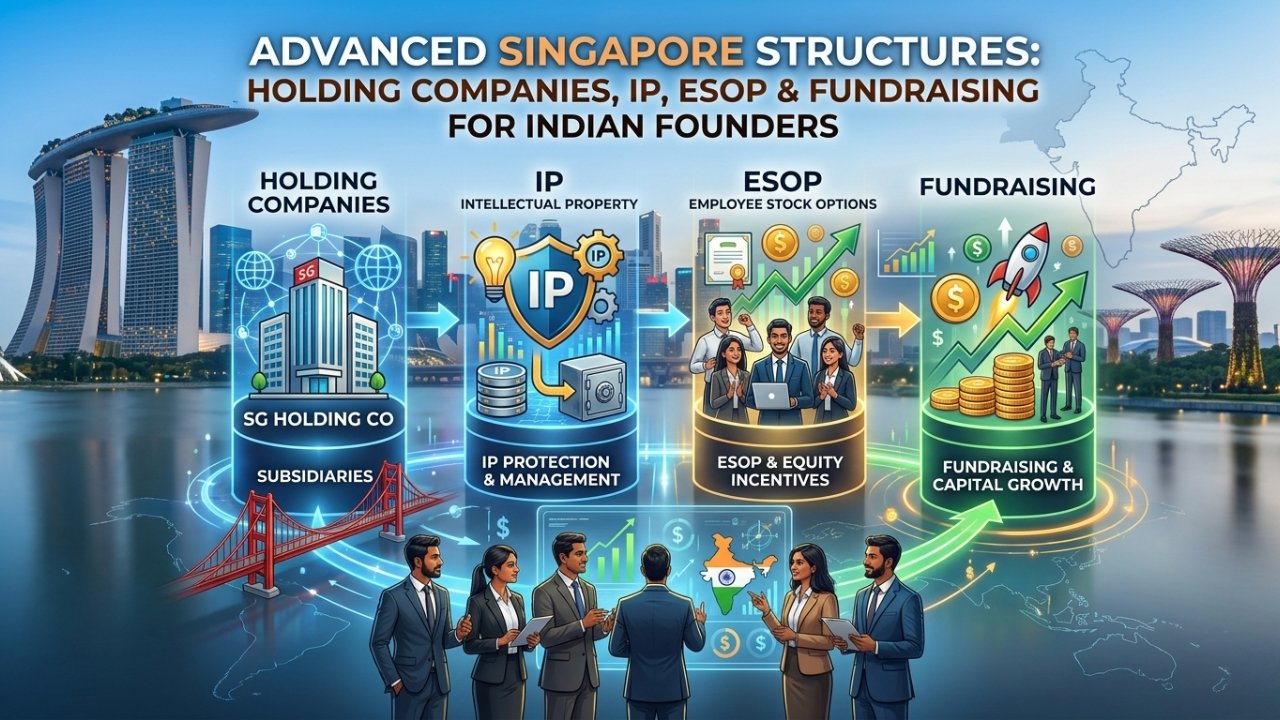
If you have already incorporated in Advanced Singapore Structures or are evaluating it seriously, the next question is not whether to use Singapore it is how to use it strategically. A basic Singapore private limited company opens the door. But the founders who extract maximum value from their Singapore entity are the ones who understand holding structures, IP migration, employee stock options, and VC-ready fundraising mechanics.
This guide is written specifically for Indian founders building global companies who want to go beyond incorporation basics and architect a structure that serves them at Series A, Series B, and beyond.
Singapore Holding Company: Why It Exists and How It Works
A holding company structure in Singapore places a parent entity incorporated in Singapore above your operating subsidiaries in India, the US, or any other market. The Singapore entity owns shares in the subsidiaries. It does not trade directly; it holds.
Why founders build this structure
Tax efficiency on dividends and capital gains. Singapore does not tax capital gains, and dividends received by a Singapore holding company from foreign subsidiaries are generally exempt from tax under the one-tier tax system. If you eventually sell your India business or list a subsidiary, gains flow up to the Singapore parent without being taxed again.
Investor preference. Most institutional investors particularly US-based VCs and growth funds prefer to hold equity in a Singapore entity over an Indian private limited company. Singapore’s legal system is English common law, its courts are fast, and shareholder agreements are predictable and enforceable.
Simplified cross-border ownership. Operating in five countries with a holding company in each creates a compliance nightmare. A Singapore holding company as the central owner of all subsidiaries simplifies equity tables, investor reporting, and group-level audits.
Banking and treasury. Singapore holding companies can maintain USD, EUR, and SGD accounts easily. Banks in Singapore DBS, OCBC, UOB are well-capitalised and comfortable with multi-currency, multi-subsidiary structures.
How to set up a Singapore holding company
The mechanics are straightforward. You incorporate a Singapore private limited company (Pte. Ltd.), ensure shareholding reflects the founder group, then have that entity acquire or subscribe for shares in your Indian entity. The Indian subsidiary typically runs operations employing people, signing contracts, earning revenue while the Singapore parent holds intellectual property, raises capital, and is the entity through which equity is issued to investors.
The entire setup can be completed within 1–2 weeks for the Singapore entity. The India side involves additional regulatory steps under the Foreign Exchange Management Act (FEMA), specifically pricing the valuation and filing with the Reserve Bank of India (RBI).
IP Holding Structure: Tax Benefits and Practical Mechanics
Intellectual property is often the most valuable asset a technology company owns. Trademarks, patents, proprietary software, trade secrets, and brand names these have enormous economic value, and where they are held determines how they are taxed.
Why Singapore is ideal for IP holding
An IP holding company in Singapore benefits from several overlapping advantages.
The Development and Expansion Incentive (DEI). Singapore’s Economic Development Board grants qualifying companies a concessionary corporate tax rate of 5% or 10% on income from IP-related activities, including royalties, licensing fees, and gains from IP disposals. For a company earning significant royalty income, the difference versus India’s 25%+ corporate tax rate is material.
Lower withholding tax on royalties paid to Singapore. The India-Singapore Double Taxation Avoidance Agreement (DTAA) allows royalties paid by an Indian entity to a Singapore entity to be taxed at a reduced rate of 10% rather than India’s standard 20% withholding tax rate. The royalties received by the Singapore entity are then taxed at Singapore’s standard corporate rate of 17%, or at 5–10% under an incentive scheme.
The IP Development Incentive (IDI) and R&D deductions. Singapore offers 150% tax deductions on qualifying research and development expenditure and additional deductions for IP registration costs. Founders who develop IP while based in Singapore get a significant tax shield during the R&D phase.
Practical IP migration: what it involves
Moving IP from India to Singapore requires careful structuring. The most common approaches are.
- Develop New IP in Singapore from Day One. For pre-revenue startups, it is cleanest to create the IP-owning entity in Singapore and have it commission development work from the Indian subsidiary. The Indian entity gets paid for its R&D services; IP ownership vests in Singapore from the start.
- License the IP from India to Singapore. Where IP already exists in an Indian entity, a licensing arrangement can allow the Singapore entity to commercialise it globally while royalties flow back to India.
- Migrate Ownership via a Formal Transfer. Transferring IP assets from India to Singapore requires a formal valuation and RBI approval. This is more complex but achievable, particularly for early-stage companies where IP value is still low.
Important: IP structuring has increased scrutiny globally under OECD BEPS (Base Erosion and Profit Shifting) rules. Singapore is fully BEPS-compliant. Ensure your Singapore entity has genuine economic substance meaning actual staff or management activity and is not a pure shell holding IP.
ESOP and Share Schemes for Singapore Startups
Employee Stock Option Plans (ESOPs) are a core tool for attracting and retaining talent at startups. Singapore’s framework for ESOP structures in Singapore startups is flexible, tax-efficient, and globally recognised.
Why structure your ESOP via Singapore
When your Singapore holding company issues options over its shares, employees globally whether in India, Singapore, or elsewhere can participate in the same option pool. This is far simpler than maintaining separate ESOP pools in each subsidiary, which creates valuation complexity and cross-border tax headaches.
The Employee Share Option Plan (ESOP) framework in Singapore
Singapore does not tax the grant of options. Employees are taxed only when they exercise their options and receive shares specifically, on the difference between the exercise price and the market value of shares at the time of exercise. This is treated as employment income in Singapore.
For qualifying Employee Equity-Based Remuneration (EEBR) schemes approved under the Singapore Income Tax Act, employees may be eligible for tax deferral spreading tax liability over a period of up to five years which significantly improves the attractiveness of equity compensation.
Key ESOP design decisions for Indian founders
Option pool size. Institutional investors at Series A typically expect a 10–15% ESOP pool on a fully diluted basis. Create this pool at or before your fundraising round.
Vesting schedule. The market standard is a 4-year vest with a 1-year cliff meaning no options vest until the employee completes one year, after which 25% vest immediately and the remaining 75% vest monthly over the subsequent three years.
Strike price. Options should be priced at fair market value (FMV) at the time of grant. For early-stage companies, this is typically a fraction of the last-round price per share. Third-party 409A-equivalent valuations are advisable once you raise institutional capital.
Indian employees. For employees based in India exercising options in a foreign company, there are FEMA implications. RBI has liberalised rules under the Overseas Portfolio Investment (OPI) framework, but employees should take professional advice on their individual tax and compliance obligations.
Share Vesting for Founders
Beyond employee ESOPs, founders should also implement reverse vesting on their own shares from day one. This protects the company and co-founders if someone exits early and is a standard requirement for institutional investors.
Fundraising: Why VCs Prefer Singapore Entities
The preference among institutional investors particularly US VC firms, Southeast Asian growth funds, and global family offices for Singapore-incorporated entities is not accidental. It reflects structural realities about ease of investment, legal predictability, and exit optionality.
Why fundraising via Singapore entity works better.
- Cayman Convertible Notes and SAFEs work seamlessly via Singapore. Singapore law is compatible with standard US investor instruments. SAFEs (Simple Agreements for Future Equity) and convertible notes from US VCs are well-understood in Singapore’s legal framework and can be executed quickly.
- Shareholder agreements are enforceable. Singapore’s common law courts consistently uphold shareholder rights, drag-along provisions, anti-dilution clauses, and liquidation preferences. Investors know what they are getting.
- No FDI restrictions on most sectors. Unlike India, Singapore does not restrict foreign direct investment in most technology sectors. Investors can hold any percentage of your Singapore entity without regulatory approval.
- MAS-regulated environment creates trust. The Monetary Authority of Singapore’s regulatory environment is respected globally. Singapore entities are bankable and investable from Day One.
- Faster round closure. A typical Singapore priced round closes faster than an equivalent Indian round due to simpler cap table management, no RBI filing timelines blocking completion, and standardised documentation (NDA, SHA, SSA).
Practical fundraising mechanics
If you raise from a Singapore-based VC, the investment flows directly into your Singapore entity. If you raise from a US investor, they typically wire USD into your Singapore USD bank account. The Singapore entity then on-lends or injects capital into the Indian subsidiary as Foreign Direct Investment (FDI) a well-understood and RBI-compliant process.
India-Singapore Flip Structure Explained
The India-Singapore flip structure also called a “flipping” is the process of restructuring an India-headquartered company so that the parent entity becomes a Singapore private limited company. This is one of the most common structures among Indian SaaS and deep-tech founders preparing for global fundraising.
How the flip works
- A new Singapore Pte. Ltd. is incorporated with the founders as shareholders, mirroring the existing Indian shareholding structure.
- The Indian private limited company becomes a wholly owned subsidiary of the Singapore entity. This is achieved by the founders transferring their shares in the Indian company to the Singapore entity.
- The share transfer is valued by a registered valuer (mandatory under FEMA) and approved at fair market value.
- FEMA filings are made with the RBI specifically Form FC-TRS within the prescribed time limits.
- The Singapore entity becomes the group holding company, through which future fundraising, IP management, and investor equity will flow.
Who should consider a flip?
The flip is most practical at the pre-Series A stage when.
- Valuation is still manageable, keeping transfer taxes low
- You have not yet taken institutional Indian capital (which complicates transfers)
- You are targeting US or global VC investors who prefer non-Indian holding companies
The flip becomes significantly more complex and expensive after Series A, particularly if you have Indian institutional investors already on the cap table. Execute early or plan around it.
Tax implications of the flip for founders
The share transfer is treated as a deemed sale by Indian founders, potentially triggering capital gains tax under Indian income tax law. Where shares have been held for more than 24 months, long-term capital gains rates may apply. Professional structuring at the point of the flip including accurate FMV computation and timing can materially reduce this liability.
Multi-Country Structures Using Singapore as Hub
Singapore’s strength as a global business hub is not limited to the India-Singapore axis. Founders building companies across Southeast Asia, the Middle East, the US, or Europe increasingly use Singapore as the central hub for a multi-country operating structure.
The hub-and-spoke model
The Singapore holding company sits at the centre. Below it are wholly owned operating subsidiaries in each country.
- India Pvt. Ltd. engineering, R&D, back-office operations
- US LLC or C-Corp sales, marketing, US customer contracts
- UAE Free Zone entity Middle East operations, regional sales
- UK Ltd. European operations, fintech licensing where required
Each subsidiary employs local staff, signs local contracts, and complies with local regulations. The Singapore holding company owns 100% of each, maintains the consolidated P&L, holds IP, and is the entity through which investors hold equity.
Transfer pricing and intercompany agreements
In a multi-entity structure, transactions between group companies such as management fees, IP licensing, intercompany loans, or shared services must be priced at arm’s length. Singapore follows OECD transfer pricing guidelines and requires proper intercompany agreements backed by transfer pricing documentation for groups above defined revenue thresholds.
This is not optional. IRAS (Inland Revenue Authority of Singapore) audits transfer pricing arrangements, and the Indian Income Tax Department has dedicated Transfer Pricing Officers who review related-party deals. Engage a transfer pricing specialist once your group revenue exceeds $5–10 million.
Banking for multi-country structures
Singapore’s banking infrastructure supports multi-currency, multi-entity treasury management. DBS, OCBC, and Standard Chartered Singapore can hold accounts in SGD, USD, EUR, GBP, and INR, issue cross-border payments, and provide trade finance products. Many founders also use fintech alternatives Aspire, Airwallex, Wise Business for day-to-day multi-currency operations before banking relationships with major banks are established.
Frequently Asked Questions
Can I set up a Singapore holding company after already incorporating in India?
Yes. The India-Singapore flip allows you to restructure an existing Indian company under a Singapore parent. The process involves transferring founder shares to the new Singapore entity, complying with FEMA valuation and filing requirements, and ensuring proper documentation. It is easier to execute at an early stage when company valuation is low.
What is the corporate tax rate in Singapore for holding companies?
Singapore’s headline corporate tax rate is 17%. However, new companies benefit from partial tax exemptions for the first three years, and companies qualifying for the Development and Expansion Incentive or IP Development Incentive may pay as little as 5–10% on qualifying income. There is no capital gains tax in Singapore.
Can Indian founders issue ESOPs to Indian employees through a Singapore company?
Yes. Indian employees can receive options in a foreign parent company. However, there are FEMA and income tax implications for the employees particularly at the point of exercise. The company must also ensure the ESOP plan is structured to comply with Singapore’s EEBR framework. Individual employees should consult a cross-border tax advisor.
How long does it take to raise capital through a Singapore entity?
A priced round through a Singapore entity typically closes within 4–8 weeks from term sheet to completion, assuming no major due diligence issues. Pre-SAFE or convertible note rounds can close faster sometimes within 1–2 weeks. This is significantly faster than equivalent Indian fundraising rounds, which often require additional regulatory filings.
Is the India-Singapore DTAA still advantageous after the 2016 renegotiation?
Yes, though the treaty was significantly renegotiated in 2016. Capital gains on shares acquired after April 1, 2017 are now taxable in India, removing the historic capital gains exemption. However, the treaty still offers benefits on dividends (reduced withholding), royalties (reduced withholding at 10%), and business income. Treaty planning should be done with a qualified advisor given the post-2016 rules.
What are the annual compliance requirements for a Singapore holding company?
Singapore companies must file annual returns with ACRA (Accounting and Corporate Regulatory Authority), hold an Annual General Meeting (or pass written resolutions in lieu), maintain proper financial accounts, and file corporate income tax returns with IRAS. Companies with group turnover above S$10 million require an audit. ACRA’s compliance requirements are well-defined and professionally administered.
Do I need a local Singapore director?
Yes. Every Singapore private limited company must have at least one director who is ordinarily resident in Singapore meaning a Singapore citizen, PR, or EntrePass/Employment Pass holder. Most incorporation service providers offer nominee director services for a monthly or annual fee while founders are in the process of obtaining their own passes.
When should I start thinking about a multi-country structure rather than just a Singapore holding company?
Once your company is generating revenue from more than two markets or is hiring staff in more than one country outside India, it is worth planning the multi-entity structure. The right time to set it up is before you need it not after employees are working informally, contracts are being signed by the wrong entity, or a fundraising round forces a rushed restructuring.