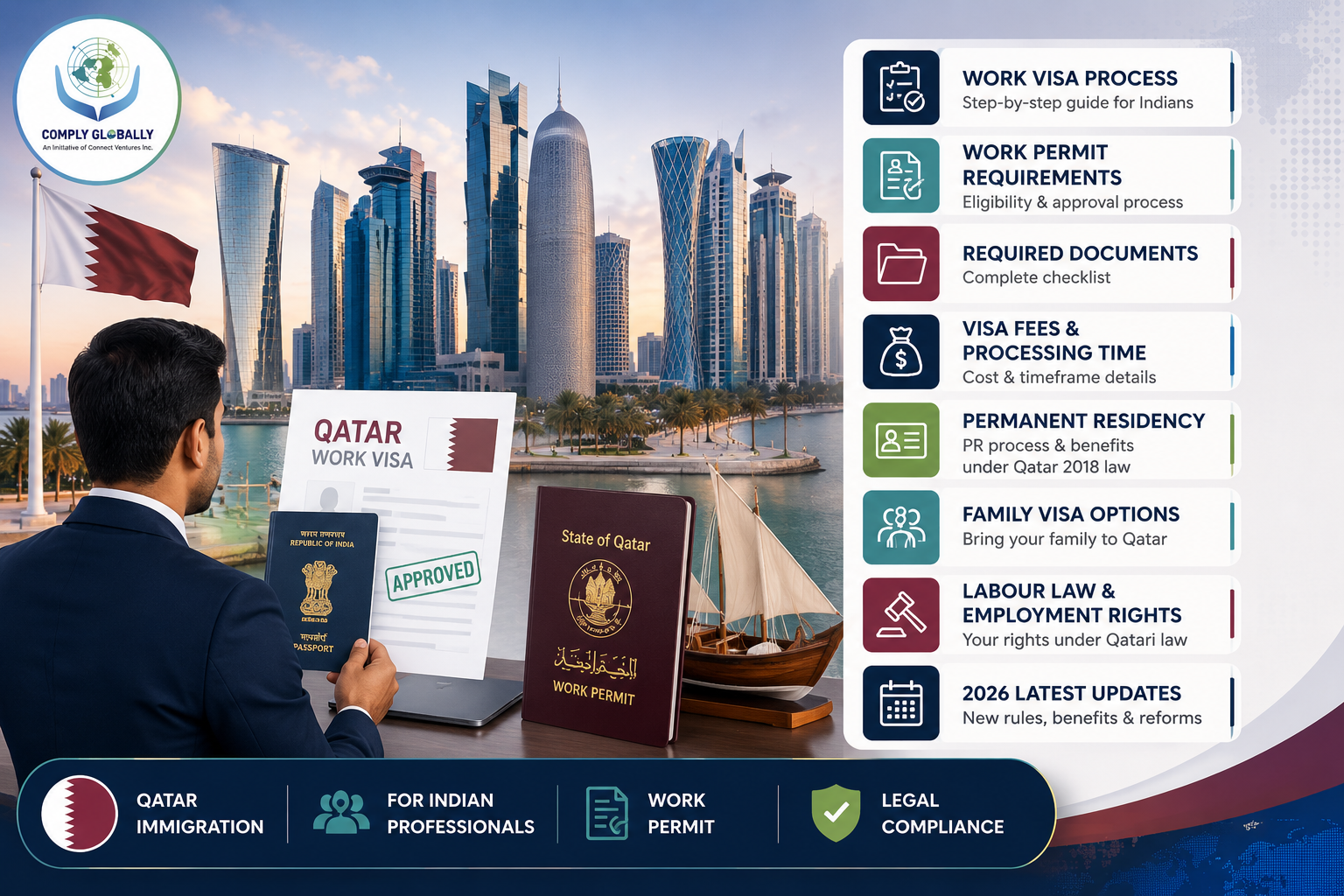
If you are an Indian professional eyeing a career move to the Gulf Expand Your Business Internationally, Qatar has never looked more welcoming. Since abolishing the No-Objection Certificate (NOC) requirement and dismantling the core elements of the Kafala system, the country has reshaped its entire labour framework and Indian workers stand to benefit enormously. This comprehensive guide walks you through the Qatar work visa for Indian nationals in 2026, the step-by-step work permit process, the 2018 permanent residency law, the end of the exit permit, and the digital tools including the MADAD platform that now protect your rights on the job.
Why Indians Choose Qatar in 2026
Qatar is home to one of the largest Indian expatriate communities in the world, with hundreds of thousands of Indian nationals working across construction, healthcare, IT, finance, hospitality, and engineering. The appeal is clear: tax-free salaries, modern infrastructure, proximity to India via a short flight, and a growing economy projected to expand at an average of 4.1% annually from 2025 to 2029.
But the biggest draw in 2026 is reform. Qatar’s labour landscape has undergone its most sweeping transformation in decades. The Kafala overhaul that began in 2020, accelerated by international scrutiny surrounding the 2022 FIFA World Cup, has now produced a system that genuinely protects workers including the ability to switch employers freely, leave the country without employer consent, and file complaints through a multilingual digital platform.
For Indian professionals whether you are a fresh graduate, a mid-career engineer, a nurse, or a senior executive understanding how the work visa system works in 2026 is your first and most critical step.
Types of Qatar Work Visas for Indian Nationals
Before diving into the work permit process, it helps to understand which visa category applies to your situation.
Employment Visa (Work Visa): This is the standard route for Indian nationals who have received a job offer from a Qatari employer. The employer sponsors the visa application through the Ministry of Interior (MOI) portal. This visa converts into a residence permit (QID Qatar ID) once you arrive in Qatar.
Executive Visa (2026 Introduced): A newly introduced category aimed at highly qualified specialists Company Formation in Qatar. It offers greater independence from employer sponsorship, allowing qualified professionals more flexibility over their residency without strict employer dominance. This is particularly relevant for senior professionals in specialised fields.
Qatar e-Visa (Tourism/Business): Indian nationals can obtain a free visa on arrival valid for 30 days, or apply online for a Qatar e-Visa in advance. This is not a work visa, but is useful for attending interviews or conducting pre-employment due diligence.
Freelance / Self-Employment Permit: Qatar has introduced limited pathways for self-employed professionals, though this remains restricted to specific sectors and requires ministerial approval.
Qatar Work Permit Process: Step-by-Step
The Qatar work permit process for Indian nationals involves both your employer and several Qatari government ministries. Here is the complete step-by-step journey from job offer to arriving in Doha.
Step 1: Receive a Formal Job Offer
Your Qatari employer issues a formal employment contract. Read it carefully the contract must specify your salary, job title, working hours, annual leave entitlement, and housing or allowance provisions. Under the post-Kafala framework, your contract is the legal backbone of your stay in Qatar.
Step 2: Employer Applies for Work Permit
Your employer applies for a work permit on your behalf through the Ministry of Labour (MOL) portal or via the Ministry of Interior (MOI). This involves submitting your qualifications, passport copy, and the signed employment contract. Annual work permit fees are standardised at QAR 100.
Step 3: Medical Examination in India
You will be required to undergo a medical examination at an approved centre in India. Qatar maintains a list of approved medical centres (GCC-approved clinics) in major Indian cities including Delhi, Mumbai, Chennai, Hyderabad, Kochi, and Bengaluru. Tests typically include a blood panel, chest X-ray for TB, and general fitness assessment.
Step 4: Employment Visa Stamped in Passport
Once your employer receives the work permit approval, the Qatari Embassy or consulate in India stamps an employment visa in your passport. In many cases this is now done electronically, and you simply carry a visa approval number.
Step 5: Fly to Qatar and Complete Biometrics
On arrival at Hamad International Airport, your biometrics (fingerprints and photograph) are taken. You will also complete a health check at the airport if not already cleared.
Step 6: Obtain Your Qatar ID (QID)
Within the first few weeks of your arrival, your employer arranges for your Qatar Identification Card (QID) also known as the residence permit. This card serves as your primary identification in Qatar. Keep it with you at all times.
Step 7: Open a Bank Account
With your QID and employment contract, you can open a bank account Cross-Border Banking Solutions with any major Qatari or international bank. This is essential for receiving your salary via Wage Protection System (WPS).
Documents Required for a Qatar Work Visa
Indian nationals applying for a Qatar work visa should prepare the following documents. Requirements may vary slightly based on your profession, employer, and visa category.
- Valid Indian passport (minimum 6 months validity beyond intended stay)
- Signed employment contract (attested by your employer)
- Educational certificates (attested by the Ministry of External Affairs, India, and the Qatari Embassy)
- Professional certificates and licences (for regulated professions: medicine, engineering, law, nursing)
- Recent passport-size photographs (white background)
- Medical fitness certificate from a GCC-approved centre
- Police clearance certificate (issued by the local police station in India)
- Prior work experience letters (if applicable to your role)
- Employer’s letter of sponsorship
For regulated professions such as medicine, dentistry, nursing, and engineering, additional credential verification through relevant licensing bodies (Hamad Medical Corporation for healthcare workers, Ashghal for engineers) is mandatory.
Fees and Timelines
Work Permit Fee: QAR 100 per year (standardised under recent ministerial decisions). This Work Permit Fee is paid by the employer.
Medical Examination Fee in India: Varies by city and clinic, typically between ₹2,000 and ₹5,000.
Attestation Costs: Educational certificate attestation through the MEA and Embassy in India can cost ₹1,000–₹3,000 per document.
Processing Time: Work permit approvals typically take 2–4 weeks after the employer submits the application. Emergency or fast-track processing may be available for critical roles.
Visa Validity: The employment visa is usually valid for a single entry, after which you receive a multi-year residence permit (QID) tied to your employment contract typically 1 or 2 years, renewable.
Kafala Reforms: What Changed and Why It Matters
The Kafala system a decades-old labour sponsorship model that tied workers’ legal status entirely to their employer has been substantially dismantled in Qatar. For Indian workers, understanding what has changed is crucial to protecting your rights.
Under the traditional Kafala model, a worker could not change jobs, leave the country, or terminate their contract without explicit employer approval. This created a severe power imbalance, leaving workers vulnerable to wage theft, contract substitution, and even passport confiscation (which remains illegal but was widely reported).
Key reforms now in effect include:
No NOC Required to Switch Jobs: Since the Kafala overhaul of 2020 and reinforced by Ministerial Decision No. 32 of 2025, workers can transfer to a new employer without requiring a No-Objection Certificate from their current sponsor. This is one of the most significant protections for Indian workers, who previously had little recourse if caught in a bad employment situation.
Freedom of Movement: The exit permit requirement has been removed entirely (see Section 7 below).
Wage Protection System (WPS): All salaries must be paid electronically through the WPS, creating a transparent audit trail. Failure to pay wages on time exposes employers to significant penalties.
Contract Enforcement: Your signed employment contract is now legally binding on the employer. If the employer attempts to change your role, salary, or working conditions without your consent, you have the right to file a formal complaint.
Exit Permit Abolished: You Can Now Leave Freely
This is perhaps the single most impactful reform for Indian workers in this state. Under the old system, leaving even for a family emergency required your employer’s explicit approval. Workers who fell out of favour with their sponsors could be stranded in the country indefinitely.
That requirement has been completely abolished. As of the current framework, all categories of workers including domestic workers from India, Nepal, and the Philippines who were initially excluded from earlier reforms can leave Qatar without employer consent. You simply need a valid ticket and a passport that has not been confiscated (passport confiscation by employers remains illegal under Qatari law).
If your employer has confiscated your passport, you can report this directly through the MADAD platform (see Section 11) or by calling the Labour Helpline at 16008, which operates around the clock in multiple languages including Hindi.
Minimum Wage in Qatar: QAR 1,000 + Allowances
Qatar established the region’s first non-discriminatory minimum wage, which applies to all workers regardless of nationality. The current structure is:
- Basic minimum wage: QAR 1,000 per month
- Housing allowance (if employer does not provide accommodation): QAR 500 per month
- Food allowance (if employer does not provide meals): QAR 300 per month
This brings the effective minimum monthly compensation to QAR 1,800 where employers do not provide housing or food roughly equivalent to approximately ₹40,000–₹42,000 at current exchange rates.
For Indian professionals in skilled roles IT, engineering, healthcare, finance salaries are substantially higher, often ranging from QAR 3,000 for entry-level technical roles to QAR 15,000+ for senior positions, all tax-free.
If your employer is paying below the minimum wage, this is a direct violation of labour law and can be reported immediately via the MADAD platform.
Qatar Permanent Residency: Law No. 10 of 2018 Explained
Qatar’s Law No. 10 of 2018 introduced a formal Permanent Residency Permit (PR) framework a significant milestone for long-serving Indian expatriates. Unlike full citizenship, permanent residency gives you the right to stay in Qatar indefinitely without requiring employer sponsorship, along with access to several government-funded services.
Benefits of Qatar Permanent Residency
- Freedom from employer sponsorship you are no longer tied to any single company
- Access to government-funded healthcare (Hamad Medical Corporation)
- Eligibility to enrol children in public schools
- Ability to own property in designated freehold zones without a Qatari partner
- Permission to invest in specific economic sectors independently
- Access to certain government subsidies and services
Eligibility Requirements Under Law No. 10 of 2018
Duration of Residency: You must have legally resided in Qatar for at least 20 consecutive years if you were born outside Qatar, or 10 consecutive years if you were born in Qatar. Temporary absences are permitted, provided they do not exceed 60 days per year any longer absences are deducted from your qualifying period.
Financial Solvency: You must demonstrate sufficient income to support yourself and your dependents. The minimum income threshold is set by the Council of Ministers.
Good Conduct: A clean criminal record is mandatory. Anyone convicted of a crime involving moral turpitude or dishonesty is disqualified.
Special Categories: The law also makes provisions for children of Qatari mothers married to non-Qatari fathers, and for exceptional professionals doctors, researchers, academics, and individuals with skills Qatar wishes to retain who may qualify outside the standard residency duration requirements.
How Many PR Permits Are Issued?
This is a critical limitation that Indian applicants must understand: Qatar currently issues only 100 permanent residency permits per year. This quota makes the PR pathway highly competitive. Long-serving Indian professionals with unblemished records and significant contributions to Qatar’s economy are among the most competitive applicants, but the limited quota means approval is far from guaranteed even for qualifying individuals.
Applications are submitted to the Ministry of Interior, and approval is ultimately discretionary. Consulting a Qatar-based immigration lawyer is strongly advised before beginning the PR application process.
New 10-Year Residency for Entrepreneurs and Executives
For senior Indian professionals and entrepreneurs, Qatar announced a significant new pathway at Web Summit Qatar 2026: a 10-year residency permit targeted at entrepreneurs and senior executives.
Who Qualifies?
The programme is limited to two specific categories and is not open to general professionals, freelancers, or retirees.
Entrepreneurs: Must be building high-impact or innovation-driven businesses aligned with Qatar’s private-sector priorities. Applicants need an official endorsement from a recognised Qatari business incubator such as the Qatar Science & Technology Park (QSTP). A bank statement showing a minimum balance of QAR 36,500 (approximately USD 10,000) maintained over the previous three months is also required.
Senior Executives: Applies to high-level leadership roles Chairman, CEO, CFO, COO, CTO, and Executive Directors. Applicants must have at least five years of senior executive Company Formation & Management Services experience. Eligible employers are restricted to public shareholding companies listed on the Qatar Stock Exchange, banks and financial institutions licensed by the Qatar Central Bank, insurance companies regulated by the Qatar Central Bank or QFMA, and consulting firms providing services to government entities.
This 10-year residency initiative signals Qatar’s preference for long-term talent retention over short-term labour contracts, making it highly relevant for Indian professionals who have built their careers in Gulf markets.
Residency by Investment
Qatar also operates a residency-by-investment pathway. Foreign nationals who invest a minimum of QAR 730,000 (approximately USD 200,000) in designated freehold residential zones may obtain residency without a local sponsor. Those investing QAR 3.65 million (approximately USD 1 million) qualify for permanent residency cards directly.
MADAD Platform: Filing Labour Complaints in Qatar
The MADAD platform operated under Qatar’s Ministry of Administrative Development, Labour and Social Affairs (MADLSA, now referred to as ADLSA) is the primary digital mechanism for workers to file labour complaints, report wage theft, and resolve workplace disputes. For Indian workers unfamiliar with their rights in Qatar, MADAD is the most important digital tool you need to know.
What You Can Report via MADAD
- Unpaid or delayed wages
- Passport confiscation by employer
- Unsafe working conditions
- Contract substitution (your actual job differs from what you signed)
- Physical or emotional abuse
- Forced labour or restricted movement
- Any breach of your employment contract
How to File a Complaint
Online Portal: Visit adlsa.gov.qa the fastest channel, available 24/7. Log in using your QID number or visa number and phone number, or via the National Authentication System (NAS/Tawtheeq).
Labour Helpline: Call 16008 free, multilingual, and available around the clock. Supports Arabic, English, Hindi, Urdu, and other major South Asian languages.
SMS: Type “5” followed by your Qatar ID or Visa number and send the SMS to 92727.
Mobile App: Use the Amerni app (available on iOS and Android).
In-Person: Visit the ADLSA office in Al Sadd, Doha.
Employers found guilty of violating labour laws face penalties ranging from fines of QAR 2,000 to QAR 100,000, and in serious cases, imprisonment of up to one month. Repeat violators can face public disclosure of their non-compliance status on the Ministry’s website a reputational deterrent that has proven effective.
The platform was updated in January 2025 to also allow employers to file complaints against employees and against registered recruitment agencies, making it a genuinely two-sided dispute resolution mechanism.
Qatarisation Law No. 12/2024: What Indian Professionals Must Know
Passed in late 2024, Law No. 12 of 2024 introduced a comprehensive Qatarisation framework requiring private-sector employers to prioritise hiring Qatari nationals and the children of Qatari women. Employers must notify the Ministry of Labour of job vacancies and can only recruit expatriates including Indian nationals if no suitable Qatari candidates are available.
For Indian professionals, this does not mean the door is closing. Qatar’s expatriate workforce makes up the overwhelming majority of its labour market, and the skills gap in sectors like healthcare, engineering, IT, and financial services means demand for qualified Indian professionals remains strong. However, you should be aware that:
- Employers must document their Qatarisation efforts before a work permit for a foreign national can be approved
- Certain junior or administrative roles may now be reserved for Qatari nationals under sectoral quotas
- Violations by employers can result in fines of up to QAR 1 million or even imprisonment, creating strong incentives for compliance
Indian job seekers with in-demand skills particularly in healthcare, technology, engineering, and senior management are unlikely to be affected negatively. The law primarily targets entry-level and mid-tier roles where Qatari candidates can be trained and placed.
Qatar Citizenship for Indians: Is It Possible?
While permanent residency is achievable for long-serving Indian professionals, Qatari citizenship is a far more restricted pathway. Under Qatar’s nationality laws, Indian nationals must meet the following conditions to be considered for naturalisation:
- A minimum of 25 consecutive years of lawful residence in Qatar
- Total absences must not exceed two months per year over the entire qualifying period; any absence exceeding six months may disqualify the application
- Demonstrated financial self-sufficiency
- A clean criminal record
- A proven commitment to Qatar’s language and culture
Even meeting all these conditions does not guarantee citizenship it remains a discretionary grant by the Qatari government. India also does not recognise dual citizenship, meaning an Indian national who obtains Qatari citizenship must renounce their Indian passport.
For most Indian professionals, permanent residency under Law No. 10 of 2018 offers the most practical and achievable form of long-term security in Qatar without requiring citizenship.
Practical Tips for Indian Professionals
Whether you are just beginning your Qatar journey or have been working there for years, these practical steps will protect your interests.
Before You Travel: Verify that your employer is registered with the Ministry of Labour. Check your employment contract thoroughly before signing ensure the salary, job title, and allowances match exactly what was discussed. Never pay a recruitment agent a placement fee; under Qatari law, recruitment fees must be borne by the employer.
On Arrival: Do not hand over your passport to your employer. Passport confiscation is illegal. If asked, politely decline and direct any such request to the Labour Helpline (16008). Ensure your QID is processed within the business legal docoments timeframe.
During Employment: Monitor your salary payments through the Wage Protection System. Register on the ADLSA portal using your QID number so you can access complaint mechanisms instantly if needed. Keep digital copies of all your documents contract, QID, passport, payslips stored securely in the cloud.
When Changing Jobs: Under the post-Kafala framework, you do not need an NOC to switch employers. However, your current employment contract may contain a notice period clause typically 30 to 60 days which you are obligated to honour. Resigning without notice can expose you to civil liability.
Returning to India: You can now leave Qatar without employer consent. If you plan to return to after a visit to India, ensure your residence permit (QID) is valid for re-entry. Renew it before it expires to avoid overstay penalties.
Frequently Asked Questions
Q: Can an Indian apply for a Qatar work visa without a job offer?
A: No. The standard work visa for Indian nationals requires a sponsoring employer in Qatar. There is currently no general skilled worker visa that allows you to enter Qatar and seek employment independently, although the new 10-year entrepreneur residency may serve this purpose for qualifying founders.
Q: How long does it take to get a Qatar work visa from India?
A: Once your employer submits the work permit application, approval typically takes 2–4 weeks. Add another 1–2 weeks for visa stamping and medical clearance, and you can generally expect to be in Doha within 4–6 weeks of receiving a job offer.
Q: Is Qatar tax-free for Indian workers?
A: Yes. Qatar does not levy personal income tax. Your salary is fully tax-free. However, you remain liable for Indian income tax on global income under Indian tax law consult a tax adviser if your salary exceeds the basic exemption threshold.
Q: Can I bring my family to Qatar on a work visa?
A: Yes, provided your salary meets the Ministry of Interior’s minimum income threshold for sponsoring dependents (generally QAR 4,000–QAR 6,000 per month depending on the number of dependents). You can sponsor a spouse, children under 25, and parents.
Q: What happens to my work permit if I lose my job?
A: Your residence permit (QID) is typically tied to your employer. If you are terminated or resign, you generally have a 60–90 day grace period to either find new employment and transfer your sponsorship, or leave the country. You should not overstay register any employment dispute immediately on the ADLSA platform.
Q: Can I apply for Qatar permanent residency after 20 years?
A: Yes, if you meet all conditions under Law No. 10 of 2018 including the 20-year continuous residency requirement, financial solvency, and good conduct. Bear in mind the annual quota is 100 permits, making it highly competitive.
Q: Is the MADAD platform available in Hindi?
A: The Labour Helpline (16008) offers multilingual support including Hindi and Urdu. The online ADLSA portal primarily operates in Arabic and English, but the phone and SMS channels are the easiest options for Hindi-speaking workers.
Summary: Key Facts at a Glance
| Topic | Detail |
|---|---|
| Standard Work Permit Fee | QAR 100 per year (employer-paid) |
| Minimum Wage | QAR 1,000 + QAR 500 housing + QAR 300 food |
| NOC Required to Switch Jobs | No (abolished) |
| Exit Permit Required | No (abolished) |
| Labour Helpline | 16008 (free, multilingual, 24/7) |
| Complaint SMS | 92727 |
| PR Residency Law | Law No. 10 of 2018 |
| PR Residency Duration Required | 20 years (foreign-born) / 10 years (Qatar-born) |
| Annual PR Quota | 100 permits |
| 10-Year Residency | Entrepreneurs & senior executives (2026) |
| Investment PR Threshold | QAR 3.65 million |
| Citizenship Residency Requirement | 25 consecutive years |
Final Thoughts
Qatar’s transformation from one of the Gulf’s most restrictive labour regimes to one of its most reformed is neither complete nor without ongoing challenges but the direction of travel is clear. For Indian professionals in 2026, the combination of a dismantled Kafala system, an abolished exit permit, a standardised minimum wage, and digital grievance mechanisms like the MADAD platform represents a fundamentally different and more equitable working environment than existed even five years ago.
Whether you are planning your first move to Qatar or considering long-term residency after years of service, understanding the work permit process, the permanent residency framework under Law No. 10 of 2018, and your rights as a worker will put you in the strongest possible position to build a secure and rewarding career in one of the world’s most dynamic economies.