You’ve formed your US LLC. You have your EIN. Now comes the question that trips up almost every foreign founder: how do you actually open a US bank account without flying to America?
The good news: it’s absolutely possible. Thousands of non-resident entrepreneurs bank in the US every year. The bad news: the process is riddled with outdated information, bank-specific policies, and unnecessary rejection if you don’t know exactly what to do.
This guide breaks down everything you need to know in 2026: which banks accept foreign owners, what documents you’ll need, and the fastest path to getting your business account open whether you’re in Lagos, Lahore, São Paulo, or anywhere else.
Can a Foreign-Owned LLC Open a US Bank Account?
Yes 100% legally and with no residency requirement.
US law does not prohibit non-residents from opening business bank accounts. The challenge is practical, not legal: many banks have internal policies that make the process difficult for foreign nationals.
Here’s what you need to understand upfront:
- You do NOT need a Social Security Number (SSN) to open a US business bank account
- You DO need an EIN (Employer Identification Number) your company’s tax ID
- An ITIN (Individual Taxpayer Identification Number) is accepted by many banks as a substitute for an SSN
- Some banks require in-person verification others are fully remote
The key is choosing the right bank from the start.
What Documents Do You Need?
Regardless of which bank you choose, gather these documents before you start any application.
Business Documents
- Articles of Organization (your LLC formation document, filed with your state)
- Operating Agreement (signed, showing ownership structure)
- EIN Confirmation Letter (IRS Form CP575 or 147C letter)
- Certificate of Good Standing (from your state usually required if your LLC is older than 6 months)
Personal Identity Documents
- Valid passport (most widely accepted form of ID globally)
- ITIN letter (if you have one not always required)
- Proof of address a utility bill, bank statement, or government document showing your home country address
- US address (a registered agent address works for most online banks)
The 4 Main Routes to a US Business Bank Account
Route 1: Online-First Banks (Best for Non-Residents)
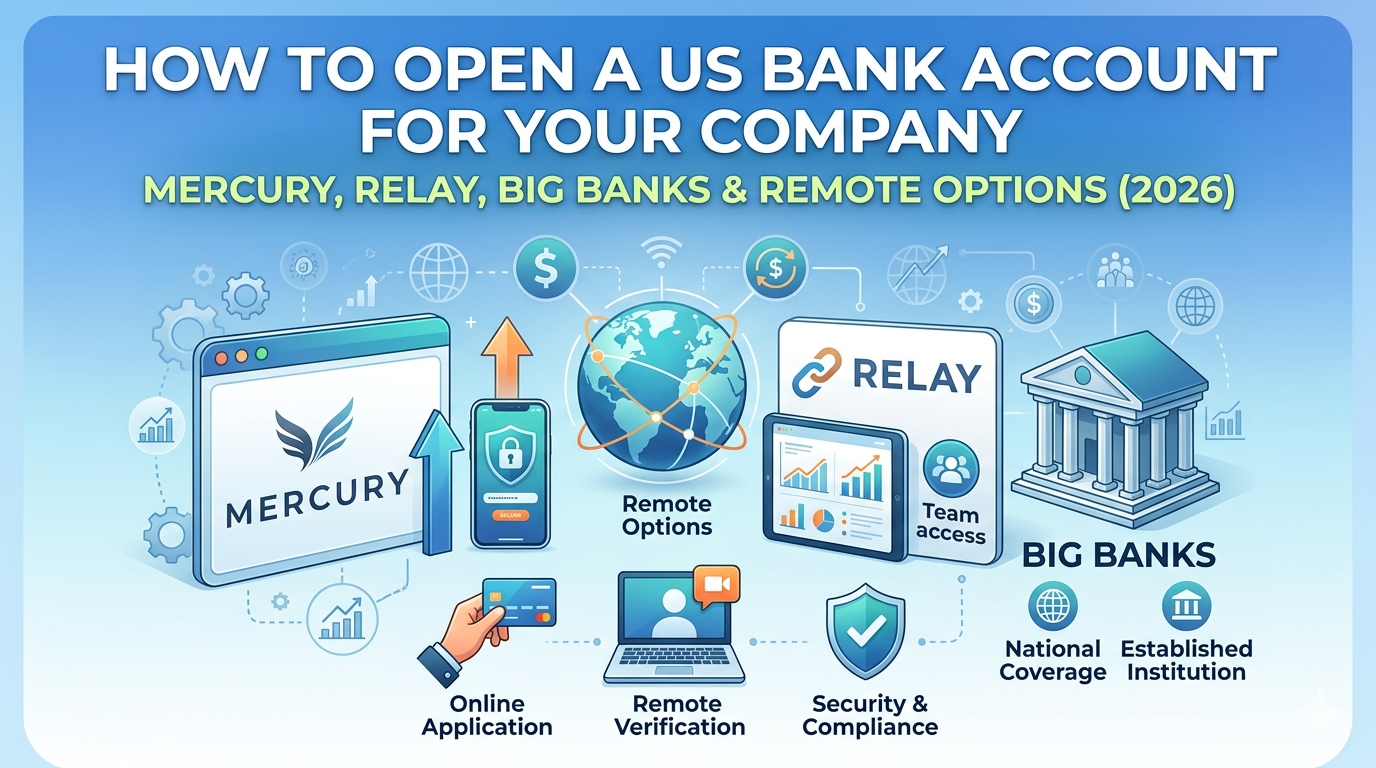
These are purpose-built for startups and foreign-owned businesses. They offer remote account opening, no physical branch required, and are the most popular options among non-resident LLC owners.
Mercury Bank Best Overall for Foreign-Owned LLCs
mercury.com | Free | FDIC insured via partner banks
Mercury is the most popular US business bank among foreign founders and for good reason. It was built specifically for startups and tech companies, and its onboarding is designed to handle international founders.
What makes Mercury stand out
- Fully remote account opening no US visit required
- Accepts non-US persons as LLC owners
- No monthly fees, no minimum balance
- Free US wire transfers and ACH
- Integrates with Stripe, PayPal, Wise, Gusto, and major accounting tools
- Virtual and physical debit cards
- API access for finance teams
What Mercury requires
- US LLC (formed in any state)
- EIN
- Valid passport
- US address (registered agent address is fine)
- Some applicants may be asked for additional KYC documents
Important: Mercury does not accept owners from certain countries flagged under OFAC sanctions. If your country is on the US sanctions list, Mercury will decline your application. Check the current OFAC list before applying.
Verdict: If you can qualify, Mercury is the easiest and most feature-rich option for foreign LLC owners. Start here.
Relay Bank Best for Multi-Account and Team Banking
Free (Pro plan available) | FDIC insured via Thread Bank
Relay is another strong choice for non-resident founders. It’s particularly useful if you want to organize your finances across multiple accounts for example, separating operating funds, taxes, and owner distributions into different buckets.
What makes Relay stand out
- Fully remote account opening
- Accepts foreign-owned LLCs
- Up to 20 individual checking accounts per business (unique feature)
- Up to 50 virtual debit cards
- Team member access with permission controls
- No transaction fees on ACH or wire transfers
What Relay requires
- US LLC + EIN
- Passport
- US address (registered agent works)
Verdict: Choose Relay if you want organized, multi-account business banking especially useful for businesses that manage cash flow across multiple revenue streams or want to earmark funds for taxes.
Route 2: Traditional Big Banks (Chase, Bank of America, Wells Fargo)
Traditional US banks are theoretically open to foreign-owned LLCs but in practice, they are significantly harder to work with as a non-resident.
Common challenges with big banks.
- Most require in-person branch visit to open an account
- Branch staff are often unfamiliar with non-resident applications and may reject you incorrectly
- SSN or ITIN is usually required for all beneficial owners
- Some branches have unofficial policies against non-residents
- Long processing times (1–4 weeks is common)
When big banks make sense
- You’re traveling to the US and can visit a branch in person
- Your business operates in industries that require a “name brand” bank (e.g., government contracts)
- You already have a personal US banking relationship
Tips if you go the big bank route:
- Call ahead and speak to the business banking department not a general teller
- Ask specifically about their policy for non-resident LLC owners
- Bring all documents including your Operating Agreement and EIN letter
- Visit a branch in a major financial hub (New York, Miami, Los Angeles) where staff are more familiar with international clients
- If rejected at one branch, try another policies can vary by location
Bottom line: Unless you have a specific reason to use a big bank, most foreign founders waste weeks trying this route and end up with Mercury or Relay anyway.
Route 3: ITIN-Based Banking
If you have an ITIN (Individual Taxpayer Identification Number), your options expand significantly.
An ITIN is a tax processing number issued by the IRS to individuals who need to file US taxes but are not eligible for an SSN. Many non-resident LLC owners apply for an ITIN when they file their first US tax return.
Banks that explicitly accept ITIN in lieu of SSN
- Some branches of Chase, Bank of America, and Wells Fargo
- Certain community banks and credit unions
- Bluevine (business checking)
- Novo (business banking for small businesses)
How to get an ITIN
- File IRS Form W-7 with your first US tax return (or with a certified acceptance agent)
- Processing takes 7–11 weeks
- Once issued, your ITIN can be used for banking and tax purposes indefinitely
Pro tip: If you plan to build a long-term US business, applying for an ITIN is worth doing early it opens more banking options and simplifies your annual tax filing.
Route 4: US-Friendly International Fintech Options
If you’re facing difficulties opening a traditional US bank account, these platforms can serve as bridges giving you a US bank account number while you sort out your primary banking.
Wise Business (formerly TransferWise)
- Provides a real US bank account number (ACH-compatible)
- Excellent for receiving USD payments from clients
- Multi-currency wallets hold and convert 50+ currencies
- Not a full business bank, but powerful for international transactions
Payoneer
- Widely used for receiving payments from marketplaces (Amazon, Upwork, Fiverr)
- Provides US payment receiving details
- Less useful for bill payment or payroll
Airwallex
- Full multi-currency business account
- Good for global businesses with operations in multiple countries
- Accepts non-US companies and non-residents
Note: These platforms are useful tools but are not substitutes for a proper US business bank account. Use them alongside Mercury or Relay not instead of them.
Setting Up Stripe and PayPal for Your Foreign-Owned LLC
Once you have a US bank account, setting up payment processing becomes straightforward.
Stripe
Stripe is the preferred payment processor for most US LLCs. To set up Stripe as a foreign-owned US entity.
- Register at stripe.com as a US business (not a foreign business)
- Provide your LLC’s EIN and US address
- Add your US bank account (Mercury or Relay works seamlessly)
- Provide personal identification passport accepted
- Note: Stripe will eventually require SSN or ITIN for the beneficial owner
Stripe’s policy: Stripe accepts non-US citizens as beneficial owners of US companies. However, they do conduct identity verification, and the process can take a few days if additional documentation is requested.
PayPal Business
PayPal Business for US LLCs requires
- US business address
- EIN
- US bank account
- Personal ID of the account holder
Non-residents can set up a US PayPal Business account tied to their LLC. Link it to your Mercury or Relay account for seamless withdrawals.
Common Reasons Foreign-Owned LLCs Get Rejected
Understanding why applications fail helps you avoid the same mistakes.
1. Incomplete or inconsistent documents Your name on your passport, Operating Agreement, and EIN letter must all match exactly.
2. High-risk countries Banks use risk classifications by country. If your country of residence or citizenship is considered higher risk under AML (Anti-Money Laundering) guidelines, additional scrutiny applies or outright rejection.
3. Unclear business purpose Banks are required under FinCEN rules to understand what your business does. Vague answers (“consulting” or “import/export”) can trigger further review.
4. Sanctions issues Any ownership connection to OFAC-sanctioned countries or individuals results in immediate rejection. This is non-negotiable and non-appealable.
5. No US business presence Some banks require evidence of actual US business activity contracts with US clients, a US website, or existing revenue. Pure holding companies or shell structures face more scrutiny.
Step-by-Step: Opening Your Mercury or Relay Account
Here’s the exact process for the most common path (online-first banking).
- Form your LLC in a business-friendly state (Delaware, Wyoming, or New Mexico are popular with non-residents)
- Apply for your EIN via IRS Form SS-4 can be done online or by fax; international applicants often fax or call
- Set up a registered agent in your LLC’s state (required by law; provides your US address)
- Prepare your documents (see checklist above)
- Apply online at mercury.com or relayfi.com takes 15–30 minutes
- Complete KYC verification upload your passport and answer compliance questions
- Wait for approval typically 1–5 business days
- Fund your account wire from your home country bank to your new US account
- Set up Stripe/PayPal link your new US bank account
Quick Comparison: Which Bank Is Right for You?
| Feature | Mercury | Relay | Chase / BOA | Wise Business |
|---|---|---|---|---|
| Remote Opening | ✅ Yes | ✅ Yes | ❌ Usually No | ✅ Yes |
| Foreign LLC Accepted | ✅ Yes | ✅ Yes | ⚠️ Case by Case | ✅ Yes |
| Monthly Fees | $0 | $0 (Pro: $30) | $15–$30 | Low / Varies |
| FDIC Insured | ✅ Yes | ✅ Yes | ✅ Yes | ❌ No |
| Stripe / PayPal Compatible | ✅ Yes | ✅ Yes | ✅ Yes | ⚠️ Limited |
| Best For | Startups, SaaS | Multi-account Needs | US-based Operations | International FX |
Frequently Asked Questions
Can I open a US bank account without visiting the US?
Yes. Mercury, Relay, and several fintech platforms allow fully remote account opening. No US visit required.
Do I need an SSN to open a US business bank account?
No. For business accounts, your EIN is the primary tax identifier. Many banks accept a passport as personal ID. An ITIN helps but is not always required.
Can I open a US bank account if I’m from a sanctioned country?
No. If you hold citizenship from or reside in an OFAC-sanctioned country (e.g., Iran, North Korea, Syria, Cuba), US banks are legally prohibited from opening accounts for you.
How long does it take to open a Mercury or Relay account?
Applications typically take 1–5 business days to review. Some are approved same-day; others may take up to 2 weeks if additional KYC is needed.
What if my application is rejected?
Ask for the specific reason. If it’s a documentation issue, reapply with corrected documents. If Mercury rejects you, try Relay — each bank has slightly different compliance criteria. If both decline, consult a US business attorney who specializes in international compliance.