The $100B Question Every Indian Founder Faces
You’ve built something real. Your product works. Your early users love it. Now comes the question that will shape the next decade of your startup’s life:
Where do you incorporate?
In 2026, Indian Startups founders are not short of options. The USA’s Delaware C-Corp remains the gold standard for VC-backed startups. Singapore’s Pte Ltd is the darling of Southeast Asian expansion plays. The UK’s Ltd company structure opens Europe’s door. And Canada’s SR&ED tax incentives are quietly attracting deep-tech founders who need runway, not just prestige.
This guide cuts through the noise. We compare all four jurisdictions across every dimension that actually matters VC fundraising, taxation, market access, banking, compliance costs, and visa pathways so you can make the right call for your specific startup.
Who This Guide Is For
This comparison is written for.
- Indian SaaS founders targeting global markets, currently deciding where to incorporate
- D2C and e-commerce founders weighing logistics, payment rails, and consumer trust
- Deep-tech and biotech startups evaluating R&D tax credits and grant ecosystems
- Founders who have already raised a seed round in India and are now considering a flip or a new holding entity abroad
If you’re still pre-product, this guide still applies but the decision calculus at idea stage is simpler (and leaning toward Singapore or the USA is usually right).
The Four Contenders: A Quick Overview
Before the deep dive, here’s how each country positions itself in the global startup ecosystem.
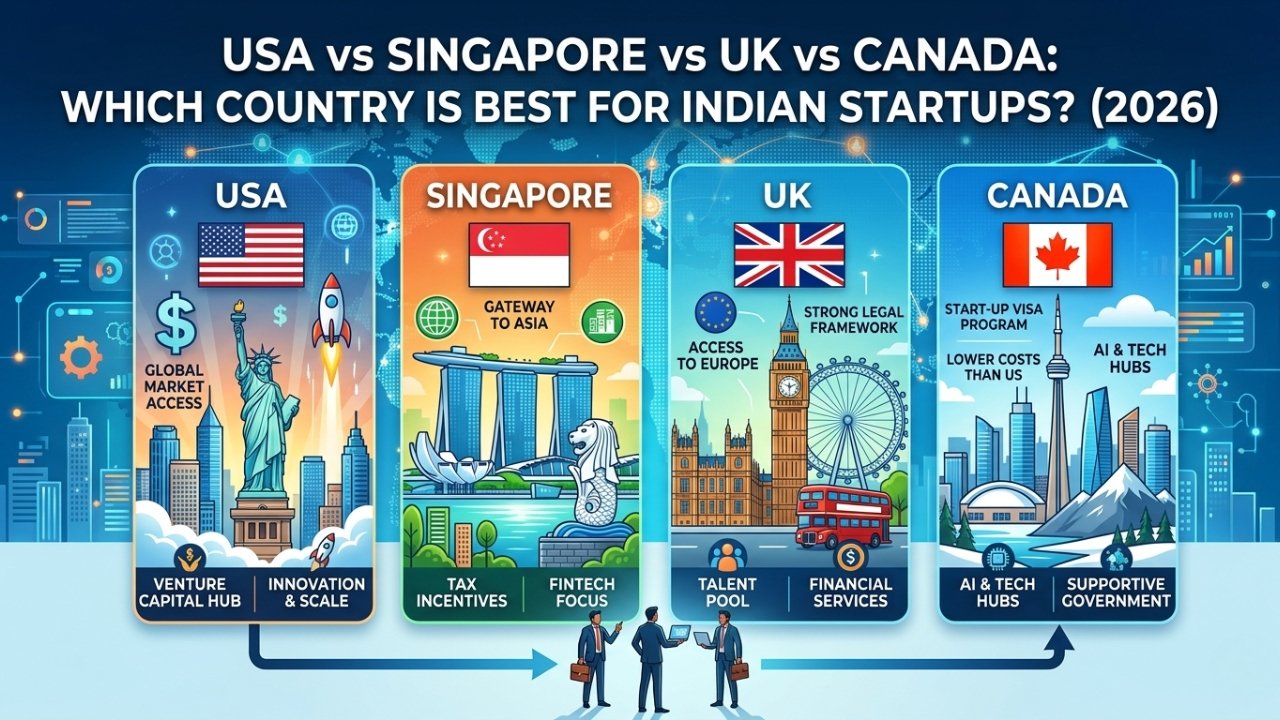
United States (Delaware C-Corp): Home to Sequoia, a16z, Tiger Global and most of the big-name VC firms. A Delaware C-Corp is the structure US investors expect to see, so choosing it tells them you plan to raise from them.
Singapore (Private Limited / Pte Ltd): A common regional base for Asian holding and tech companies. It is politically stable, tax-efficient and English-speaking, with strong banks, and the Monetary Authority of Singapore (MAS) runs a clear, predictable regime for tech and fintech businesses.
United Kingdom (Private Limited Company / Ltd): Post-Brexit, the UK has doubled down on tech entrepreneurship through initiatives like the Global Talent Visa and SEIS/EIS investor tax relief schemes. London’s fintech ecosystem in particular remains one of the world’s strongest.
Canada (Corporation / Inc.): The dark horse. Canada’s SR&ED (Scientific Research and Experimental Development) program offers refundable tax credits that can directly fund a startup’s burn rate. Combined with relatively open immigration, it’s becoming a serious option for deep-tech and AI startups.
Head-to-Head Comparison: 8 Dimensions That Matter
VC Fundraising Where the Money Lives
This is the most critical factor for most Indian founders, and the answer is almost unambiguous.
USA wins but only if you’re targeting US VCs.
If your fundraising target is US-based institutional venture capital, you need a Delaware C-Corp. The reason is structural: US institutional LPs invest in funds that are legally constrained from backing non-US entities. Most term sheets from US VCs include a requirement that the company be incorporated in Delaware. Trying to raise from Andreessen Horowitz or Bessemer with a Singapore Pte Ltd will slow you down, require costly restructuring, or simply not work.
The Delaware C-Corp structure also gives you access to the QSBS (Qualified Small Business Stock) exemption, which can save your US angel investors up to $10M in capital gains taxes making your cap table far more attractive to early-stage US angels.
Singapore is the right answer for Southeast Asian and some India-focused VCs. Firms like Sequoia Southeast Asia, Peak XV (formerly Sequoia India), and many family offices from the GCC specifically prefer Singapore-incorporated entities. If your fundraising is regional rather than strictly US-focused, Singapore’s Pte Ltd is cleaner, faster, and cheaper to maintain.
UK and Canada are weaker for traditional VC fundraising but have niche strengths. The UK’s SEIS and EIS schemes provide meaningful tax relief to UK-based angels (up to 50% income tax relief on SEIS investments), which can make your seed round more attractive locally. Canada’s fundraising ecosystem is thinner but growing, particularly in AI thanks to institutions like BDC Capital and the pan-Canadian AI Strategy.
Verdict: USA (Delaware C-Corp) for US VC. Singapore (Pte Ltd) for Asian VC. UK for angel rounds with UK investors. Canada if you’re explicitly targeting Canadian institutional programs.
Taxation What You Actually Keep
Taxation is where the conventional wisdom is most often wrong, and where Indian founders leave the most money on the table.
Singapore’s headline corporate tax rate is a flat 17%, with the first SGD 100,000 of chargeable income subject to a 75% exemption for new startup companies for the first three years. In practice, many Singapore startups pay an effective rate well under 10% in their early years. There is no capital gains tax and no dividend withholding tax on payments to foreign shareholders a major advantage for Indian founders returning profits to India.
The USA has a federal corporate tax rate of 21%, plus state taxes (Delaware itself charges a modest franchise tax, not an income tax, making it popular for holding structures). However, the US tax system is complex, and Indian founders often face unexpected exposure particularly on global income once they become US tax residents.
The UK corporate tax rate is 25% for profits above £250,000 (as of 2026), down to 19% for profits under £50,000. The UK’s R&D tax relief has been restructured in recent years and remains meaningful for qualifying companies particularly the merged R&D Expenditure Credit (RDEC) scheme.
Canada’s federal corporate tax rate is 15%, but small Canadian Controlled Private Corporations (CCPCs) enjoy a further reduction under the Small Business Deduction, bringing the effective rate down to around 9% on the first CAD 500,000 of active business income. Combined with SR&ED credits (which can refund up to 35% of qualifying R&D expenditure in cash), Canada’s effective tax cost for deep-tech companies can be extremely low.
Verdict: Singapore for tax efficiency with VC optionality. Canada for cash-back R&D tax credits. USA for access to capital markets despite higher complexity. UK sits in the middle.
Market Access Selling to Customers
Where you incorporate is not the same as where you sell but they are related in ways that matter.
A US entity dramatically simplifies selling to US enterprise customers. US procurement teams, especially at Fortune 500 companies, are conditioned to work with US-incorporated vendors. SOC 2 compliance (a US framework), US bank accounts, US contracts under US law all of these are expected. A Singapore entity selling to a US corporate buyer will face questions that a Delaware C-Corp simply doesn’t.
For Indian SaaS startups with US enterprise GTM strategies, a Delaware C-Corp is not just a VC requirement it’s a sales requirement.
Singapore is the natural base for Southeast Asian markets. Singapore sits at the geographic and regulatory centre of ASEAN, a 680 million person market that is increasingly digital-first. Singapore companies are a familiar sight to regulators and partners in Indonesia, Vietnam, Malaysia, Thailand and the Philippines, though each of those countries still applies its own foreign-ownership rules.
The UK is still a strong base for selling to European customers, particularly in fintech, healthtech, and legaltech. Despite Brexit, the UK’s financial regulatory framework (FCA-regulated) is trusted across Europe, and London remains Europe’s largest tech hub by venture investment.
Canada’s market access story is primarily about the US, due to the USMCA (formerly NAFTA) trade agreement. For startups that want proximity to the US market with lower operating costs, Canada particularly Toronto and Vancouver offers meaningful advantages.
Verdict: USA for US enterprise sales. Singapore for ASEAN. UK for European regulated industries. Canada for US adjacency with lower costs.
Incorporation Cost & Speed
For early-stage founders, time and money spent on legal setup is time and money not spent on product.
Singapore is quick and inexpensive to incorporate. The Accounting and Corporate Regulatory Authority (ACRA) charges S$15 for the name application and S$300 to register a local company (ACRA fees), and allows online incorporation in as little as one business day for standard setups. Total first-year costs including a registered address and company secretary typically run SGD 1,000–1,500 (approximately USD 750–1,100). Annual compliance is relatively light.
Delaware C-Corp incorporation typically takes 1–5 business days (expedited options available). State filing fees are modest (around USD 90 for standard filing). However, the real costs are legal a proper C-Corp setup with a founders’ agreement, IP assignment, vesting schedules, and initial equity structure will cost USD 3,000–8,000 at a US startup law firm. Many founders use services like Stripe Atlas or Clerky to reduce this cost to USD 500–2,000.
UK Ltd incorporation is usually done online within 24 hours through Companies House, for a filing fee of £100 (source: GOV.UK). However, as with the US, proper legal structuring adds meaningful cost expect £1,000–3,000 for a professionally structured startup.
Canadian incorporation at the federal level (CBCA) takes a few days and costs around CAD 200 in filing fees. Total professional setup costs are similar to the UK CAD 1,500–4,000 for a properly structured entity.
Verdict: Singapore wins on speed and cost of incorporation. Delaware wins on ecosystem support and standardized documentation. UK and Canada are comparable to each other.
Banking & Payment Infrastructure
A company is only as functional as its ability to move money and this is where many Indian founders hit an unexpected wall.
US banking for a Delaware C-Corp is accessible but not trivial for founders who are not physically in the USA. Mercury, Brex, and Relay have changed this significantly in recent years offering online business bank accounts for US-incorporated companies founded by non-US residents. These fintech banks are now the standard for early-stage Indian-founded US startups.
Singapore banking is excellent DBS, OCBC, and UOB offer business accounts that are trusted globally, and multi-currency capabilities are standard. The challenge: opening a business bank account in Singapore without a locally resident director can be slow.
UK banking is well-developed but incumbent banks (Barclays, HSBC, Lloyds) are notoriously slow for SME account opening. Fintech alternatives like Wise Business, Revolut Business, and Tide have largely solved this problem.
Canadian banking is dominated by the Big Five (RBC, TD, BMO, Scotiabank, CIBC), which are conservative but reliable. Fintech options are growing but less mature than UK or US alternatives.
Verdict: USA (with Mercury/Brex) and Singapore work well for globally mobile Indian founders. UK has good fintech alternatives. Canada’s banking is reliable but less founder-friendly for remote incorporation.
Visa & Founder Relocation
Many Indian founders want to eventually relocate themselves, not just their entity.
USA: The founder visa situation in the US remains challenging. There is no dedicated founder visa. Indian founders typically rely on the O-1A (Extraordinary Ability), L-1A (Intracompany Transfer), or for those with a US-based investor the EB-1C or EB-2 NIW pathways. The H-1B lottery is not a viable path for founders. Wait times for employment-based green cards from India are historically long (often decades for EB-2/EB-3).
Singapore: The EntrePass is specifically designed for startup founders. Eligibility is linked to funding from recognized Singapore VCs, incubator acceptance, or other criteria. Singapore PR and citizenship pathways, while not automatic, are more predictable than the US for high-skilled professionals.
UK: The Global Talent Visa (endorsed by Tech Nation, although Tech Nation’s endorsement role ended now via UKRI and other bodies) and the Innovator Founder Visa are the primary routes. The UK is actively competing for global tech talent post-Brexit and the visa system reflects this.
Canada: The Start-Up Visa (SUV) program is one of the most underrated immigration pathways in the world. If your startup receives a commitment from a designated Canadian VC, angel network, or business incubator, you can apply for permanent residence directly bypassing the temporary work visa stage entirely. Processing times have improved but still average 12–24 months.
Verdict: Singapore and Canada have the most founder-friendly immigration pathways. UK is improving. USA is the hardest for Indian founders due to visa backlogs.
Ecosystem & Network Effects
Ecosystem is about more than capital it’s about customers, talent, advisors, and communities.
The US ecosystem is far larger than the other three. Y Combinator, Techstars and hundreds of other accelerators; Stanford, MIT and the talent around them; and a dense network of repeat founders, operators and investors. If you get into YC or base yourself in the SF Bay Area, that network keeps paying off for decades.
Singapore has a strong ecosystem for a country of its size, anchored by Enterprise Singapore and the Infocomm Media Development Authority (IMDA). The government is an active and sophisticated participant in the startup ecosystem directly funding through grants like the Enterprise Development Grant (EDG) and Startup SG programs.
London is strong in fintech and legaltech, and the London-to-India founder pipeline is well-established. Many Indian founders find London more culturally accessible than Silicon Valley as a first base outside India.
Canada’s ecosystem is growing quickly, particularly in AI (Montreal, Toronto, and the Vector Institute), cleantech (Vancouver), and fintech (Toronto). The government’s pan-Canadian AI Strategy has produced real density in machine learning research.
Verdict: USA for maximum network effect. Singapore for regional Asia + government support. UK for fintech/legaltech and Indian diaspora network. Canada for AI and deep-tech research density.
Delaware C-Corp vs Singapore Pte Ltd for VC Fundraising The Definitive Answer
This is the question we get most often, and it deserves its own section.
Choose Delaware C-Corp if
- You are targeting US-based institutional VCs (Tier 1 or Tier 2 US funds)
- Your primary market is the United States
- You plan to list on a US exchange (NASDAQ/NYSE) as an exit
- You have already engaged with US angels or accelerators (YC, Techstars, a16z Scout, etc.)
- Your co-founders are willing to or are already living in the US
Choose Singapore Pte Ltd if
- Your primary investor targets are Southeast Asian VCs, India-focused funds, or GCC-based family offices
- You are building for the ASEAN, Middle East, or South Asian market
- You want a tax-efficient, compliance-light holding structure
- Your co-founders are based in Singapore or are willing to relocate there
- You want to avoid the complexity of US tax reporting as a foreign-founded company
The Flip: Many Indian startups that incorporate in Singapore early find themselves doing a “flip” to a Delaware C-Corp structure once they’re ready for Series A from US VCs. This flip (technically a share swap where Singapore entity shareholders receive shares in a new Delaware entity) costs USD 10,000–25,000 in legal fees and takes 2–4 months. It’s manageable, but it’s better to anticipate it early and structure Singapore cap tables cleanly.
The Verdict Which Country Is Best for Your Indian Startup?
There is no single right answer — but there are right answers for specific startup profiles.
| Startup Profile | Best Country | Entity Type |
|---|---|---|
| Indian SaaS targeting US enterprise | USA | Delaware C-Corp |
| Consumer app targeting Southeast Asia | Singapore | Pte Ltd |
| Fintech targeting Europe/UK | United Kingdom | Ltd |
| AI/ML deep-tech with R&D-heavy roadmap | Canada | Federal Corp (CBCA) |
| Pre-Series A, raising from Indian/GCC VCs | Singapore | Pte Ltd |
| Targeting US VCs at Series A+ | USA | Delaware C-Corp |
| Founder wants to relocate via SUV | Canada | Federal Corp |
| Founder wants lowest corporate tax | Singapore | Pte Ltd |
Common Mistakes Indian Founders Make
Mistake 1: Incorporating in the wrong country because their co-founder’s immigration lawyer suggested it. Immigration law and startup corporate law are different fields. A visa pathway and the best entity for fundraising are separate considerations.
Mistake 2: Assuming Singapore is always cheaper than the USA. Annual compliance costs for a Singapore Pte Ltd (company secretary, annual returns, audit thresholds) can surprise founders. Delaware annual costs are also real (franchise tax is based on authorized shares watch your share authorization numbers).
Mistake 3: Waiting too long to decide. Every month you operate as an unregistered entity, or as an Indian entity that you plan to flip, is a month of IP assignment complexity, employee agreement messiness, and investor concern. Decide early.
Mistake 4: Building your cap table without thinking about the future. Singapore cap tables with complex ESOP structures, convertible notes in Indian rupees, and multiple share classes can make a flip to Delaware expensive and time-consuming. Keep early-stage cap tables clean.
Frequently Asked Questions
Can I incorporate in Delaware but live in India?
Yes. A Delaware C-Corp does not require the founder or directors to be US residents or citizens. However, you will need a registered agent in Delaware (cost: ~USD 100–150/year), and you will need a US bank account (Mercury or Brex work well for remote founders).
Is a Singapore Pte Ltd suitable for ESOP issuance to Indian employees?
Yes, but there are compliance implications under India’s Foreign Exchange Management Act (FEMA) and the RBI’s overseas investment rules. Employees receiving ESOPs from a foreign entity must comply with Indian reporting requirements. Work with a CA familiar with both Indian and Singapore regulations.
How long does it take to flip from Singapore to Delaware?
Typically 2–4 months from start to close, assuming clean cap tables. Costs range from USD 10,000–25,000 in US legal fees plus Singapore dissolution or holding costs. Plan for this well before you need the flip to be complete.
Does incorporating in Canada help with US market access?
Partially. USMCA provides trade advantages, and proximity and time zones help operationally. However, US enterprise customers and US VCs still prefer a US-incorporated entity for contractual and legal familiarity reasons.
What is the best country for an Indian SaaS startup targeting SMBs globally?
Singapore. The combination of low taxes, clean banking, ASEAN market access, and the ability to flip to Delaware later makes Singapore the most flexible choice for early-stage SaaS founders without a clear US-first mandate.
Conclusion
The best country for your Indian startup in 2026 depends entirely on where your capital is coming from, who your customers are, and where you personally want to build your life.
If US venture capital and the US enterprise market are your north star, Delaware is non-negotiable.
If you want tax efficiency, regional optionality, and a clean compliance structure while you find your product-market fit, Singapore is the smartest default.
If deep-tech R&D and cash-back tax credits are more valuable to you right now than prestigious zip codes, Canada deserves serious consideration.
And if you’re building for European regulated industries with a clear London GTM, the UK’s ecosystem and investor base make it the right call.
No jurisdiction is perfect. Every choice involves tradeoffs. The key is making the decision intentionally with full awareness of the implications for fundraising, taxation, talent, and your own life as a founder.