
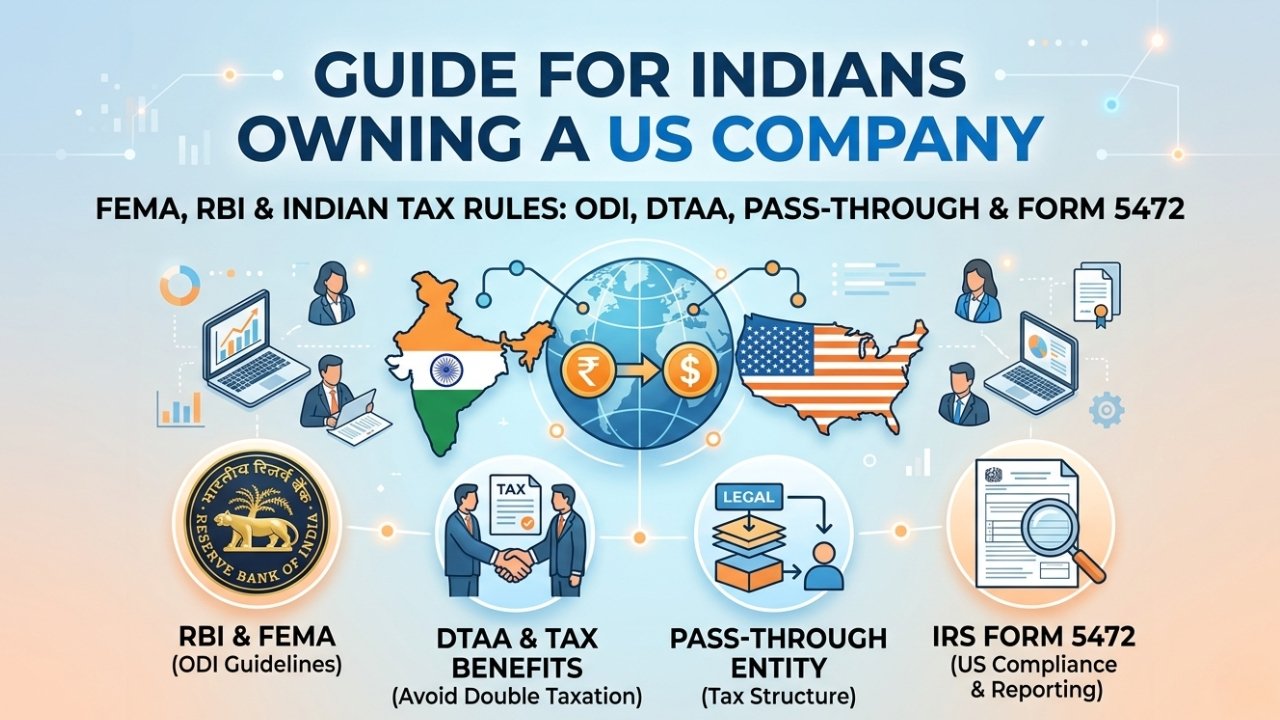
USA FEMA RBI Rules Indians resident who owns or plans to own a US LLC or C-Corp, you’re operating at the intersection of two complex legal systems FEMA on the Indian side, and the IRS on the US side. This guide covers every major compliance obligation: RBI’s ODI framework, FEMA reporting, India-USA DTAA benefits, Foreign Tax Credits under Section 90, LLC pass-through taxation quirks, and Form 5472. Bookmark this you’ll refer to it often.
Can an Indian Resident Legally Own a US Company? {can-indian-resident-own-us-company}
Yes an Indian resident can own a US LLC or C-Corporation. There is no blanket prohibition under Indian law against holding equity in a foreign entity. However, the word “legally” carries significant weight here. Ownership without compliance is not the same as permissible ownership.
The governing framework is the Foreign Exchange Management Act, 1999 (FEMA), administered by the Reserve Bank of India (RBI). FEMA replaced FERA (Foreign Exchange Regulation Act) and shifted the philosophy from presumption of guilt to presumption of innocence but it still mandates rigorous reporting and prior approvals in specific cases.
The structure of your ownership whether you hold shares in a C-Corp, membership interest in an LLC, or function as a director/officer determines which FEMA provisions apply and what your annual compliance burden looks like.
Key distinction to understand from the outset.
| Entity Type | US Tax Treatment | India Treatment | Compliance Complexity |
|---|---|---|---|
| Single-Member LLC | Disregarded Entity | Opaque Foreign Entity | HIGH mismatch risk |
| Multi-Member LLC | Partnership (Pass-Through) | Likely opaque entity | HIGH double taxation risk |
| C-Corporation | Separate taxable entity | Separate foreign company | MODERATE dividend taxation |
| S-Corporation | Pass-through (US residents only) | Non-resident can’t hold S-Corp | N/A for Indian residents |
This mismatch between how the US and India treat an LLC is the single most dangerous compliance gap for Indian entrepreneurs operating in America. We’ll address this in detail in Section 5.
FEMA Rules and the ODI Framework Explained {fema-rules-odi-framework}
What is ODI (Overseas Direct Investment)?
When an Indian resident acquires ownership in a foreign entity whether through equity, loans, or guarantees this is classified as Overseas Direct Investment (ODI) under FEMA. The RBI’s ODI regulations govern when you need prior approval, how much you can invest, and what you need to report afterward.
The primary regulation is FEMA Notification No. 120 (Overseas Investment Regulations), now significantly updated by the Foreign Exchange Management (Overseas Investment) Rules, 2022 and the accompanying RBI Master Direction on Overseas Investment (2022).
The Automatic Route vs. Approval Route
Automatic Route (No prior RBI approval needed)
- Investment in a foreign entity that is not in the financial services sector
- The Indian entity/individual is not under investigation or has no overdue submissions
- Investment does not exceed 400% of the net worth of the Indian entity (for companies) for individuals, the Liberalised Remittance Scheme (LRS) limit applies
Approval Route (Prior RBI approval required).
- Investment in Pakistan or any FATF non-compliant country
- Investment by entities already under investigation
- Investments in financial services entities (banking, insurance, NBFC) require additional sector-specific approvals
Liberalised Remittance Scheme (LRS) for Individuals
If you’re an Indian individual (not a company) investing in a US entity, your route is primarily the Liberalised Remittance Scheme (LRS).
- Annual limit: USD 250,000 per financial year per individual
- Permitted use: Acquisition of foreign securities, setting up of foreign entities, professional/educational purposes
- Not permitted under LRS: Remittances for margins or margin calls, purchase of lottery/gambling instruments, capital account transactions not explicitly permitted
Important 2023-24 update: Tax Collected at Source (TCS) at 20% now applies on LRS remittances exceeding ₹7 lakh per financial year (for non-educational, non-medical purposes). This TCS is creditable against your final tax liability but creates a temporary cash flow impact. For remittances specifically for purchasing foreign securities, the 20% TCS applies on the full amount.
What Counts as ODI vs. OPI (Overseas Portfolio Investment)?
This distinction matters because the compliance regimes differ.
- ODI: Holding 10% or more of the paid-up equity capital of a foreign entity, OR having control regardless of percentage
- OPI (Overseas Portfolio Investment): Holding less than 10% and without control
If you own 100% of your US LLC or C-Corp, that’s clearly ODI. If you’re one of many investors in a US startup holding a 3% stake with no board seat, that’s OPI, with different (lighter) reporting requirements.
RBI Reporting Obligations APR, FLA & More {#rbi-reporting-obligations}
Owning a US company isn’t a one-time event it creates ongoing annual reporting obligations to the RBI. Missing these filings doesn’t just create penalties; under FEMA, it can be construed as a violation, potentially triggering adjudication proceedings.
Annual Performance Report (APR)
Who must file: Every Indian resident who has made an ODI and the foreign entity in which the investment is made is operational.
Due date: July 31 of every year (for the preceding financial year ending March 31)
What it covers.
- Financial performance of the foreign entity (revenue, profit/loss, assets)
- Dividend remitted to India (if any)
- Further investment made during the year
- Changes in shareholding, directors, or business activities
How to file: Through the FIRMS portal (Foreign Investment Reporting and Management System) maintained by RBI
Consequence of non-filing: Penalty under FEMA up to 3x the amount involved in the contravention, or up to ₹2 lakh where the amount cannot be quantified, plus ₹5,000 per day of continuing default.
Foreign Liabilities and Assets (FLA) Return
Who must file: Indian companies (not individuals) that have received FDI or made ODI must file the FLA return with the RBI.
Due date: July 15 of every year
Note for individuals: If you personally (not through an Indian company) hold a US entity, the FLA return doesn’t directly apply to you, but the APR does.
Form FC-GPR and FC-TRS
These forms are relevant when there are transactions involving fresh equity issuance or transfer of shares between residents and non-residents in an Indian company they apply less directly to Indian residents owning foreign entities, but can come into play in complex cross-border restructuring.
Summary of Key RBI Filing Calendar
| Filing | Applicable To | Due Date | Portal |
|---|---|---|---|
| APR (Annual Performance Report) | Indian residents with ODI | July 31 | FIRMS |
| FLA Return | Indian companies with FDI/ODI | July 15 | RBI FLAIR |
| Form ODI – Part I | At time of making fresh ODI | Within 30 days of transaction | FIRMS |
| LRS Reporting | Banks report on behalf of remitters | Per transaction | Automatic via AD Banks |
How India Taxes Your US Company Income {india-taxes-us-company-income}
The Foundational Principle: Global Income for Residents
Under the Income Tax Act, 1961, Indian tax residents are taxed on their global income. If you are a Resident and Ordinarily Resident (ROR) of India, income earned anywhere in the world including through a US company is subject to Indian income tax.
Your residential status under Indian law depends on:
- Physical presence in India (182 days in the relevant financial year, or 60/365 days under the extended test)
- Whether you’ve been resident for at least 2 of the preceding 10 years (for ROR status)
C-Corporation Income How India Taxes It
If you own a C-Corp in the US, the taxation is conceptually straightforward.
- The C-Corp is a separate legal entity, taxed in the US at 21% federal corporate tax rate
- When the C-Corp distributes dividends to you (the Indian resident shareholder), those dividends are income in your hands in India
- The dividends are taxed as “Income from Other Sources” in India at your applicable slab rate
- You can claim a Foreign Tax Credit (FTC) under Section 90 for the US withholding tax paid on those dividends (typically 25% under the India-US DTAA, or 15% for qualified dividends with proper treaty application)
The retained earnings trap: What the C-Corp earns and retains is NOT taxed in your hands in India currently. India doesn’t have comprehensive CFC (Controlled Foreign Corporation) rules like the US does. However, this isn’t a permanent shelter when those retained earnings are eventually distributed as dividends or returned on liquidation, they come back into the Indian tax net.
LLC Income India’s Unique Problem {llc-india-problem}
This is where things get genuinely complicated. Skip ahead to Section 5 for the full analysis.
The LLC Pass-Through Problem India’s Unique Complication {llc-pass-through-problem}
How the US Treats an LLC
A Single-Member LLC (SMLLC) is treated as a “disregarded entity” by the IRS by default. This means:
- The LLC itself pays no US federal income tax
- All income and expenses flow through to the owner’s personal US tax return (Form 1040 or 1040-NR)
- The LLC is essentially transparent for US tax purposes
A Multi-Member LLC is treated as a partnership by default:
- The LLC files Form 1065 (US Return of Partnership Income)
- Each member receives a Schedule K-1 showing their share of income
- Members pay tax on their allocable share, not just distributions
How India Treats an LLC The Fatal Mismatch
Here is the critical problem that trips up most Indian entrepreneurs and even many tax advisors: India does not recognise the concept of a “disregarded entity.”
Under Indian tax law, a Limited Liability Company is an entity it has separate legal existence, limited liability for its members, and its own income-generating capacity. The Income Tax Act does not have a provision to “look through” a foreign LLC the way the US IRS does.
What this creates in practice.
Scenario A Single-Member LLC held by an Indian resident.
- US side: LLC income is disregarded; you report it directly on your 1040-NR. You pay US tax (if any) as an individual.
- India side: The Indian tax department may treat the LLC as a foreign company. The LLC’s income is the LLC’s income not yours until distributed.
- Result: On the US side, you’ve already paid tax on the income personally. On the India side, the income isn’t taxed when earned (the LLC is a separate entity) but will be taxed when dividends are paid to you.
- Double taxation risk: If the LLC distributes income to you, India taxes that distribution as dividend income. But you’ve already paid US tax on the same income as personal income. The DTAA credit mechanism may not cleanly resolve this because the payer of Indian tax (you, as dividend recipient) and the payer of US tax (also you, but in your capacity as the LLC’s “owner” for US purposes) may not be the same “person” in the eyes of Indian law.
Scenario B Multi-Member LLC.
- The partnership income allocation on K-1 may not be recognised by India
- India may wait for actual distribution before taxing
- The US tax already paid at the partner level may not qualify for Section 90 credit in India because the income hasn’t yet been “taxed in India”
The Hybrid Entity Problem
International tax law has a formal name for this: the “hybrid entity mismatch.” The LLC is “transparent” in the US but “opaque” in India. Different countries treating the same entity differently creates planning gaps that tax authorities are increasingly targeting.
The OECD’s BEPS (Base Erosion and Profit Shifting) project, specifically Actions 2 and 4, explicitly addresses hybrid mismatches. While India-US DTAA currently doesn’t have a comprehensive hybrid mismatch rule, the Indian income tax department has the tools including GAAR (General Anti-Avoidance Rules) to challenge structures it views as abusive.
Practical Solutions How to Structure Around This
Option 1: Elect C-Corp Treatment for the LLC
An LLC can elect to be treated as a C-Corporation for US tax purposes by filing Form 8832 (Entity Classification Election). This makes the entity opaque from both the US and Indian perspectives, eliminating the mismatch. The trade-off: you lose pass-through efficiency and face US corporate-level tax at 21%.
Option 2: Use a C-Corporation from the Start
For Indian residents with no US personal tax obligations, forming a C-Corp rather than an LLC often creates cleaner cross-border tax treatment. The corporate veil is respected in both countries, dividend flows are clearly defined, and DTAA application is unambiguous.
Option 3: Careful Characterisation in Indian Returns
Some advisors take the position that an Indian resident owning a US SMLLC should report the LLC’s income directly on their Indian return (treating the LLC as transparent, consistent with US treatment). This is defensible but aggressive and not universally accepted by the Indian revenue department.
Option 4: Proper FTC Documentation
If you maintain the LLC structure, document every US tax paid at both the entity and individual level with proper Form 1040-NR, Schedule E, and state returns, so that FTC claims in India are well-supported.
India-USA DTAA: Rates, Benefits & How to Claim FTC {india-usa-dtaa-ftc}
Overview of the India-USA Double Taxation Avoidance Agreement
India and the United States signed their DTAA in 1989, and it remains in force with no major renegotiation since. The treaty is a comprehensive income tax treaty covering most categories of income.
Key treaty benefits for Indian residents with US income .
| Income Type | Typical US Withholding | DTAA Rate | India Tax | FTC Available? |
|---|---|---|---|---|
| Dividends (general) | 30% | 25% | At slab rate | Yes |
| Dividends (substantial holding) | 30% | 15% | At slab rate | Yes |
| Interest income | 30% | 15% | At slab rate | Yes |
| Royalties | 30% | 15% | At slab rate | Yes |
| Business profits (with PE) | Standard US rate | Treaty rules | At slab rate | Yes |
| Capital gains | 0-20% US rate | Complex see below | At slab rate | Partial |
Note on dividends: The 15% rate applies when the Indian resident holds at least 10% of the voting stock of the US company. For holdings below 10%, the 25% rate applies. To claim treaty rates, your US payer will need a completed Form W-8BEN (for individuals) or Form W-8BEN-E (for entities).
Capital Gains Under the DTAA A Complex Area
The India-US DTAA does not fully override domestic US capital gains tax rules. Gains from the sale of US situs property (including shares of US companies, US real estate) can be taxed in the US. India also taxes the same gains under domestic law. The DTAA allows FTC but the interaction can be complex:
- Short-term gains in the US are taxed at ordinary rates; India has its own short/long-term distinction based on holding period
- If the US tax rate exceeds the Indian tax rate on the same income, you cannot claim a refund — the excess US tax becomes a permanent cost
Claiming Foreign Tax Credit (FTC) Under Section 90
Section 90 of the Income Tax Act enables Indian residents to claim credit for foreign taxes paid where India has a DTAA with the source country. The US qualifies. Here’s the procedure.
Step 1: Determine the foreign tax paid
Gather all US tax documentation Form 1040-NR, W-2, 1099s, state tax returns, and any withholding certificates showing the tax actually paid to the IRS.
Step 2: File Rule 128 Foreign Tax Credit
Effective from FY 2016-17, Rule 128 of the Income Tax Rules governs FTC claims. Key requirements.
- The foreign tax must be on income that is also taxable in India
- The credit is limited to the Indian tax payable on the same income (you can’t get a net refund)
- The credit is computed separately for each source country
- You must file Form 67 with the Indian income tax return to claim FTC
Step 3: Attach supporting documentation
- Certificate or statement from the foreign tax authority (IRS transcript or Form 1040-NR acknowledgment)
- Self-certification in cases where the foreign authority certificate is not available
Step 4: Timing of FTC claim
The FTC claim must be made in the year the income is offered to tax in India. If you’re claiming FTC on dividends received, include both the dividend income and the FTC claim in the same year’s return.
Important Limitation FTC on Tax Paid by the LLC
If your LLC is treated as a disregarded entity for US purposes and you pay US tax in your personal capacity, but India treats the LLC’s income as distributable only when actually paid out the FTC timing mismatch can mean you’ve paid US tax in Year 1 but can only claim Indian FTC in Year 2 (when dividends are paid). This is another dimension of the hybrid mismatch problem.
Form 5472 and Its Interaction with Indian Compliance {form-5472-indian-compliance}
What is Form 5472?
Form 5472 (Information Return of a 25% Foreign-Owned U.S. Corporation or a Foreign Corporation Engaged in a U.S. Trade or Business) is an IRS information reporting form. Since 2017, its scope expanded significantly to include Single-Member LLCs owned by foreign persons.
Who must file
- A US corporation that is 25% or more owned by a foreign person (including Indian residents)
- A US LLC that is 100% owned by a foreign person (SMLLC disregarded entity rule this was the 2017 expansion)
What it reports
- Reportable transactions between the US entity and its foreign owners or related parties
- Loans, payments, services, rents, royalties between the US LLC/Corp and the Indian owner
- The form itself is not a tax payment mechanism it’s purely informational
Penalty for non-filing: USD 25,000 per failure one of the steepest IRS penalties. The IRS takes Form 5472 compliance very seriously for foreign-owned US entities.
How Form 5472 Interacts with Your Indian Compliance
The interaction between Form 5472 and Indian compliance is primarily a transfer pricing and information asymmetry issue.
Transfer Pricing Risk.
If you (the Indian owner) are providing services to your US LLC and charging a fee (or not charging when you should), both the IRS and the Indian income tax department can scrutinize these transactions. The IRS uses Form 5472 data to identify potential transfer pricing issues. India’s transfer pricing rules (Sections 92-92F) require arm’s length pricing for international transactions between associated enterprises.
Information Disclosure.
Form 5472 data is shared with the OECD’s Common Reporting Standard (CRS) and Foreign Account Tax Compliance Act (FATCA) systems. India participates in both. This means the Indian tax authority may receive information about transactions between you and your US entity independently before you’ve disclosed it in your Indian return.
Practical implication.
Your Form 5472 and your Indian Schedule FA (Foreign Assets disclosure) must be consistent. Discrepancies between what you’ve reported to the IRS and what you’ve disclosed in India are a red flag for both jurisdictions.
Form 5472 and the SMLLC Conundrum
Here’s a specific scenario that creates compliance complexity.
You own a US SMLLC (disregarded entity). The LLC has a bank account, invoices US clients, and receives revenue. You occasionally transfer money from the LLC account to your personal Indian account.
For Form 5472 purposes.
Each transfer from the LLC to you (the foreign owner) is a “reportable transaction” that must be disclosed on Form 5472. The transfer is treated as a distribution from a disregarded entity to its owner.
For Indian FEMA purposes.
The money you receive in India from the LLC must be routed through proper banking channels and categorized correctly as a dividend, return of capital, or loan repayment. An uncharacterised transfer from your US LLC to your Indian account creates FEMA compliance issues.
The solution.
Maintain proper bookkeeping in the LLC, declare dividends formally (even in an LLC structure, via “distributions”), route payments through properly documented channels, and ensure your Form 5472 and Indian FEMA/ITR filings are mirror images of each other.
Repatriating Profits from the USA to India {repatriating-profits-usa-india}
Bringing money from your US company back to India “repatriation” involves navigating both US rules (can you take money out?) and Indian rules (how must you receive it?).
From a C-Corporation
US side: The C-Corp can distribute dividends to you. US withholding tax applies at 30% (reducible to 15-25% under DTAA with Form W-8BEN). The dividend is paid from post-tax corporate profits.
India side: The dividend you receive in India is income from other sources. You declare it in your ITR and claim FTC for the US withholding tax suffered.
Routing: Transfer from the US company’s bank account to your Indian NRO or resident savings account. Ensure the bank classifies the inward remittance correctly as “dividend income from foreign investment.”
From an LLC
US side: LLC “distributions” to members are not taxed again at the LLC level (pass-through already happened). If the LLC has accumulated profits, distributions are generally tax-free at the federal level once the member’s basis is recovered.
India side: As discussed, India may treat this as a dividend from an opaque foreign entity, taxable as income from other sources.
Banking documentation: Your Indian bank will ask for the source of funds under FEMA’s inward remittance guidelines. Provide a letter from your US LLC confirming the distribution, along with LLC financial statements.
Loan from Your US Company to You
Some Indian residents try to structure repatriation as a loan from their US entity to themselves, avoiding dividend taxation. This is problematic:
- FEMA: Loans from a foreign entity to an Indian resident require prior RBI approval in many cases
- US tax: The IRS scrutinizes shareholder loans particularly in closely held corporations and may recharacterize them as dividends if they lack commercial terms
- Transfer pricing: Must be at arm’s length interest rates
Tax-Efficient Repatriation Planning
The most tax-efficient structure for ongoing repatriation depends on your specific situation, but a common framework.
- Minimize Indian-side taxation by timing dividends in low-income years
- Claim FTC aggressively but correctly don’t leave credits on the table
- Consider partial reinvestment in the US (retained by the C-Corp) vs. repatriation based on your Indian tax slab in each year
- For large lump-sum repatriations, model the tax impact before triggering the distribution
Disclosing Your US Company in Your Indian Tax Return {disclosing-us-company-indian-tax-return}
This is non-negotiable and non-optional: If you are an Indian tax resident who owns a foreign company, you must disclose it in your Indian Income Tax Return.
Schedule FA Foreign Assets Disclosure
Schedule FA (Foreign Assets) in the Indian ITR forms (applicable to ITR-2 and ITR-3) requires disclosure of.
- Foreign bank accounts: Any accounts held outside India during the financial year
- Foreign equity and debt interest: Shares, membership interests, debentures, or bonds held in foreign companies
- Foreign immovable property: Real estate held outside India
- Foreign accounts in which you have signing authority: Even if the beneficial owner is different
- Foreign trusts: If you are a settlor, trustee, or beneficiary
For your US LLC or C-Corp: You must disclose under “Foreign equity and debt interest” the name of the entity, country, nature of interest (equity/membership), date of acquisition, and the value at year-end (both peak value and closing value).
Black Money Act The Severe Consequence of Non-Disclosure
The Black Money (Undisclosed Foreign Income and Assets) and Imposition of Tax Act, 2015 imposes severe penalties for non-disclosure of foreign assets.
- Tax rate: 30% flat on the value of the undisclosed foreign asset (not just the income)
- Penalty: Additional 90% of the tax (so effectively 120% of the asset value in tax + penalty)
- Prosecution: Up to 7 years imprisonment in serious cases
This is not a theoretical risk. Indian income tax authorities are receiving data through FATCA (India-US inter-governmental agreement) and CRS automatically. Your US bank accounts and LLC ownership are likely already known to the Indian tax department the question is whether your disclosure matches what they know.
Foreign Asset Reporting Practical Checklist
Before filing your Indian ITR, ensure you have.
Name and address of the US company
Country of incorporation (USA)
Date you acquired your interest
Nature of interest (100% equity, membership interest, etc.)
Peak value during the year (in INR, converted at RBI reference rate)
Closing value as of March 31 (the Indian financial year end)
Income earned from the entity during the year (dividends, salary, etc.)
US taxes paid on that income
FTC claim details
FIRPTA What Indian Real Estate Investors Must Know {firpta-indian-real-estate-investors}
FIRPTA (Foreign Investment in Real Property Tax Act) is a US law that ensures the US can tax gains when a foreign person sells US real property interests. It operates as a withholding mechanism at the time of sale, not at the time of tax filing.
How FIRPTA Works
When an Indian resident (or a foreign-owned entity) sells US real property.
- The buyer is required to withhold 15% of the gross sale price (not the gain the full price) and remit it to the IRS
- The foreign seller then files a US tax return (Form 1040-NR) reporting the actual gain and claims the 15% withholding as a credit against their actual tax liability
- If the actual tax owed is less than 15% of the gross price, the seller gets a refund
Example: You sell a US property for USD 500,000 with a cost basis of USD 400,000. Your actual gain is USD 100,000. At 20% long-term capital gains rate, your US tax is USD 20,000. But FIRPTA withholding is 15% × USD 500,000 = USD 75,000. You’d be owed a refund of USD 55,000 but you must file a US return to get it.
FIRPTA and Indian-Owned US LLCs
If you hold US real estate through a US LLC (a common structure), the FIRPTA analysis depends on the LLC’s classification.
- Disregarded LLC: The LLC is ignored; FIRPTA applies directly to you as the foreign owner. Your interest in the LLC is itself a US Real Property Interest (USRPI) for FIRPTA purposes.
- C-Corp election: If the LLC has elected C-Corp status, the shares of that corporation are generally NOT USRPIs unless the corporation is a “US Real Property Holding Corporation” (USRPHC) which it is if more than 50% of its assets are US real property.
Indian Tax on FIRPTA Gains
The gain from selling US property will also be taxable in India (as capital gains from foreign assets). You can claim FTC for the US tax paid. However.
- The characterization of gains (long-term vs. short-term) differs between India (24 months for immovable property) and the US (12 months for long-term)
- Indexation benefits available in India for long-term capital gains on property are not mirrored in the US
- The interaction between FIRPTA withholding, actual US tax, and Indian FTC requires careful planning before the sale, not after
FIRPTA Withholding Certificate A Critical Planning Tool
If you’re selling US property, you can apply for a FIRPTA Withholding Certificate (Form 8288-B) from the IRS before closing. If approved, the IRS can reduce the withholding to the actual expected tax freeing up the difference at closing rather than making you wait for a refund. Processing takes 90+ days, so plan ahead.
Structuring Recommendations & Expert Checklist {structuring-recommendations}
Choosing the Right Entity Structure
Based on your situation, here’s a decision framework.
Use a C-Corporation if.
- You plan to raise institutional funding (VCs invest in C-Corps, typically Delaware)
- You want the clearest cross-border tax treatment
- You’re not planning to take profits out of the US in the near term (retained earnings grow at 21% corporate rate, not your personal Indian slab)
- You anticipate selling the company (US capital gains rules, M&A structures favor C-Corps)
Use an LLC with C-Corp election if.
- You want the operational flexibility of an LLC with corporate tax treatment
- You have specific liability or structural reasons for an LLC
Avoid an LLC with pass-through treatment if.
- You are an Indian resident who will personally receive the pass-through income in India the hybrid mismatch creates a genuine double taxation risk without reliable resolution
Use an LLC with pass-through treatment only if.
- You have US-side income that benefits from pass-through (e.g., rental real estate where depreciation offsets income)
- You have a qualified US tax advisor who has specifically modeled the India-side treatment
- The amounts are small enough that the tax risk is manageable
Pre-Investment Compliance Steps
Before remitting any money to form or invest in your US entity.
- Confirm your Indian residential status are you ROR, RNOR, or NR? This determines whether foreign income is taxable in India at all.
- Determine if your investment is under LRS (individual) or requires ODI approval (company investing)
- Complete the LRS remittance through your authorised dealer bank with proper purpose coding
- File ODI-Part I on FIRMS within 30 days of investment (for ODI)
- Register with the IRS obtain an ITIN (Individual Taxpayer Identification Number) if you’ll file US returns as an individual, or an EIN (Employer Identification Number) for your entity
- Complete Form W-8BEN or W-8BEN-E and provide to your US bank and any US payers to claim DTAA benefits
Ongoing Annual Compliance Calendar
| Month / Period | Action |
|---|---|
| January – March | Compile US entity financials for the calendar year ended December 31 |
| April | File US federal tax return or extension (April 15 deadline); review DTAA positions |
| June – July | File Indian ITR with Schedule FA (by July 31 for non-audit cases) |
| July | File APR on FIRMS (by July 31) |
| October | File US extended returns (October 15 deadline) |
| Year-round | Maintain LRS remittance records; document inward remittances for FEMA |
Frequently Asked Questions
Can an Indian resident open a US bank account for their LLC without visiting the USA?
Yes, some US banks (Mercury, Relay, Bluevine) offer remote account opening for US LLCs with foreign owners. However, you still need a US EIN, formation documents, and must comply with FinCEN beneficial ownership reporting requirements.
Do I need to pay Indian income tax on profits my US C-Corp earns even if I haven’t received any dividends?
Generally no, under current Indian law. India does not have comprehensive CFC rules that would tax undistributed foreign corporate profits in your hands. But check the Black Money Act even if not currently taxable, the asset must be disclosed.
Is a US LLC’s income taxable in India for an Indian resident who operates the business from India?
This is highly fact-specific. If you (an Indian resident) are running the business from India, the LLC’s “effective management and control” may be in India, making the LLC resident in India under Indian tax law regardless of where it’s incorporated. This “Place of Effective Management (POEM)” issue is a separate compliance concern. Get specific advice.
My US LLC made no money this year. Do I still need to file Form 5472?
Yes, if there were any reportable transactions between you and the LLC including a single dollar transfer, any expense paid on behalf of the LLC, or any service rendered. A dormant LLC with zero transactions may be exempt, but confirm with your US CPA.
What’s the TCS rate on remittances for buying foreign company shares?
As of 2024, TCS at 20% applies on LRS remittances for overseas investments (purchase of foreign securities) exceeding ₹7 lakh in a financial year. This is creditable against your final tax liability when you file your ITR.