 Comply Globally
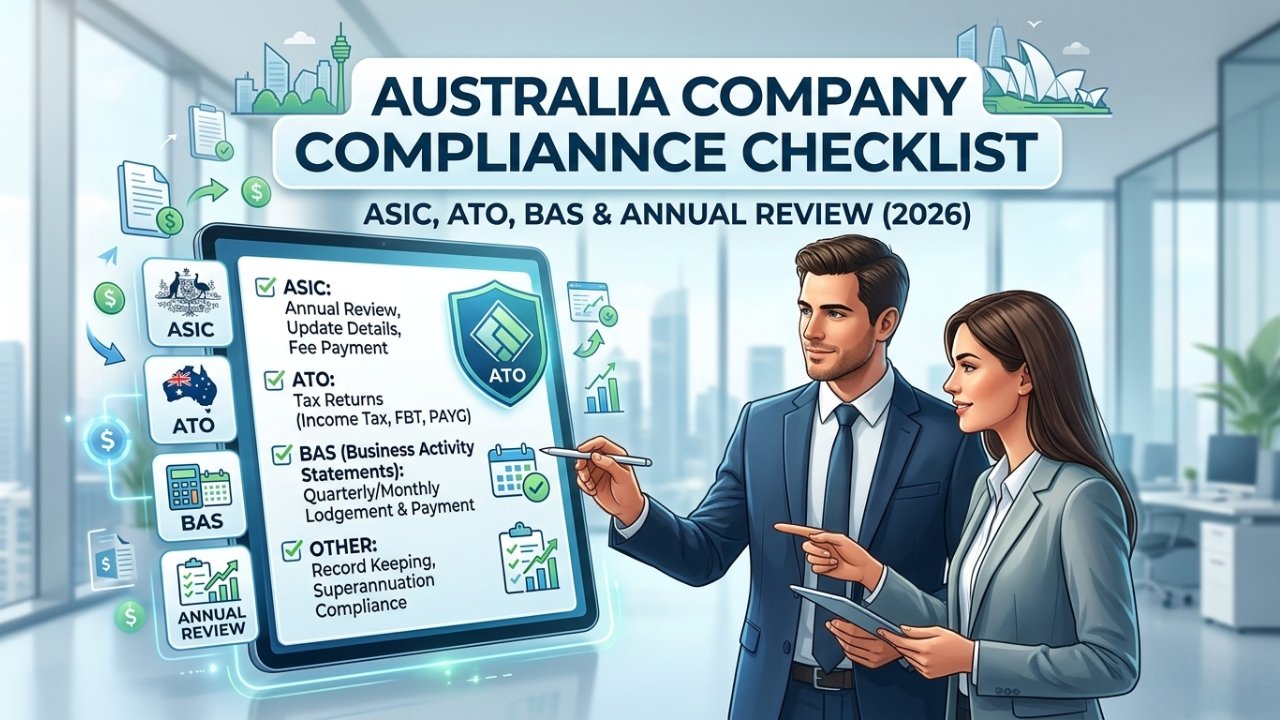
Running a company in Australia company compliance checklist means meeting a specific set of annual legal and tax obligations whether you are a local operator or a foreign-owned business. Australia’s financial year runs from 1 July to 30 June, and the compliance calendar is structured around this cycle.
This guide gives you a complete, actionable checklist of every major compliance requirement: ASIC annual review, ATO tax returns, BAS lodgement, PAYG obligations, Director ID, audit thresholds, and penalty consequences for missing deadlines. Bookmark this page as your one-stop reference for FY2025–26 compliance.
ASIC Annual Review Deadline, Fees & Process
Every registered Australian company must complete an ASIC Annual Review each year. ASIC issues a review notice on your company’s anniversary of registration not on a fixed calendar date so the deadline varies by company.
What Is the ASIC Annual Review?
The ASIC Annual Review is a statutory requirement under the Corporations Act 2001 (Cth). It confirms that your company’s details on the ASIC register are correct: registered address, officeholders, shareholders, and share structure. It is not a tax return it is a corporate governance obligation.
Annual Review Fee (2025–26)
Company Type | ASIC Annual Review Fee |
Proprietary Company (Pty Ltd) | AUD 310 |
Public Company | AUD 1,538 |
Special Purpose Company | AUD 57 |
Late Payment Penalty (up to 1 month) | AUD 93 |
Late Payment Penalty (over 1 month) | AUD 387 |
ASIC Annual Review Process
- ASIC sends a review notice to your registered agent or company address on the anniversary date
- Review the notice and confirm all details are accurate (officeholders, address, share structure)
- Pay the annual review fee within 2 months of the review date
- If any details are incorrect, lodge a change form (Form 484) within 28 days
- ASIC will issue a certificate of registration confirmation after payment
What If You Miss the ASIC Annual Review?
Failure to pay results in penalty fees and ultimately deregistration. ASIC can strike off a company that fails to maintain compliance, which has serious legal and financial consequences for directors and shareholders.
ATO Company Tax Return Due Dates & Requirements
All Australian companies are required to lodge an annual company tax return with the Australian Taxation Office (ATO). The tax return covers income, deductions, and tax payable for the financial year (1 July to 30 June).
Company Tax Return Lodgement Deadlines
Lodgement Pathway | Due Date |
Self-lodgement (no tax agent) | 31 October each year |
Lodged via registered tax agent | 15 January (standard) |
Large/complex companies via agent | 15 May (concessional) |
New company (first year) | 31 October or as directed by ATO |
Company Tax Rates (2025–26)
Company Category | Tax Rate |
Base rate entity (turnover < AUD 50M, ≤80% passive income) | 25% |
All other companies | 30% |
Foreign-owned companies (branch profit) | 30% |
Key Information Required for Tax Return
- Total income and gross revenue
- Cost of goods sold (COGS) and deductible expenses
- Depreciation on assets (Division 40 and 43 claims)
- Fringe benefits tax (FBT) reconciliation
- Related-party transactions and transfer pricing disclosures
- International dealings schedule (if applicable for foreign-owned entities)
- Research & Development (R&D) tax incentive claims
BAS Lodgement Business Activity Statement
If your company is registered for Goods and Services Tax (GST), you must lodge a Business Activity Statement (BAS) regularly. The BAS reports your GST collected, GST credits claimed, PAYG withholding, and PAYG instalments.
GST Registration Threshold
You must register for GST if: your annual turnover is AUD 75,000 or more (AUD 150,000 for non-profit bodies). Once registered, GST obligations and BAS lodgement become mandatory.
BAS Lodgement Frequency
Frequency | Who It Applies To | Due Date |
Monthly | Turnover > AUD 20M | 21st of following month |
Quarterly | Turnover AUD 75K – AUD 20M | 28th of month after quarter end |
Annually | Turnover < AUD 75K (voluntary GST) | 31 October each year |
Quarterly BAS Due Dates (FY2025–26)
Quarter | Period | Due Date |
Q1 | 1 July – 30 September 2025 | 28 October 2025 |
Q2 | 1 October – 31 December 2025 | 28 February 2026 |
Q3 | 1 January – 31 March 2026 | 28 April 2026 |
Q4 | 1 April – 30 June 2026 | 28 July 2026 |
PAYG Instalments & PAYG Withholding
PAYG Withholding
If your company employs staff or pays contractors under voluntary withholding agreements, you must withhold tax from payments and remit it to the ATO. This is reported on the BAS.
- Register for PAYG withholding before making the first payment to employees
- Withhold at the correct rate per the ATO tax tables
- Report and pay withheld amounts monthly or quarterly (depending on size)
- Lodge a PAYG withholding annual report (payment summaries / STP finalisation)
Single Touch Payroll (STP)
Australia mandates Single Touch Payroll (STP) reporting for all employers. STP-enabled payroll software automatically reports salary, wages, PAYG withholding, and superannuation to the ATO each pay cycle. STP Phase 2 is now required for all employers, including closely held payees.
PAYG Instalments
PAYG instalments are prepayments of your expected income tax liability. The ATO will notify you when you are required to enter the instalment system (generally when your tax liability exceeds AUD 1,000 in a prior year).
Payment Frequency | Annual Instalment Income |
Quarterly | AUD 1,000 – AUD 8,000 |
Monthly | Over AUD 8,000 |
Annual | Below AUD 1,000 threshold |
Director ID (DIN) Obligations & Compliance
The Director Identification Number (Director ID or DIN) is a unique 15-digit identifier that every director of an Australian company must hold. It was introduced to prevent illegal phoenixing activity and strengthen corporate governance.
Who Needs a Director ID?
- All directors of Australian companies registered under the Corporations Act
- Directors of Aboriginal and Torres Strait Islander corporations (CATSI Act)
- Foreign directors of Australian companies operating in Australia
Director ID Deadlines
Director Category | Application Deadline |
Existing directors (appointed before Nov 2021) | Must already have DIN |
Directors appointed 1 Nov 2021 – 4 Apr 2022 | Must already have DIN |
New directors (appointed from 5 Apr 2022 onward) | Must apply before appointment |
How to Apply for a Director ID
- Apply via the Australian Business Registry Services (ABRS) portal myGovID
- Verify identity using myGovID (strong identity strength required)
- The DIN is permanent and follows the director across all company appointments
It is an offence to have multiple DINs or provide false information
Audit Thresholds for Foreign-Owned Companies
Not every Australian company requires an independent audit, but foreign-owned companies are subject to stricter thresholds under the Corporations Act 2001. If your company meets the criteria for a “large proprietary company,” an annual financial audit is compulsory.
Large Proprietary Company Thresholds
A company is classified as “large” if it meets at least 2 of the following 3 criteria.
Threshold | Amount |
Annual consolidated revenue | ≥ AUD 50 million |
Gross assets at year end | ≥ AUD 25 million |
Number of employees | ≥ 100 full-time equivalent |
Foreign-Controlled Company Rules
A foreign-controlled proprietary company must lodge audited financial statements with ASIC regardless of size. This includes companies where a foreign company holds >50% of voting shares or exercises effective control. There is no small company exemption for foreign-controlled entities.
Audit Requirements
- Appoint a registered company auditor (RCA) registered with ASIC
- Audited financial statements must be lodged with ASIC within 4 months of year end
- Directors must sign a solvency declaration alongside the financial statements
- Financial statements must comply with Australian Accounting Standards (AASB/IFRS)
Company Solvency Declaration
Under Section 295(4) of the Corporations Act, the directors must declare that in their opinion the company is solvent that is, able to pay its debts as and when they fall due. This declaration is made at the time of approving the financial statements.
Month-by-Month Compliance Calendar FY2025–26 (Jul–Jun)
Month | Key Deadline | Action Required |
July 2025 | 28 Jul | Q4 BAS lodgement (Apr–Jun 2025) — GST & PAYG |
August 2025 | STP Finalisation | Single Touch Payroll — finalise FY25 payroll data |
September 2025 | 30 Sep | Superannuation Guarantee Q1 contributions due |
October 2025 | 28 Oct / 31 Oct | Q1 BAS due (Jul–Sep) • Self-lodged tax return due |
November 2025 | 28 Nov | PAYG instalment (if monthly) — October |
December 2025 | 28 Dec | Superannuation Guarantee Q2 contributions due |
January 2026 | 15 Jan / 28 Jan | Company tax return (via agent) • Q2 BAS due (Oct–Dec) |
February 2026 | 28 Feb | Q2 BAS lodgement extended deadline (via BAS agent) |
March 2026 | 28 Mar | Superannuation Guarantee Q3 contributions due |
April 2026 | 28 Apr | Q3 BAS due (Jan–Mar 2026) |
May 2026 | 15 May | Large/complex company tax returns (concessional deadline) |
June 2026 | 30 Jun | Year end — review records, stocktake, prepare for FY27 |
Penalty Matrix What Happens If You Miss Deadlines
Compliance Area | Penalty Amount | Details |
ASIC Annual Review (late <1 month) | AUD 93 | Automatic penalty on overdue invoice |
ASIC Annual Review (late >1 month) | AUD 387 | Escalates; deregistration risk |
Late BAS lodgement | AUD 222 per 28-day period | Maximum 5 penalty units (AUD 1,110) |
PAYG Withholding failure | Up to 75% of shortfall | Plus interest on unpaid amounts |
Superannuation Guarantee shortfall | Charge + 200% admin | SGC payable to ATO (not fund) |
Director ID failure | Up to AUD 26,640 | Criminal penalty for non-compliance |
Late company tax return | AUD 222–AUD 1,110 | Failure to lodge (FTL) penalty applies |
Failure to maintain records | Up to AUD 2,664 | Per offence under Corporations Act |
Solvency declaration — false | Up to AUD 200,000 | Criminal liability for directors |
Record Keeping Requirements
Under both the ATO and the Corporations Act, Australian companies must retain financial records for a minimum of 5 years from the date of the transaction. Records must be in English (or readily convertible) and must accurately reflect the company’s financial position.
- Financial statements and supporting journals
- Bank statements and reconciliations
- Contracts and legal agreements
- Employee payroll and superannuation records
- GST invoices and receipts (tax invoices > AUD 1,000)
- ASIC correspondence and corporate resolutions
Frequently Asked Questions (FAQ)
What is the ASIC annual review fee for a proprietary company in 2026?
The ASIC annual review fee for a standard proprietary company (Pty Ltd) in 2025–26 is AUD 310. Fees are indexed annually and typically increase in July. Always verify the current fee at ASIC’s official website.
When is the company tax return due in Australia?
If you lodge yourself, the due date is 31 October each year. If you use a registered tax agent, the standard concessional deadline is 15 January (or 15 May for large companies). The financial year runs from 1 July to 30 June.
How often do I need to lodge a BAS?
Lodgement frequency depends on your annual turnover. Companies with turnover over AUD 20 million lodge monthly. Companies between AUD 75,000 and AUD 20 million lodge quarterly. Very small companies may lodge annually. Your BAS frequency is set by the ATO when you register for GST.
Do I need an auditor for my Australian company?
Mandatory audits apply to large proprietary companies (meeting 2 of 3 size tests: revenue ≥ AUD 50M, assets ≥ AUD 25M, employees ≥ 100). All foreign-controlled proprietary companies must lodge audited financial statements with ASIC regardless of size.
What is a Director ID and who needs one?
A Director Identification Number (DIN) is a unique 15-digit identifier required for every director of an Australian company. New directors must apply before taking on the role. Applications are made via the ABRS portal using a verified myGovID.
What are the penalties for missing an ASIC annual review payment?
ASIC applies automatic late fees: AUD 93 for payments under one month late, and AUD 387 for payments more than one month overdue. Continued non-payment leads to deregistration of the company.
What records must an Australian company keep, and for how long?
Australian companies must retain financial and corporate records for at least 5 years. This includes financial statements, bank records, employee records, contracts, tax invoices, and ASIC correspondence. Records must be accessible and readable in English.
What is a solvency declaration and when is it required?
A solvency declaration is a statement by the directors that the company can pay its debts as they fall due. It is required when the directors pass a resolution to approve the financial statements. Signing a false solvency declaration carries criminal penalties of up to AUD 200,000.
Can a foreign director obtain a Director ID from outside Australia?
Yes, but the process is more complex. Foreign directors without Australian tax file numbers must apply using an alternative identity verification pathway and submit additional documentation. Contact the ABRS for the specific requirements for non-resident directors.
What is the superannuation guarantee rate in 2025–26?
The Superannuation Guarantee (SG) rate is 11.5% for FY2025–26, rising to 12% on 1 July 2026. Superannuation must be paid to employees’ nominated funds (or the ATO stapled fund) by the 28th day after each quarter end.