

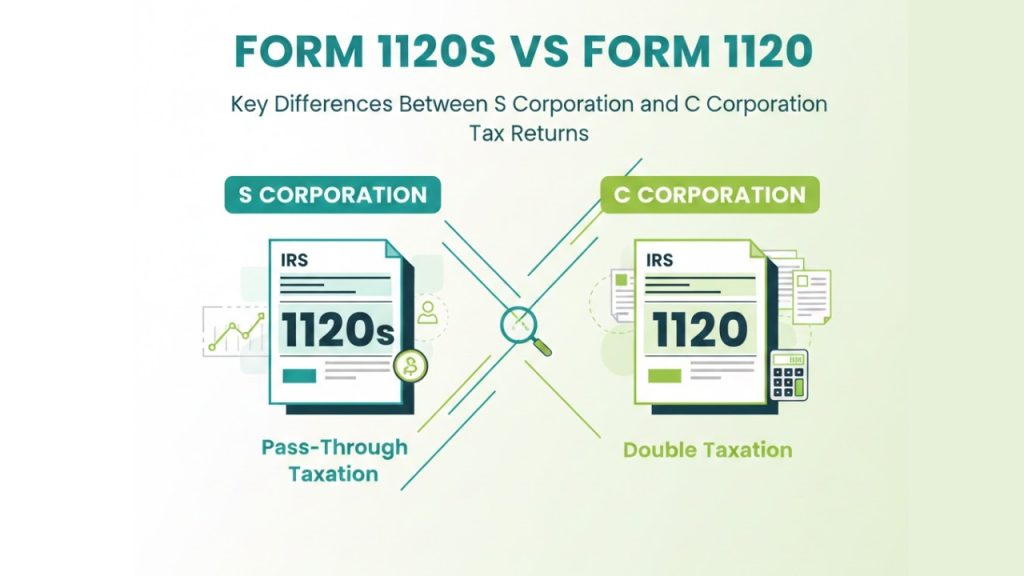
If you are forming or already running a corporation in the United States, one of the most important decisions you will make is whether your company should file Form 1120S or Form 1120.
This choice determines how your profits are taxed, whether you face double taxation, who can own shares in your company, and how easily you can attract investors or expand internationally.
This is not just a compliance decision it is a long-term growth strategy.
What Is the Difference Between Form 1120S and Form 1120?
Both forms are filed with the IRS but apply to two different tax treatments:
• Form 1120S → Filed by S Corporations
• Form 1120 → Filed by C Corporations
Core Difference:
• S Corporation = Pass-through taxation
• C Corporation = Corporate-level taxation (double taxation possible)
What Is Form 1120S? (S Corporation Tax Return)
Form 1120S is used by corporations that elect S Corporation status.
How taxation works:
• The corporation does not pay federal income tax.
• Profits and losses pass directly to shareholders.
• Shareholders report income on personal returns.
• Income is taxed once at the individual level.
Eligibility Requirements:
• 100 or fewer shareholders
• Only U.S. citizens or residents
• One class of stock
• Timely filing of Form 2553
What Is Form 1120? (C Corporation Tax Return)
Form 1120 is filed by C Corporations, treated as separate tax entities.
How taxation works:
• The corporation pays tax at a flat 21% federal rate.
• Dividends distributed to shareholders are taxed again.
• This creates double taxation.
Advantages:
• Unlimited shareholders
• Foreign shareholders allowed
• Multiple stock classes
• Suitable for venture capital and international expansion
Filing Deadlines
• Form 1120S → March 15 (calendar-year corporations)
• Form 1120 → April 15 (calendar-year corporations)
Extensions may be requested using Form 7004, but payment deadlines remain unchanged.
Common Mistakes
• Filing the wrong form
• Missing S Corporation election deadline
• Incorrect Schedule K-1 issuance
• Ignoring quarterly estimated taxes
• Poor planning for double taxation
Expanding Your Horizons? How Comply Globally Can Help
If your business ambitions extend beyond domestic borders, corporate structuring becomes a strategic necessity not just a legal formality. An S Corporation does not permit non-US resident shareholders, which makes it unsuitable for many international founders and foreign investors. In such cases, a C Corporation filing Form 1120S or Form 1120 as applicable becomes the preferred and often the only viable structure for global expansion.
This is where Comply Globally steps in. As a premier Cross-Border Compliance Management and Corporate Service Provider, we specialize in simplifying complex international structures.
Whether you are:
A US company establishing a foreign subsidiary, or
An international entrepreneur setting up a C Corporation in the United States,
We ensure your entity formation, tax filings, and ongoing global compliance obligations are handled with precision and strategic foresight.
Conclusion: Strategic Corporate Tax Filing That Powers Growth
Understanding the distinction between S-Corporation and C-Corporation taxation is critical for protecting your financial interests and maintaining regulatory compliance in the United States.
Form 1120S supports pass-through taxation, ideal for qualifying domestic shareholders.
Form 1120 supports scalability, profit reinvestment, multiple share classes, and international ownership flexibility.
Choosing the right corporate structure is not merely a compliance decision it is a long-term growth strategy. The right framework safeguards assets, optimizes taxation, and builds a sustainable global foundation.
With expert planning and structured documentation, corporate tax compliance transforms from a routine obligation into a strategic growth lever.
At Comply Globally – Your Globalization Partner, we assist Indian founders, multinational groups, and global investors with accurate US corporate tax filings and cross-border structuring designed for long-term scalability.
Need expert assistance with your US corporate tax filings?
Connect with us at: anil.gupta@theconnectventures.com
Can a business switch from Form 1120 to Form 1120S?
Yes, by electing S Corporation status if eligibility requirements are met.
Do S Corporations pay corporate income tax?
Generally, no. Income passes through to shareholders.
Why would someone choose a C Corporation?
For investment flexibility and unlimited shareholders.
Is Form 1120 more complex than Form 1120S?
It can be, due to corporate-level tax calculations.
Are state tax rules the same?
Not always. Some states tax S Corporations differently.
What happens if I miss the filing deadline?
Penalties and interest may apply.