

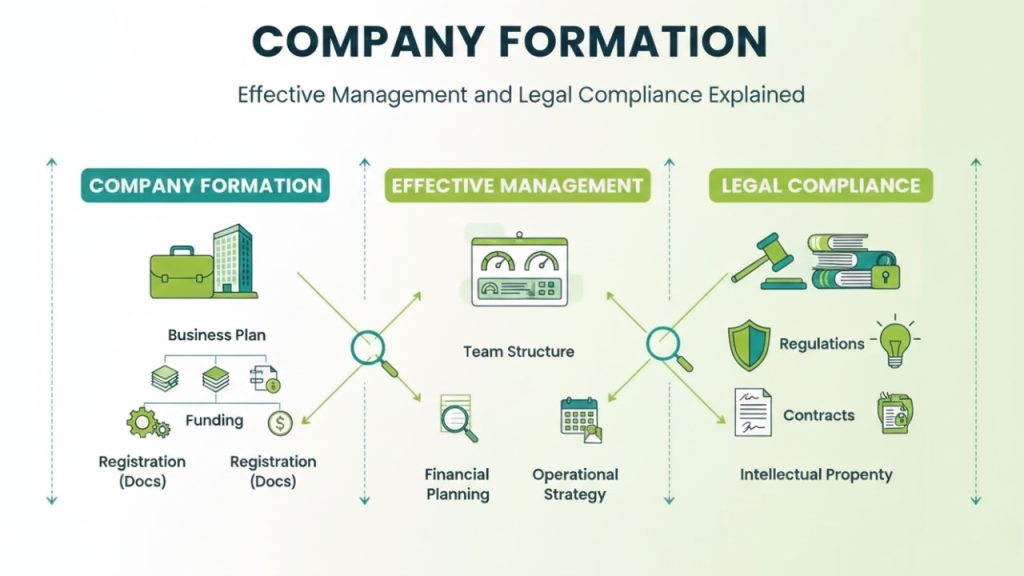
Starting a business is exciting but without the right legal foundation, management systems, and compliance habits, even the best ideas can unravel. Whether you are launching your first venture or restructuring an existing one, understanding how to properly form your company, manage it effectively, and stay legally compliant is essential. This guide breaks down each of these pillars in a clear, practical way so you can build a business that is not just profitable, but durable and protected.
Why Company Formation Sets the Tone for Everything
The way you form your company is the single most consequential decision you will make as a business owner. It determines your tax structure, personal liability exposure, ability to attract investment, and how your business is treated in the eyes of the law. Many entrepreneurs operate informally at first, assuming registration can wait until the business gains traction. This is a costly mistake. Without formal registration, there is no legal wall between you and your business meaning creditors, courts, and tax authorities can pursue your personal assets if things go wrong.
Formal company formation legitimizes your business instantly. It enables you to open business bank accounts, sign enforceable contracts in the company’s name, hire employees legally, and apply for funding. It also builds credibility with clients and partners who expect to work with a properly registered entity. Think of formation not as paperwork, but as the act of giving your business its own identity one that stands independently of you and is protected by the law.
Choosing Your Business Structure Wisely
Your legal structure is the architecture of your company. The four most common options are Sole Proprietorship, General Partnership, Limited Liability Company (LLC), and Corporation. Each carries different implications for taxes, liability, administration, and growth potential.
A Sole Proprietorship is the simplest option no registration required, income taxed personally but it offers zero liability protection. A General Partnership is similar but shared between two or more owners, all of whom carry unlimited personal liability. For most serious business owners, neither structure provides adequate protection.
An LLC is the most popular choice for small and mid-sized businesses because it blends liability protection with tax flexibility. Members are shielded from personal liability for business debts, and the business can choose how it is taxed. A Corporation either C-Corp or S-Corp suits businesses planning to raise significant investment or scale aggressively. C-Corps face double taxation but are preferred by investors. S-Corps pass income directly to shareholders but are restricted to 100 U.S.-based shareholders. The right choice depends on your goals, industry, and growth plans. A business attorney and CPA can help you decide.
Registering Your Company What You Actually Need to Do
Registration is more straightforward than most people expect, but it must be done completely and correctly. Start with your business name search your state’s business registry and the USPTO trademark database to confirm availability. Secure a matching domain name at the same time to protect your online presence.
File your formation documents with the Secretary of State. LLCs file Articles of Organization; corporations file Articles of Incorporation. These documents establish your company’s legal existence and typically include your business name and address, registered agent details, and founding member or director information. Filing fees range from $50 to a few hundred dollars depending on the state.
Next, obtain your Employer Identification Number (EIN) from the IRS free and available online which you will need for tax filings, bank accounts, and payroll. Finally, research and obtain all required licenses and permits for your industry and location. Operating without them, even unknowingly, can result in fines, forced closure, and personal liability. Build a checklist and complete each item before you open for business.
Establishing Effective Management from Day One
Legal formation gets your business registered but management is what makes it run. Many businesses fail not because of a bad product or insufficient funding, but because of poor internal organization, unclear decision-making authority, and unresolved conflicts between founders. Building a professional management structure from the very beginning is not optional; it is the foundation of everything else.
Start with your governance documents. LLCs need a comprehensive Operating Agreement that defines each member’s ownership stake, voting rights, profit distribution, and procedures for adding or removing members. Corporations need Corporate Bylaws that establish board composition, officer responsibilities, shareholder meeting procedures, and how major decisions are made. These documents create the rules of the game before any conflict arises making them invaluable when disagreements occur, which they inevitably do.
Establish a clear organizational structure with defined roles, reporting lines, and decision-making authority. Determine what decisions require full member or board approval versus what can be handled by individual managers or officers. Conduct regular management reviews monthly or quarterly to assess performance, review financials, identify problems early, and adjust strategy as needed. A business that reviews its own performance consistently and honestly will always outperform one that operates on instinct alone.
Financial Management The Engine of Your Business
No management system is complete without disciplined financial management. Poor cash flow is one of the leading causes of business failure not lack of revenue, but failure to track, control, and plan the movement of money in and out of the business. From day one, open a dedicated business bank account and never mix personal and business finances. Commingling funds is not just sloppy it can legally void your liability protection and expose personal assets to business claims.
Implement a reliable bookkeeping system and generate monthly financial reports: an income statement showing profitability, a balance sheet showing assets and liabilities, and a cash flow statement showing money movement. Review these reports monthly, not just at tax time. Tools like QuickBooks, Xero, or Wave make this manageable for small teams. Pair your bookkeeping software with a Certified Public Accountant (CPA) who reviews your books quarterly and helps you plan proactively for taxes, payroll, and growth investments. Good financial management does not just keep you compliant it makes you a smarter, more strategic business owner.
Building and Managing a Strong Team
Your people are your most important business asset and also your most significant legal responsibility. Hiring without proper documentation or misclassifying workers can trigger serious legal and financial consequences. Every employee should have a signed offer letter, a clear job description, and access to an employee handbook that outlines your policies, expectations, and procedures. Independent contractors must be genuinely independent using the wrong classification for workers who function as employees is one of the most common and costly employment law violations.
Beyond documentation, invest in your people. A thoughtful onboarding process, regular feedback, clear performance expectations, and genuine career development opportunities are what turn good hires into long-term contributors. High turnover is expensive recruiting, hiring, and training replacements costs far more than retaining good employees through fair compensation and a respectful workplace culture. Define your company values early and hire people who embody them. Culture is not what you put on your website it is what happens inside your organization every single day.
Legal Compliance An Ongoing Responsibility
Compliance is not a one-time task that you complete at formation. It is an ongoing, evolving responsibility that touches every aspect of your business. At the state level, most businesses must file annual or biennial reports to maintain good standing miss these deadlines and you risk late fees, loss of standing, or even automatic dissolution of your company. At the federal level, income tax, payroll tax, and benefits compliance must be managed continuously and accurately.
Employment law compliance covers minimum wage and overtime requirements under the Fair Labor Standards Act, workplace safety standards under OSHA, anti-discrimination obligations under Title VII and the ADA, and leave entitlements under the Family and Medical Leave Act. Industry-specific regulations add further complexity healthcare businesses must comply with HIPAA, financial services firms with SEC and FINRA rules, food businesses with FDA standards, and technology companies collecting EU user data with GDPR requirements. The best approach is a compliance calendar that tracks every regulatory deadline and assigns clear ownership so nothing slips through the cracks.
Protecting Your Intellectual Property
Your intellectual property your brand, your innovations, your creative work, and your proprietary processes is often the most valuable thing your business owns. Yet many business owners fail to protect it until a competitor copies their brand or a disgruntled former employee walks out with their trade secrets. Register your business name and logo as a trademark with the USPTO as early as possible. Federal trademark registration gives you nationwide protection and legal grounds to stop infringing uses.
Copyright protection applies automatically to original creative works your website content, marketing materials, software code, photographs, and videos but registering with the U.S. Copyright Office strengthens your legal position significantly. Patents protect novel inventions and processes for up to 20 years and can be enormously valuable in technology, manufacturing, and product-based industries. Protect trade secrets proprietary formulas, customer lists, algorithms, and business strategies through Non-Disclosure Agreements with every employee, contractor, and partner who accesses sensitive information. Do not wait until you have been harmed to protect what you have built.
Business Insurance Protection You Cannot Afford to Skip
Insurance is not an optional expense it is a fundamental part of responsible business ownership. General Liability Insurance covers third-party claims for bodily injury, property damage, and advertising injury and is required by most landlords and clients. Professional Liability Insurance protects service-based businesses against claims that their advice or work caused financial harm to a client. Product Liability Insurance is essential for any business that manufactures or sells physical goods.
Workers’ Compensation Insurance is legally required in most states for businesses with employees and covers medical costs and lost wages for on-the-job injuries. Commercial Property Insurance protects your physical assets equipment, inventory, and premises from fire, theft, and damage. Cyber Liability Insurance covers the growing risk of data breaches, regulatory penalties, and legal costs resulting from security failures. Work with a commercial insurance broker to assess your specific risk profile and ensure your coverage is comprehensive, current, and appropriate for your industry.
Record Keeping, Governance, and Exit Planning
Disciplined record keeping is the mark of a well-governed business and it matters far more than most owners realize until they need it. Maintain meeting minutes for all board or member meetings, written records of all major business decisions, a current register of owners and their interests, copies of all signed contracts and agreements, and complete financial records including bank statements, invoices, and tax returns. Federal law requires most tax records to be retained for at least seven years. Implement a digital document management system to keep everything organized, secure, and accessible. Poor record keeping weakens your legal defense in disputes, complicates tax filings, and dramatically reduces your business’s value to potential buyers or investors.
Every business owner should also plan for the eventual transition out of the business whether through a sale, family transfer, management buyout, or closure. Begin this planning long before you intend to act on it. Buyers conduct thorough due diligence, and businesses with clean records, strong management teams, documented processes, and consistent financial performance command premium valuations. Identify and develop internal successors. Document institutional knowledge so the business does not depend entirely on you. The earlier you begin exit planning, the more options you will have and the greater the financial reward when the time comes.
Final Thoughts
Company formation, effective management, and legal compliance are not separate concerns they are deeply interconnected pillars of a successful business. The choices you make about how to structure, register, manage, and protect your company will shape its trajectory, its culture, and its long-term value. Entrepreneurs who invest in getting these fundamentals right from the beginning spend less time fighting preventable problems and more time doing what they set out to do: building something meaningful.
The path is not always simple. Regulations change, teams grow, markets shift, and challenges arise that no one anticipated. But a business built on a solid legal foundation, managed with clarity and discipline, and operated in full compliance with the law is a business that can weather any storm. Get the right advisors around you. Build the right systems. And grow with the confidence that comes from knowing your business is protected, organized, and ready for whatever comes next.