

Ask ten business owners what it takes to build a successful company, and you will get ten different answers. Some will say it is all about the product. Others will point to sales, marketing, culture, or timing. All of these things matter but underneath every thriving business, without exception, is a solid legal foundation, a professional management structure, and a disciplined approach to compliance. These are not the glamorous parts of entrepreneurship. They rarely make headlines. But they are the reason some businesses survive economic downturns, investor scrutiny, and rapid growth while others, often with better products and bigger ambitions, fall apart when the pressure is applied.
This guide explores not just what company formation, management, and compliance each involve in isolation, but how they work together as one unified system to produce business success. When these three pillars are designed, built, and maintained in harmony, they create a business that is legally protected, operationally strong, financially transparent, and positioned to take full advantage of every opportunity that growth brings. When even one pillar is weak, the entire structure is compromised. Understanding this interdependence is the insight that separates business owners who build to last from those who build to struggle.
The Integrated System Why Formation, Management, and Compliance Cannot Be Separated
The most common mistake business owners make is treating company formation, management, and compliance as three unrelated tasks to be completed in sequence form the company, then figure out management, then deal with compliance when it becomes unavoidable. This sequential, siloed approach creates compounding problems. Formation decisions made without thinking about management implications result in governance documents that create conflict rather than clarity. Management systems built without considering compliance obligations leave regulatory deadlines untracked and responsibilities unassigned. Compliance failures gradually erode the legal protections that formation was designed to establish, until the business is exposed in ways its founders never anticipated.
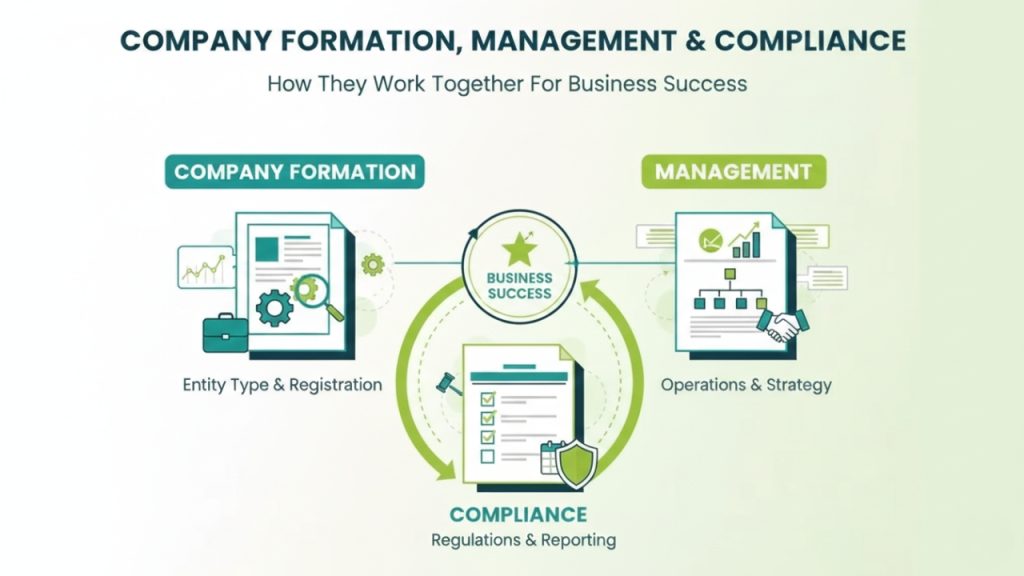
Think of these three elements as the legal, operational, and regulatory dimensions of a single integrated system. Formation establishes the rules of the game the legal structure, ownership framework, and governance architecture within which the business will operate. Management is how those rules are put into daily practice how decisions are made, how resources are deployed, how people are led, and how financial performance is tracked and improved. Compliance is how the business demonstrates to the outside world to regulators, tax authorities, courts, and counterparties that it is operating within the boundaries of the law. Each dimension depends on the strength of the others. And together, they create the conditions in which genuine, sustainable business success becomes not just possible but probable.
Formation The Strategic Decision That Shapes Everything Downstream
Company formation is the act of giving your business a legal identity and the decisions made during that process reverberate through every aspect of how the business will be managed and how it will meet its compliance obligations for as long as it exists. The legal structure you choose determines your tax treatment, your personal liability exposure, your ability to bring in partners and investors, and the governance framework within which your management team will operate. There is no formation decision that is purely administrative every choice has strategic implications that compound over time.
A Sole Proprietorship offers simplicity but no liability protection and no legal separation between owner and business. A General Partnership creates shared ownership but unlimited shared liability among all partners. A Limited Liability Company provides the liability protection most business owners need, combined with the tax flexibility and governance adaptability that makes it the most versatile structure for businesses at virtually every stage of development. A C-Corporation provides the most powerful legal and capital-raising infrastructure, but it demands the most rigorous governance and compliance and it is the structure of choice for businesses that intend to attract institutional investment, issue equity to employees, or eventually go public.
Registration Turning Formation Decisions Into Legal Reality
Once the formation decision is made, registration is the process that makes it legally real. This is where your business acquires its official identity a name on file with the state, a taxpayer identification number on file with the federal government, and the documentation that establishes the governance framework within which it will operate. Registration done correctly and completely creates a clean, defensible legal record from day one. Registration done hastily or incompletely creates gaps that grow into vulnerabilities.
The name selection process deserves more care than most founders give it. A thorough name search covers your state’s business registry, the USPTO Trademark Electronic Search System, and domain name availability simultaneously. A name that clears your state registry may still infringe a federally registered trademark, creating expensive legal exposure the moment your brand gains recognition beyond your immediate market. File your Articles of Organization or Articles of Incorporation with your state’s Secretary of State, obtain your Employer Identification Number from the IRS, and open a dedicated business bank account before any revenue is collected or any expense is paid. Operating for even a brief period without these basics in place creates legal and financial vulnerabilities that can be surprisingly difficult to fully remediate after the fact.
Governance Documents Where Formation and Management Converge
The most direct and powerful connection between company formation and management is the set of governance documents drafted at or shortly after formation. These documents the Operating Agreement for an LLC, the Corporate Bylaws for a corporation are simultaneously legal requirements and management blueprints. They do not just satisfy state filing requirements; they define the management architecture within which every business decision, every dispute, and every ownership transition will be handled for the life of the company.
A comprehensive Operating Agreement answers the questions that destroy businesses when they are left unanswered: Who owns what percentage of the company, and what did each owner contribute to earn that ownership? What vote is required to approve major decisions hiring executives, taking on significant debt, entering new markets, or selling the company versus routine operational matters? How are profits allocated among members, and when are distributions made? What happens if a member wants to sell their interest — does the company or the remaining members have a right of first refusal? What non-compete obligations apply to a departing member? How are disputes between members resolved and is there a mediation or arbitration requirement that keeps conflicts out of expensive public litigation?
Management Systems The Engine That Runs Between Formation and Compliance
If formation establishes the rules and compliance enforces the boundaries, management is what happens in between the daily, monthly, and annual work of running the organization effectively within those rules and boundaries. Strong management systems are what transform governance documents from static legal agreements into dynamic operational practices. They are what ensure that compliance deadlines are tracked, assigned, and met before they become violations. They are what convert financial data from historical records into forward-looking strategic intelligence. And they are what create the organizational clarity, accountability, and discipline that allow a business to grow without losing control.
Organizational management begins with structure. As the business moves beyond the founding team, define every role with clarity what each person is responsible for, what authority they have to make decisions within their area, and how their performance will be measured. Establish a decision-making hierarchy that empowers managers to act efficiently within defined parameters while ensuring major decisions receive appropriate review and authorization. Conduct regular management reviews monthly for financial performance, quarterly for strategic progress, annually for comprehensive organizational assessment. Document the outcomes of these reviews in writing so that the business’s decision-making history is clear, defensible, and accessible.
Building and Leading the People Behind the Business
No formation document, management system, or compliance program runs itself people do. The team you build, the culture you establish, and the employment practices you implement are central to how well your business performs across every dimension. And because employment is one of the most heavily regulated areas of business law, the people dimension is also one of the most significant sources of legal and compliance risk for growing businesses.
Hiring well is the beginning, not the end, of people management. Before the first candidate is interviewed, ensure your hiring process is legally sound standardized job descriptions, structured interviews based on job-related criteria, documented evaluation processes that demonstrate decisions were based on legitimate, non-discriminatory factors, and background check procedures that comply with applicable law. Once hired, employees must be properly documented signed offer letters, clear job descriptions, executed confidentiality and invention assignment agreements, completed I-9 verification, and enrolled in whatever benefits the business provides. Employment law compliance is not optional and it is not forgiving errors in classification, documentation, or process create legal exposure that grows more serious with time and organizational size.
Legal Compliance The Ongoing Discipline That Protects Everything Else
Compliance is the discipline that ensures your business continues to deserve the legal protections and operational freedoms that formation established. A business that was properly formed but is not properly maintained that misses annual report filings, lets licenses lapse, fails to meet tax obligations, or operates without the required permits for its activities gradually forfeits the standing and protection it worked to establish. In the worst cases, chronic non-compliance results in administrative dissolution of the entity, personal liability for owners who believed they were protected, and regulatory enforcement actions that can shut down operations and generate penalties that dwarf the cost of compliance.
Federal compliance obligations cover income tax, payroll tax, and industry-specific requirements that vary by business type and size. Payroll tax compliance deserves particular emphasis the IRS treats failures to deposit withheld payroll taxes with exceptional severity, assessing the Trust Fund Recovery Penalty personally against any officer or employee responsible for the non-remittance. This means that a payroll tax compliance failure can pierce the corporate veil entirely, creating personal liability for the very individuals the LLC or corporate structure was designed to protect. State and local compliance obligations multiply as the business grows annual reports, license renewals, sales tax collection and remittance, unemployment insurance contributions, and compliance with state-specific employment laws that may be more demanding than their federal equivalents.
Intellectual Property The Asset That Formation Protects, Management Builds, and Compliance Preserves
Intellectual property sits at the precise intersection of formation, management, and compliance making it one of the clearest illustrations of why these three pillars must work together. At formation, the legal structure determines how IP is owned and whether it is protected by the company’s liability shield or exposed as a personal asset of the founder. A business whose IP is owned by the company rather than the founder personally benefits from both the liability protection of the legal entity and the clarity of ownership that investors and acquirers require. Formation documents particularly Operating Agreements and employment agreements should include explicit IP assignment provisions ensuring that all work created by members, employees, and contractors in connection with the business is owned by the company.
Management builds the IP portfolio over time through deliberate investment, systematic capture of innovations, and diligent enforcement of IP rights. This means implementing invention disclosure processes that identify patentable innovations as they emerge from product development. It means conducting freedom-to-operate analyses before launching new products to ensure they do not infringe existing patents. It means requiring Non-Disclosure Agreements from every employee, contractor, vendor, and partner who has access to proprietary information. And it means actively monitoring the marketplace for potential trademark infringements and responding promptly when competitors use confusingly similar names, logos, or product designations.
Financial Controls, Insurance, and Risk Management Working in Concert
Risk management is not a single function it is the combined result of formation decisions, management practices, and compliance disciplines working in concert to minimize exposure and ensure the business can absorb and recover from unexpected events. Formation establishes the liability shield. Management maintains it through proper governance and financial discipline. Compliance keeps the business in good legal standing so the shield remains effective. And insurance provides the financial backstop for the risks that the other three elements cannot fully eliminate.
Internal financial controls are a management responsibility with direct compliance implications. Segregate financial duties so that the person who approves purchases is different from the person who processes payments and different still from the person who reconciles accounts. Require dual authorization for transactions above defined thresholds. Conduct monthly bank reconciliations. Generate accurate financial statements on a consistent schedule. These controls prevent fraud, catch errors before they compound, and demonstrate to auditors, investors, and regulators that the business’s financial records can be trusted. A business that cannot produce clean, accurate financial records on demand is a business that is perpetually vulnerable to audit findings, to investor skepticism, and to the internal misappropriation that thrives in the absence of oversight.
Record Keeping and Governance The Evidence That the System Is Working
In the context of an integrated formation, management, and compliance system, record keeping is not simply an administrative function it is the evidence that the entire system is functioning as designed. Complete, accurate, and well-organized records demonstrate to auditors that taxes were filed correctly, to courts that governance was followed properly, to investors that the business is managed with discipline and transparency, and to potential acquirers that the company they are evaluating is exactly what it appears to be. The absence of good records creates uncertainty and uncertainty, in a legal, regulatory, or transactional context, is almost always resolved in the direction that is worst for the business.
A comprehensive business records system encompasses formation documents and all amendments, governance documents including Operating Agreements, Bylaws, and all related amendments, minutes from every board or member meeting held, written resolutions authorizing major business decisions, a current and accurate register of all owners and their ownership interests, executed copies of all material contracts, leases, employment agreements, and IP assignments, complete financial records including bank statements, invoices, receipts, payroll records, and tax returns for a minimum of seven years, personnel files for every current and former employee maintained for the periods required by applicable law, and all IP registrations, maintenance filings, and enforcement correspondence.
Growth, Investment Readiness, and the Exit That Everything Has Been Building Toward
Every element of the formation, management, and compliance system described in this guide contributes to a single ultimate outcome: a business that is valuable, defensible, and transferable. Whether your long-term goal is to build a business that generates income and provides financial freedom indefinitely, to grow it to a scale where it attracts strategic acquirers at a premium valuation, or to transition it to family members or key employees who will carry on what you built, the integrated strength of your legal foundation, management systems, and compliance practices is what determines how well and on what terms that goal is achieved.
Investment readiness the state of being prepared to attract and close capital from outside investors is a direct function of formation, management, and compliance quality. Investors and their counsel conduct due diligence that examines every dimension of the business: the cleanliness and completeness of corporate records, the accuracy and consistency of financial reporting, the clarity and enforceability of governance documents, the status of IP ownership and protection, the compliance history and current regulatory standing, and the depth and independence of the management team. Businesses that have maintained strong systems across all three pillars consistently close investment rounds faster, at higher valuations, and with fewer investor-imposed conditions than businesses that scramble to address gaps discovered in due diligence. The business that is always investment-ready is the business that has been building correctly all along.
Final Thoughts
Company formation, management, and compliance work together for business success because they are, at their core, expressions of the same underlying commitment: the commitment to building something real, something legitimate, something protected, and something worth the investment of time, capital, and effort that entrepreneurship demands. Formation says: this business has a legal identity and a defined ownership structure. Management says: this business is run with discipline, clarity, and accountability. Compliance says: this business respects the rules within which it operates and can demonstrate that respect to anyone who asks.
Together, these three pillars create a business that is more than the sum of its daily transactions. They create an institution an organization with its own legal standing, its own governance, and its own track record of operating responsibly. Institutions attract better talent, better clients, better partners, and better capital than informal ventures. They withstand adversity more effectively, recover from setbacks more completely, and ultimately deliver more value to everyone connected to them owners, employees, customers, and communities alike.
Build your business as an institution from the very first day. Form it with intention. Manage it with discipline. Comply with rigor. And when success comes as it will for those who build this way it will be the kind of success that endures, compounds, and ultimately reflects the quality of the foundation on which everything was built.