

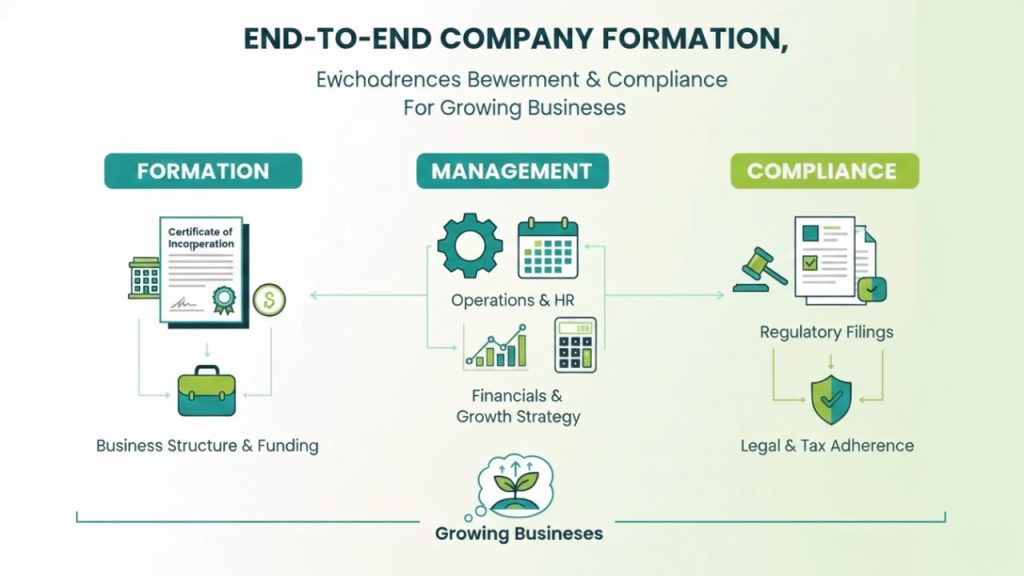
Growth is the goal of every ambitious business owner. But growth without structure is chaos and chaos without compliance is catastrophe. The businesses that scale successfully are not simply the ones with the best products, the largest budgets, or the most aggressive marketing strategies. They are the ones that built the right legal foundation at the start, developed professional management systems as they grew, and maintained rigorous compliance practices throughout every stage of their evolution. This guide provides a complete, end-to-end roadmap covering everything a growing business needs to know about company formation, effective management, and legal compliance not as isolated topics, but as an interconnected system designed to support and sustain growth at every level.
Starting Right Why Formation Is the Growth Decision You Cannot Undo
Every decision you make about company formation echoes through the entire life of your business. The legal structure you choose, the state you register in, the governance documents you draft, and the systems you put in place at inception either support your growth ambitions or constrain them. This is why formation is not just a legal formality it is the most consequential strategic decision a growing business will ever make.
Consider the entrepreneur who forms a sole proprietorship to get started quickly, plans to restructure later, and then lands a major investor two years in. The conversion from sole proprietorship to a corporation capable of issuing equity involves legal fees, tax consequences, and administrative complexity that could have been avoided entirely by forming a C-Corporation at the outset. Or consider the two co-founders who launch an LLC without an Operating Agreement, each assuming the other shares their vision for the business, only to discover irreconcilable differences about profit distribution and decision-making authority when the business starts generating real revenue. These are not hypothetical cautionary tales they are among the most common and costly mistakes made by growing businesses, and they are entirely preventable with thoughtful formation planning.
For a growing business, the right formation decision means choosing a legal structure that accommodates not just where you are today, but where you intend to be in three, five, and ten years. It means registering in a jurisdiction with favorable laws and tax treatment for your industry. It means drafting governance documents that are comprehensive enough to handle complexity and flexible enough to evolve. And it means building the compliance infrastructure that will allow the business to meet its legal obligations efficiently, even as those obligations multiply with growth.
Choosing the Legal Structure That Can Scale With You
The legal structure that serves a solo freelancer is not the same structure that serves a ten-person team, and the structure that works for a ten-person team may be entirely inadequate for a company raising venture capital or preparing for an IPO. Growing businesses must choose their initial legal structure with an eye toward scalability and must be prepared to revisit and potentially restructure as the business evolves.
For businesses in the early stages, the LLC remains the most versatile starting point for most industries. It provides personal liability protection, avoids the administrative complexity of a corporation, and offers significant tax flexibility. An LLC can be taxed as a sole proprietorship, a partnership, an S-Corporation, or a C-Corporation depending on what is most advantageous at each stage of growth. This flexibility makes the LLC an excellent vehicle for businesses that are still finding their footing and want to preserve options without locking into a rigid structure prematurely.
For businesses with serious capital-raising ambitions particularly those in technology, biotech, consumer products, or any sector where venture capital or institutional investment is part of the growth strategy a C-Corporation is almost always the preferred structure. Institutional investors and venture capital funds have a strong structural preference for Delaware C-Corporations, both because of Delaware’s well-established corporate law and because the C-Corp structure allows for multiple classes of stock, stock option plans for employees, and clean equity capitalization tables that investors understand and trust. S-Corporations offer the tax pass-through benefits of an LLC while maintaining corporate governance structure, but the restrictions on shareholder eligibility and stock classes make them less suitable for businesses with aggressive growth plans.
The Registration Process Building Your Legal Identity
Registering your business is the process of transforming your formation decisions into legal reality. It is the moment your company acquires a distinct legal identity a name recognized by the state, a taxpayer identification number recognized by the federal government, and a set of formation documents that define its structure and governance. For a growing business, this process must be executed completely and correctly, because gaps or errors in your registration create vulnerabilities that become more serious as the business grows.
Begin with a comprehensive name search checking your state’s Secretary of State database, the USPTO Trademark Electronic Search System, and the major domain name registrars simultaneously. A name that is legally available in your state may still infringe on a federally registered trademark, creating costly legal exposure as your brand gains recognition. File your Articles of Organization or Articles of Incorporation with your state’s Secretary of State and obtain your Employer Identification Number from the IRS immediately thereafter. The EIN is required to open business bank accounts, process payroll, file federal tax returns, and apply for most forms of business credit and funding.
Governance Documents The Constitution of Your Growing Business
If your certificate of formation or articles of incorporation is the birth certificate of your business, your Operating Agreement or Corporate Bylaws is its constitution the foundational document that defines how power is held and exercised, how decisions are made, how disputes are resolved, and how the organization evolves over time. For a growing business, governance documents are not a one-time drafting exercise. They are living documents that must be reviewed and updated as the business adds owners, raises capital, brings on professional management, and navigates major strategic transitions.
A well-drafted Operating Agreement for a growing LLC should address the initial capital contributions and ownership percentages of each member, the conditions under which additional capital contributions can be required, voting rights and the threshold required for different categories of decisions (routine operational decisions versus major strategic decisions versus constitutional amendments), how profits are allocated and when distributions are made, restrictions on the transfer of membership interests and rights of first refusal, procedures for admitting new members or for the departure, disability, or death of existing members, non-compete and non-solicitation provisions protecting the business if a member departs, and dispute resolution procedures including mediation and arbitration clauses that can resolve conflicts without expensive and disruptive litigation.
Building the Management Infrastructure for Scale
The management practices that work for a two-person startup become inadequate and sometimes actively harmful as a business grows to ten, twenty, fifty, or one hundred employees. Growing businesses must continuously invest in upgrading their management infrastructure to match their operational complexity, their team size, and the expectations of the clients, partners, and investors who are watching how the organization functions from the inside.
Organizational clarity is the foundation of scalable management. As headcount grows, define reporting relationships explicitly, create clear job descriptions for every role, and establish decision-making frameworks that empower managers to act within defined boundaries without requiring founder involvement in every decision. Implement a performance management system that sets clear goals for every employee, provides regular feedback, conducts formal quarterly or annual reviews, and links compensation and advancement to measurable performance outcomes. Document your key operational processes sales, fulfillment, customer service, finance, HR, and compliance so that the business does not depend on institutional memory held in any individual’s head.
People Operations Hiring, Developing, and Retaining a Growing Team
For a growing business, talent is simultaneously the greatest growth driver and the greatest source of legal and operational risk. Every hire you make is an investment in productivity, in culture, and in capability. Every hire is also a legal relationship governed by employment law, and managing that relationship incorrectly can expose your business to employment claims, regulatory penalties, and reputational damage that undermines everything else you are building.
Build a talent acquisition process that is both systematic and legally sound. Use standardized job descriptions and interview processes that evaluate candidates against defined, job-related criteria. Train all hiring managers on lawful interviewing practices what questions can and cannot be asked, how to evaluate candidates consistently and without bias, and how to document hiring decisions in a way that demonstrates they were based on legitimate, non-discriminatory factors. Implement a comprehensive onboarding process that introduces new employees to the company’s culture, values, systems, and expectations and that ensures every required legal document is executed before the employee’s first day of work, including offer letters, employment agreements, confidentiality and invention assignment agreements, and I-9 employment eligibility verification forms.
Compliance at Scale Managing a More Complex Regulatory Landscape
The compliance obligations of a growing business multiply rapidly with scale. A company with five employees in one state has a fundamentally different compliance profile than a company with fifty employees in five states. Growth brings new federal obligations benefits compliance under ERISA, affirmative action requirements for federal contractors, expanded OSHA record-keeping and reporting requirements, securities law implications if the company is raising capital from investors. It brings new state obligations foreign qualification, state income tax nexus in every state where significant business activity occurs, sales tax collection and remittance obligations that multiply with geographic expansion. And it brings industry-specific obligations that grow more complex and more scrutinized as the business becomes larger and more visible.
The only reliable way to manage compliance at scale is through systems not heroic individual effort. Build a compliance management system that maintains a comprehensive inventory of all applicable obligations, assigns clear ownership for each, tracks deadlines with automated reminders, and generates regular reports confirming that obligations have been met. For businesses operating in highly regulated industries, engage a compliance officer or compliance consulting firm to conduct annual audits that evaluate the completeness and accuracy of your compliance program against current regulatory requirements. Regulatory environments change new laws are enacted, existing rules are amended, enforcement priorities shift and staying current requires deliberate, systematic effort rather than passive assumption that nothing has changed.
Protecting Your Intellectual Property as Your Business Grows
Intellectual property that seemed modest at the founding of your business becomes increasingly valuable and increasingly exposed as the business grows. Your brand gains recognition and attracts imitators. Your technology becomes more sophisticated and more commercially valuable. Your customer relationships and business processes represent competitive advantages that competitors would love to replicate. The IP protection strategy appropriate for a startup must grow and evolve alongside the business it protects.
Trademark protection should be established early and expanded deliberately. Register your core marks business name, logo, and primary product or service names with the USPTO as a foundational priority. As the business grows into new product categories, new geographic markets, or new distribution channels, evaluate whether additional trademark registrations are needed to protect the brand’s expansion. For businesses with international ambitions, consider international trademark protection through the Madrid Protocol, which allows a single application to extend trademark protection to over 120 countries. Monitor the marketplace actively for potential infringements unauthorized uses of confusingly similar marks, counterfeit products, and cybersquatting on domain names similar to your registered trademarks and act promptly when infringement is identified. Delay in enforcing trademark rights can result in legal challenges to the validity and enforceability of your marks.
Business Insurance Scaling Your Protection With Your Risk
The insurance program appropriate for a startup is rarely adequate for a growing business. As revenue increases, as the team grows, as physical assets accumulate, as the customer base expands, and as the business’s profile rises, the nature and magnitude of its risk exposure changes and its insurance program must evolve to match. Growing businesses that fail to regularly review and update their coverage find themselves dangerously underinsured precisely when they have the most to lose.
General Liability Insurance coverage limits that were appropriate at launch may be insufficient as the business takes on larger contracts, serves more customers, or operates in more locations. Many commercial contracts require minimum coverage limits of one million dollars per occurrence and two million dollars in aggregate limits that growing businesses should maintain as a baseline and increase as their risk profile warrants. Professional Liability coverage must be reviewed as the scope of services expands and as the business enters new markets where the consequences of professional errors are more severe. Directors and Officers (D&O) Insurance becomes increasingly important as the business brings on a board of directors, raises outside capital, or hires senior executives who could face personal liability for management decisions.
Employment Practices Liability Insurance (EPLI) is a category that growing businesses frequently overlook until they face their first employment claim. EPLI covers legal defense costs and damages arising from claims of wrongful termination, discrimination, harassment, retaliation, and other employment-related violations. As a business grows its headcount and the complexity of its HR practices increases, the statistical likelihood of an employment claim grows with it. The average cost of defending a single employment lawsuit even one that is ultimately resolved in the employer’s favor runs into the tens of thousands of dollars. Cyber Liability Insurance must grow with your data footprint as you collect more customer data, process more transactions, and rely more heavily on digital systems, the potential financial impact of a data breach escalates dramatically.
Record Keeping and Corporate Governance at Scale
The record keeping practices adequate for a small business become genuinely inadequate and potentially legally dangerous as the business scales. Growing businesses accumulate contracts, employment agreements, IP assignments, investment documents, board resolutions, and regulatory filings at a rate that quickly overwhelms informal filing systems. At the same time, the stakes associated with those records increase: investors examine them during due diligence, regulators review them during audits, opposing counsel analyzes them during litigation, and potential acquirers scrutinize them when evaluating the business for purchase.
Implement a document management system that is scalable, secure, and systematically organized. Cloud-based platforms such as Google Workspace, Microsoft SharePoint, or dedicated legal document management solutions provide version control, access permissions, audit trails, and search functionality that paper files and informal digital storage cannot match. Establish a document retention policy that complies with applicable legal requirements federal tax law requires retention of most tax records for seven years, employment records for specific periods defined by statute, and certain contracts for the duration of the agreement plus applicable statute of limitations. Apply consistent naming conventions, folder structures, and metadata standards across all document categories so that any authorized user can find what they need quickly and reliably.
Strategic Growth, Capital Raising, and Exit Planning
For a growing business, the end-to-end approach to formation, management, and compliance pays its most significant dividends at the moments of greatest strategic importance when you are raising capital, entering a major partnership, acquiring another company, or preparing for an eventual exit. At each of these inflection points, the quality of your legal foundation, the strength of your management systems, and the rigor of your compliance practices are examined with extraordinary care by people whose job is to find the flaws, gaps, and vulnerabilities that could undermine the value of their investment or acquisition.
Capital raising whether from angel investors, venture capital firms, strategic partners, or institutional lenders invariably involves due diligence. Investors examine your corporate records, capitalization table, governance documents, material contracts, IP ownership, employment agreements, compliance history, financial statements, and the quality of your management team. Businesses that have maintained clean records, operated with sound governance, and met their compliance obligations consistently complete due diligence faster, encounter fewer deal-threatening discoveries, and negotiate from a position of strength. Businesses that have been run informally with missing records, governance gaps, compliance failures, and undocumented decision-making face deal delays, price reductions, and sometimes the loss of the transaction entirely.
Exit planning for growing businesses is not a conversation for the year you intend to sell it is a continuous strategic discipline that begins the moment you start building. Every decision you make about legal structure, equity ownership, governance, financial reporting, and compliance either increases or decreases the value and salability of your business. Build your business as if you will own it forever and sell it tomorrow.
Final Thoughts
End-to-end company formation, management, and compliance is not a program you implement once and then move on from. It is the ongoing practice of building and maintaining the legal, operational, and regulatory infrastructure that allows your business to grow safely, efficiently, and sustainably. Every stage of growth brings new formation considerations, new management challenges, and new compliance obligations. The businesses that navigate this evolution most successfully are those that approach it proactively that anticipate what the next stage of growth will require, invest in the systems and expertise needed to meet those requirements, and treat every aspect of their legal and operational foundation as a strategic asset rather than an administrative burden.
The businesses that achieve enduring success that grow from startup to market leader, that attract exceptional talent and capital, that serve customers with consistency and excellence, and that ultimately deliver meaningful financial returns to their founders and stakeholders are built on exactly this kind of end-to-end discipline. They are formed correctly. They are managed professionally. They are operated in full compliance with the law. And they are built with the long view with an understanding that every decision made today either strengthens or weakens the foundation that will support everything that comes next.