

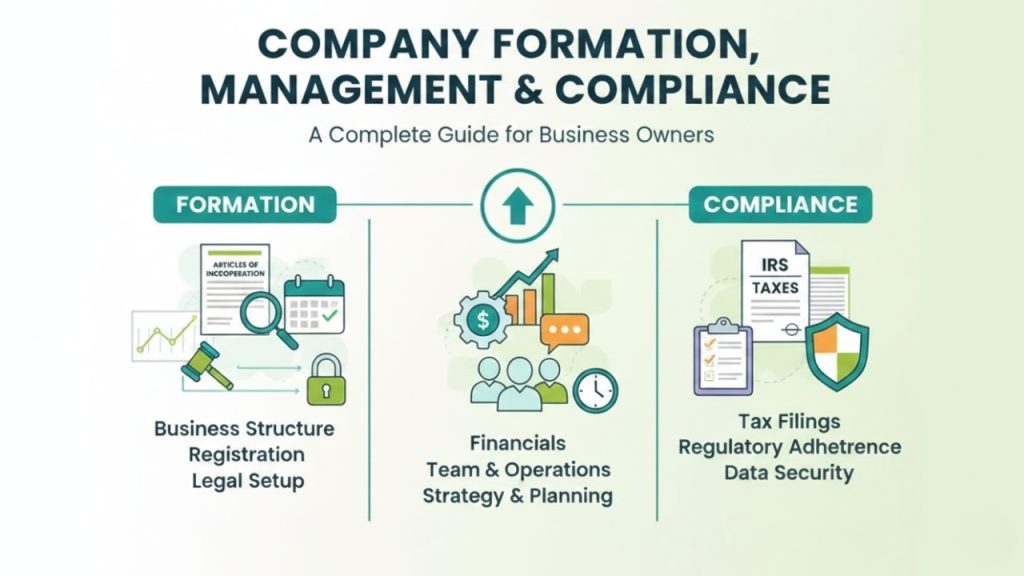
Starting and running a business is one of the most rewarding endeavors you can pursue but it also comes with a complex web of legal, operational, and regulatory responsibilities. Whether you are launching a brand-new startup or scaling an established company, understanding the fundamentals of company formation, management, and compliance is not optional it is the bedrock of every successful enterprise. Entrepreneurs who skip these foundational steps often find themselves facing personal liability, legal disputes, tax penalties, or even forced closure of their business. This comprehensive guide walks you through every critical stage, from your very first decision about business structure all the way to ongoing governance, risk management, and strategic scaling. By the end, you will have a clear roadmap to build a business that is legally sound, financially strong, professionally managed, and positioned for long-term success.
Why Proper Company Formation Matters
Many entrepreneurs underestimate the importance of a solid legal foundation and treat company formation as a mere formality. In reality, it is one of the most consequential decisions you will ever make as a business owner. Skipping or rushing through proper formation steps may seem like a time-saving shortcut in the beginning, but it exposes you to serious risks including personal liability for business debts, inability to enforce contracts, loss of investor confidence, and significant tax penalties.
A formally registered company creates a legal separation between you and your business. This means that if your company faces a lawsuit or goes into debt, your personal savings, home, and assets are generally protected. Beyond liabili ty protection, formal registration establishes your business as a credible, professional entity in the eyes of banks, clients, partners, and government agencies. It also makes you eligible for business loans, government grants, and investment funding that are simply not available to unregistered ventures. The way you form your company sets the tone for how it will operate, grow, and be perceived for years to come.
Choosing the Right Business Structure
The very first and most fundamental decision in company formation is selecting the appropriate legal structure. This choice affects everything from how much tax you pay and how profits are distributed, to how much personal liability you carry and how easy it is to raise capital. The most common business structures include Sole Proprietorship, General Partnership, Limited Liability Company (LLC), S-Corporation, and C-Corporation.
A Sole Proprietorship is the simplest form there is no legal distinction between the owner and the business. It is easy to set up but offers no liability protection, meaning your personal assets are at risk if the business is sued. A General Partnership works similarly but involves two or more owners sharing profits, losses, and liability. For most modern entrepreneurs, these two structures carry too much personal risk.
A Limited Liability Company (LLC) is by far the most popular choice for small to mid-sized businesses. It combines the liability protection of a corporation with the tax flexibility and simplicity of a partnership. Members of an LLC are not personally liable for the company’s debts, and the business can choose how it wants to be taxed as a sole proprietor, partnership, S-Corp, or C-Corp. This adaptability makes the LLC structure ideal for a wide range of businesses.
A C-Corporation is a fully independent legal entity, separate from its owners. It offers the strongest liability protection and is the preferred structure for businesses planning to raise venture capital, go public, or issue stock options to employees. However, C-Corps face double taxation the company pays corporate income tax, and shareholders pay personal income tax on dividends. An S-Corporation avoids double taxation by passing income directly to shareholders, but it comes with restrictions on the number and type of shareholders. Choosing the wrong structure can lead to costly restructuring later, so this decision deserves careful thought and, ideally, guidance from a business attorney or CPA.
Registering Your Company Step by Step
Once you have selected your business structure, the next step is formal registration. This process varies by state and country, but typically involves several key actions that must be completed in the right order to ensure your business is fully legitimate and operational.
The first step is choosing a unique business name. Conduct a thorough name availability search through your state’s business registry and the United States Patent and Trademark Office (USPTO) database to ensure no other business is already using the name or a confusingly similar one. Securing a matching domain name for your website at the same time is also a smart move.
Next, file your formation documents. For LLCs, this is the Articles of Organization. For corporations, it is the Articles of Incorporation. These documents are filed with your state’s Secretary of State office and typically include your business name, address, registered agent information, and the names of founders or organizers. After filing, obtain your Employer Identification Number (EIN) from the IRS this is essentially your business’s Social Security number and is required for opening bank accounts, hiring employees, and filing taxes.
The Critical Need for Professional Management
One of the most frequently overlooked aspects of building a successful business is the need for structured, professional management right from the start. Statistics consistently show that poor management not bad products or insufficient funding is the primary reason most businesses fail within their first five years. Professional management creates internal accountability, sets clear expectations across the organization, ensures efficient use of resources, and positions the business to handle growth without chaos.
Effective management begins with foundational governance documents. For LLCs, this means drafting a comprehensive Operating Agreement. For corporations, it means creating detailed Corporate Bylaws. These documents do far more than satisfy legal requirements they serve as the rulebook for how your company operates. They outline ownership percentages and capital contributions, define voting rights and decision-making processes, establish procedures for profit and loss distribution, and set clear protocols for resolving disputes, adding new members, or buying out departing ones. Without these documents in place, a disagreement between co-founders can escalate quickly into litigation that destroys the business entirely.
Beyond governance, effective management requires clear organizational structure. Define who is responsible for what. Establish a hierarchy of decision-making authority so that everyday decisions do not require consensus from all stakeholders, while major decisions such as taking on debt, entering new markets, or acquiring other businesses receive proper review and approval. As the business grows, invest in management training for team leaders and department heads. Strong managers at every level are what allow a founder to step back from day-to-day operations and focus on strategic growth.
Building a Strong Team and Company Culture
No business grows to its full potential without the right people. Building a strong, motivated team is one of the most important investments you will make. Start by defining the roles and skills your business needs, then recruit strategically prioritizing candidates whose values align with your company culture, not just their technical qualifications. A technically brilliant employee who does not share your commitment to quality, integrity, or customer service can do more harm than good.
Establish clear onboarding processes so new hires understand their roles, responsibilities, and expectations from day one. Invest in ongoing training and professional development employees who feel invested in are more productive, more loyal, and less likely to leave. Create a culture of open communication where team members feel safe raising concerns, suggesting improvements, and holding each other accountable. Document all employment relationships with proper contracts, offer letters, and job descriptions. Clearly distinguish between employees and independent contractors to avoid misclassification penalties from the IRS and Department of Labor.
Company culture is not a luxury it is a strategic asset. A positive, values-driven culture attracts top talent, reduces turnover, improves customer experience, and makes your business more resilient during difficult periods. Define your core values early and embed them into every aspect of the business hiring decisions, performance reviews, customer interactions, and leadership behavior. Culture flows from the top down, so as the business owner, your conduct sets the standard for everyone else.
Staying Compliant Year-Round
At the state level, most businesses are required to file annual or biennial reports with their Secretary of State to maintain good standing. These reports confirm your business address, registered agent, and ownership information. Failure to file on time can result in late fees, loss of good standing, and in some states, automatic administrative dissolution meaning your LLC or corporation is legally terminated without your knowledge. Maintain a compliance calendar with all state and federal filing deadlines clearly marked.
Tax compliance is equally non-negotiable. Federal obligations include income tax, payroll tax (Social Security, Medicare, and federal unemployment tax), and excise taxes for certain industries. State obligations vary but typically include state income tax, sales tax for product-based businesses, and state unemployment insurance. If you have employees, you must also comply with the Fair Labor Standards Act (FLSA) regarding minimum wage and overtime, the Family and Medical Leave Act (FMLA), and all applicable anti-discrimination laws including Title VII of the Civil Rights Act and the Americans with Disabilities Act (ADA).
Industry-specific compliance adds another layer of complexity. Healthcare businesses must comply with HIPAA privacy regulations. Financial services firms face oversight from the SEC, FINRA, and CFPB. Food and beverage companies must follow FDA guidelines. Construction companies must comply with OSHA safety standards. If your business operates internationally or collects data from European users, you must also navigate GDPR requirements. The consequences of non-compliance fines, license revocations, lawsuits, and reputational damage far outweigh the cost of staying current. Working with a compliance consultant or business attorney to conduct annual compliance audits is a worthwhile investment.
Protecting Your Intellectual Property
Your intellectual property (IP) is often your most valuable business asset, yet many entrepreneurs fail to protect it until it is too late. Intellectual property includes your brand name, logo, product designs, software, trade secrets, creative content, and proprietary processes. Without proper legal protection, competitors can legally copy your brand, replicate your products, or use your creative work without compensation.
Trademarks protect your brand identity your business name, logo, slogans, and other identifiers that distinguish your products or services in the marketplace. Register your trademark with the USPTO as early as possible. A registered trademark gives you exclusive rights to use your mark nationwide and provides legal grounds to stop others from using confusingly similar names or logos. Copyrights protect original creative works articles, designs, software code, photographs, music, and videos and are automatically created when the work is produced, though registration with the U.S. Copyright Office strengthens your legal position in infringement cases.
Patents protect inventions and innovations, giving you exclusive rights to manufacture, use, and sell your invention for a set period typically 20 years for utility patents. If your business has developed a novel product, process, or technology, consult a patent attorney to evaluate whether patent protection is appropriate. Trade secrets such as formulas, customer lists, or proprietary processes are protected through confidentiality agreements and strong internal security policies rather than government registration. Require all employees, contractors, and business partners who have access to sensitive information to sign Non-Disclosure Agreements (NDAs) before they begin work.
Business Insurance Your Financial Safety Net
No matter how well-managed and compliant your business is, unexpected events can and do happen. A customer slips and falls on your premises. A product you sell injures a consumer. A disgruntled former employee files a discrimination lawsuit. A data breach exposes your customers’ personal information. A fire destroys your inventory. Without the right insurance coverage, any of these events could be financially devastating or even fatal to your business.
General Liability Insurance is the foundation of business insurance and covers third-party claims for bodily injury, property damage, and advertising injury. It is often required by landlords, clients, and licensing boards. Professional Liability Insurance (also called Errors and Omissions or E&O insurance) covers claims that your professional services caused financial harm to a client essential for consultants, accountants, attorneys, architects, and other service professionals. Product Liability Insurance protects businesses that manufacture or sell physical products against claims that those products caused injury or damage.
If you have employees, Workers’ Compensation Insurance is required in most states and covers medical expenses and lost wages for employees injured on the job. Commercial Property Insurance protects your physical assets equipment, inventory, furniture, and the building itself against damage from fire, theft, vandalism, and certain natural disasters. Cyber Liability Insurance is increasingly essential as data breaches become more common and regulatory penalties for data security failures escalate. Work with a licensed commercial insurance broker to assess your specific risks and build a coverage package that protects your business comprehensively.
Record Keeping and Corporate Governance
Maintaining accurate, organized, and complete records is not only a legal requirement for most business entities it is a hallmark of professional management and a critical factor in your business’s long-term success. Poor record-keeping creates vulnerabilities: it weakens your legal defense in disputes, complicates tax filings, delays fundraising processes, and undermines investor confidence.
At a minimum, every business should maintain meeting minutes from all board of directors or member meetings, written records of all major business decisions, a current register of shareholders or LLC members, copies of all signed contracts and agreements, complete financial records including bank statements, invoices, receipts, and tax returns, and personnel files for all employees. Many states legally require corporations and LLCs to maintain these records and make them available for inspection by members or shareholders upon request. Failure to keep proper records can result in penalties and critically can pierce the corporate veil, exposing owners to personal liability.
Implement a digital document management system to store and organize records securely. Cloud-based solutions like Google Workspace, Microsoft SharePoint, or dedicated legal document platforms provide secure storage, easy access, version control, and audit trails. Establish a document retention policy that defines how long different types of records are kept federal law requires businesses to retain certain tax records for at least seven years. Regularly review and update your governance documents, ownership records, and compliance filings to reflect any changes in your business structure, ownership, or operations.
Planning for Growth, Exit, and Succession
Every business owner should have a clear vision not just for how their business will grow, but also for how they will eventually transition out of it. Whether your long-term goal is to sell the business, pass it to a family member, take it public, or simply wind it down responsibly, planning for these scenarios from the early stages makes the transition far smoother and more financially rewarding.
Growth planning involves regularly revisiting your business structure to ensure it still serves your needs. A sole proprietorship or simple LLC may work well in the early years but become inadequate as you scale, hire more employees, take on investors, or expand into new markets or jurisdictions. Conduct an annual strategic review with your attorney and accountant to assess whether your current structure, governance framework, and compliance posture align with where your business is headed. Develop written strategic plans with clear financial targets, market expansion goals, and operational milestones.
Succession planning ensures your business can survive the departure of any key individual including yourself. Document all critical processes, systems, and institutional knowledge so that the business does not depend entirely on any one person. Identify and develop internal leaders who can step into greater responsibilities. If you plan to sell the business, work with a business broker or M&A advisor to understand your valuation, clean up your financial records, and prepare for due diligence. A well-documented, well-managed, compliant business commands a significantly higher sale price than one that has been run informally.
Final Thoughts
Company formation, management, and compliance are not just legal obligations they are the strategic pillars upon which every successful, sustainable business is built. The decisions you make in the earliest stages of your business will shape its culture, legal standing, financial health, and growth trajectory for years, even decades, to come. From selecting the right legal structure and registering properly, to building strong management systems, protecting your intellectual property, staying compliant, and planning for the future each of these steps represents an investment in the longevity and credibility of everything you are working to build.
Do not treat these responsibilities as burdens or bureaucratic formalities. Treat them as the foundation of your competitive advantage. Businesses that are properly formed, professionally managed, and rigorously compliant are more attractive to investors, more trusted by customers, more resilient during economic downturns, and more valuable when it comes time to sell or transition. Surround yourself with the right advisors a skilled business attorney, a knowledgeable CPA, an experienced insurance broker, and trusted mentors who have built businesses before. Their guidance will save you from costly mistakes and accelerate your path to sustainable success.
The entrepreneurial journey is demanding, but it is also profoundly fulfilling. By laying the right foundation and managing your business with discipline and integrity, you give yourself the freedom to do what you do best: innovate, serve your customers, lead your team, and build something truly lasting. Start right. Manage well. Stay compliant. And grow with confidence.